

The search for novel magnetic materials receives a boost from new research into the behaviour of pure carbon fullerene molecules, which exhibit surprisingly complex magnetic properties when arranged in specific two-dimensional networks. Jiaqi Wu, alongside Alaric Sanders and Rundong Yuan from the University of Cambridge, and Bo Peng, demonstrate how these molecules self-assemble into a unique structure resembling a Shastry-Sutherland lattice, giving rise to an ‘altermagnetic’ state where magnetism arises from an unusual arrangement of electron spins. This arrangement creates effective spin clusters, and the research reveals a splitting of electronic and magnon bands, indicating a rich magnetic phase diagram with potential for phases including altermagnetism, spin liquids, and dimerisation. The findings establish magnetic fullerene monolayers as a promising, tunable platform for exploring exotic magnetism and developing future spintronic devices.
The unique structure creates effective spin-1/2 clusters from unpaired electrons, and arranging these building blocks into a two-dimensional, rutile-like lattice establishes an altermagnetic ground state. Investigations into the electronic band structure reveal a splitting of spin-polarised states and strong chiral-split magnon bands, confirming the altermagnetic order.
Fullerene Lattices for Altermagnetic Spin Splitting
Fullerene monolayers provide a tunable platform for exploring exotic quantum magnetism and spintronic applications. Altermagnetic systems, characterised by zero net magnetisation, exhibit spin-splitting in their band structure due to a lack of inversion symmetry. Researchers have demonstrated the potential of magnetic fullerene monolayers as topological materials and now propose a design based on polymeric C40 to create an altermagnetic Shastry-Sutherland lattice. The method involves density functional theory calculations to model the electronic structure and magnetic interactions within the material.
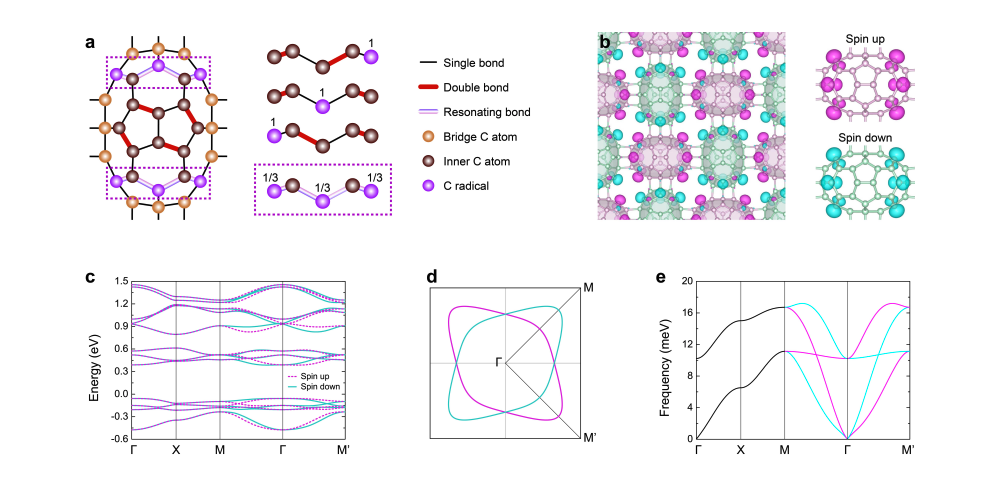
Calculations utilise specific parameters to accurately represent the material’s properties and ensure reliable results. Crystal structures are fully relaxed to their lowest energy configuration, and the resulting magnetic interactions are analysed. A Wannier function tight-binding model is constructed to simplify calculations and focus on the essential carbon bonds, and exchange interactions are computed to determine the strength and nature of magnetic coupling between atoms. Strain is applied by modifying the lattice parameters while allowing the atomic coordinates to relax. The C40 building blocks consist of carbon atoms with different bonding configurations, leading to a resonance structure and an averaged magnetic moment of 1/3 μB per carbon atom in specific locations, resulting in a total magnetic moment of 1 μB for a group of five atoms.
Rotating neighbouring C40 building blocks creates a two-dimensional, rutile-like lattice, establishing an altermagnetic ground state. Spin density distributions confirm the resonance structure and the 1/3 μB magnetic moment per carbon atom. Band structure analysis reveals spin-up and spin-down states that become split along certain directions. Iso-energy surface calculations exhibit features characteristic of d-wave order, similar to RuO2. Magnon dispersion calculations confirm the altermagnetic order and demonstrate giant chiral splitting.
Examination of exchange interactions reveals dominant ferromagnetic interactions within effective spin-1/2 groups, weaker intramolecular couplings, and antiferromagnetic intermolecular interactions. A lattice spin model based on the Shastry-Sutherland lattice is constructed, with exchange interactions divided into intramolecular and intermolecular components. The phase diagram is tuned by the ratio between these couplings. When intramolecular coupling dominates, a dimer valence bond solid phase forms. Increasing the intermolecular coupling leads to a quantum spin liquid phase due to frustration.
Further calculations suggest the dimer phase is stable at all strains, demonstrating tunability through screening effects. The realisation of the Shastry-Sutherland lattice in C40 fullerene networks offers opportunities to observe exotic physics in molecular materials. This work demonstrates the feasibility of realising exotic spin phases using molecular building blocks and establishes a foundation for exploring novel quantum phenomena in pure carbon-based systems.
Altermagnetic Monolayers Exhibit Tunable Magnetic Behaviour
Researchers have demonstrated a novel platform for exotic magnetism using carbon fullerene molecules arranged in a unique monolayer structure. The team designed altermagnetic carbon networks based on a Shastry-Sutherland lattice, leveraging the inherent properties of these molecules to create a system with potentially tunable magnetic behaviour. Each fullerene molecule exhibits effective spin-1/2 clusters, arising from unpaired electrons and resulting in a resonant distribution of magnetic moments. Rotating these building blocks creates a two-dimensional, rutile-like lattice that establishes an altermagnetic ground state.
Detailed analysis of magnon dispersion demonstrates linear behaviour near the centre of the Brillouin zone, characteristic of antiferromagnetic and altermagnetic materials, and reveals giant chiral splitting along specific high-symmetry paths. Calculations of exchange interactions show dominant ferromagnetic coupling within each spin-1/2 group, exceeding 7 meV, while intermolecular interactions are weaker but still significant, reaching up to −0. 42 meV. This arrangement gives rise to a Shastry-Sutherland model, allowing for a rich phase diagram accessible through moderate bi-axial strain. The researchers identified several distinct phases, including altermagnetic, spin liquid, plaquette, and dimer phases.
Specifically, they found that increasing the ratio of intermolecular to intramolecular exchange coupling (J1/J0) above 0. 675 leads to the formation of independent “plaquette” units. A quantum spin liquid phase emerges when J1/J0 lies between 0. 77 and 0. 82, offering potential for error-resistant qubits due to long-range correlations, while a dominant intermolecular interaction results in a Ńeel ground state altermagnetic phase. This tunability positions fullerene monolayers as a promising platform for both fundamental research into exotic magnetism and the development of advanced spintronic applications.
Carbon Fullerene Monolayers Exhibit Exotic Magnetism
This research demonstrates the potential of using molecular building blocks, specifically carbon fullerene monolayers, to create materials exhibiting exotic magnetic phases. By arranging these molecules into a specific crystal structure, researchers have shown the emergence of an altermagnetic phase, characterised by unusual chiral splitting in magnon behaviour. Importantly, the system exhibits a rich phase diagram, extending beyond simple altermagnetism to include potential quantum spin liquid and dimer phases, all accessible through moderate strain. These findings open new possibilities for designing materials with tailored magnetic properties using purely carbon-based systems. While the study focuses on demonstrating the altermagnetic phase as a proof of principle, the broader implications suggest a pathway towards creating tunable platforms for both fundamental studies of exotic magnetism and potential spintronic applications. The authors acknowledge that further investigation is needed to fully explore the range of accessible phases and optimise the material’s properties, but this work establishes a promising new direction in molecular magnetism.
🗞 Altermagnetic Shastry-Sutherland fullerene networks
🧠 ArXiv: https://arxiv.org/abs/2508.21056


