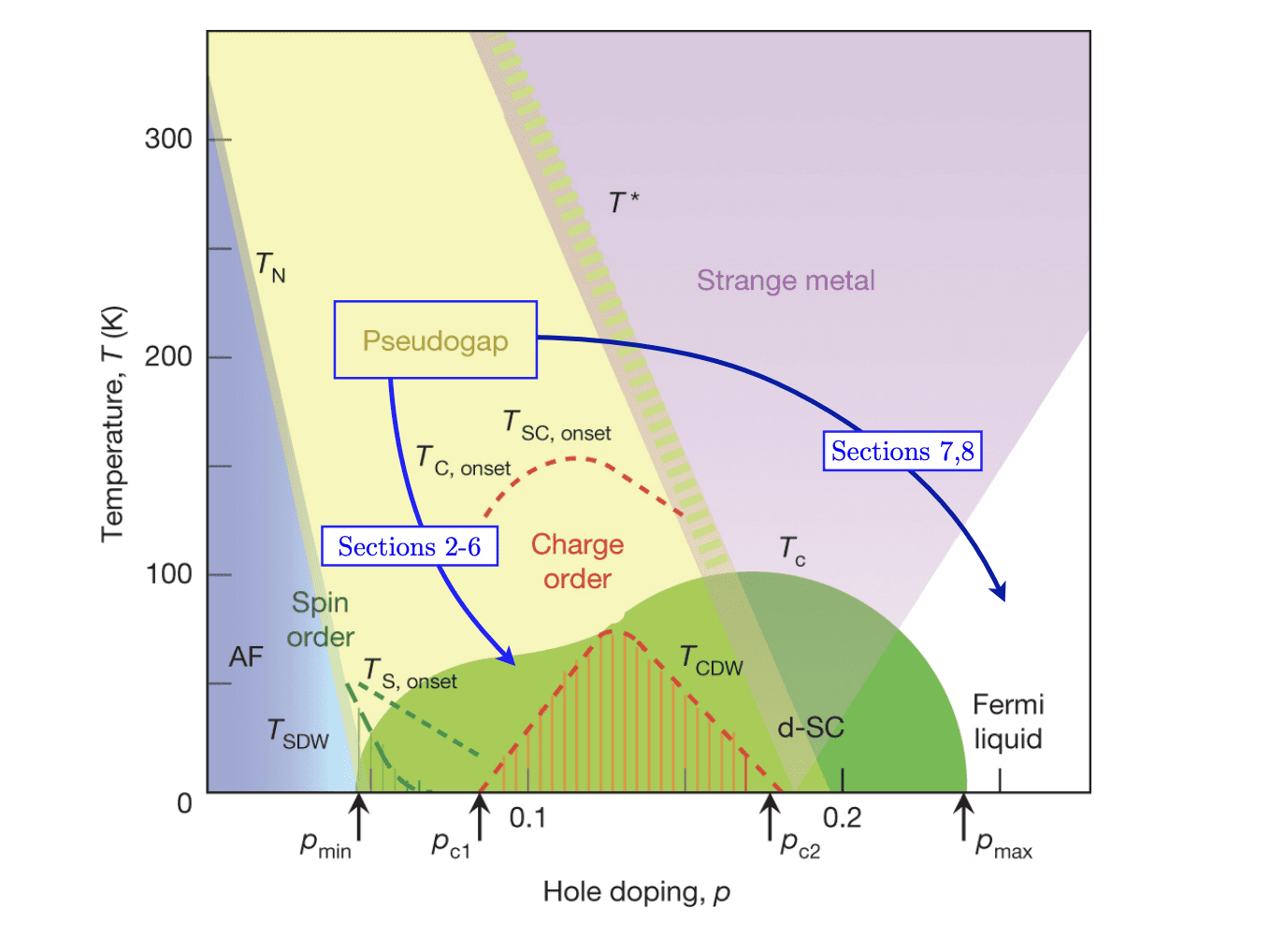
The enduring mystery of high-temperature superconductivity in cuprate materials takes a step closer to resolution with new theoretical work led by Pietro M. Bonetti, Maine Christos, and Alexander Nikolaenko, alongside Aavishkar A. Patel from the Flatiron Institute and Subir Sachdev. This research presents a comprehensive framework explaining the behaviour of these materials, starting from a unique ‘fractionalized Fermi liquid’ state that appears at intermediate temperatures, and extending to both superconducting and charge-ordered phases. The team’s calculations predict specific electronic properties, including the size and shape of electron pockets, which align with recent experimental observations, and crucially, offer a pathway to understanding the strange metallic behaviour often seen before superconductivity emerges. By connecting this microscopic picture to broader phenomena like charge ordering and the influence of disorder, this work provides a significant advance in the quest to design and understand materials with even higher superconducting transition temperatures.
A theoretical framework for the cuprate superconductors exists, rooted in a fractionalized Fermi liquid (FL) description of the intermediate-temperature pseudogap phase at low doping. This FL theory predicts hole pockets, each with a fractional area, in contrast to predictions from other theories, and recent magnetotransport observations of the Yamaji angle strongly support this prediction. Researchers have developed a novel model to represent the complex quantum behaviour of electrons within the material, accurately reproducing the gapped electronic spectrum observed in photoemission experiments.
Strange Metals and Quantum Criticality Studies
This collection of research papers explores the fascinating world of strange metals, quantum criticality, disordered systems, and high-temperature superconductivity. The central theme revolves around understanding materials that defy conventional metallic behaviour, exhibiting properties like linear-in-temperature resistivity and a breakdown of standard electron behaviour. A key idea is that many of these strange metal behaviours arise from being close to a quantum phase transition, even if the transition itself is suppressed, and a significant portion of the research investigates the role of disorder in driving or enhancing these unusual properties. Many papers are motivated by understanding the normal state of cuprate superconductors, hoping that understanding this state will provide clues to the mechanism behind high-temperature superconductivity.
Researchers are finding that traditional theories often fail to explain the observed behaviour, necessitating new theoretical frameworks, and the overarching goal is to understand systems that don’t conform to the standard model for metals, the Fermi liquid theory. Several studies focus on the phenomenon of magic-angle graphene, a material exhibiting strange metal behaviour in a moiré superlattice, while others explore the role of quantum criticality and magnetic fluctuations in cuprates. Investigations into disorder and randomness reveal the importance of infinite randomness quantum critical points, a concept describing a specific type of phase transition, and theoretical work delves into advanced concepts like sign-problem-free quantum Monte Carlo simulations and gauge theory, providing tools to study these complex systems. The papers build on each other, creating a complex web of interconnected ideas.
Fractionalized Fermi Liquid Explains Cuprate Superconductivity
Researchers have developed a theoretical framework to explain the behaviour of cuprate superconductors, focusing on a state called a fractionalized Fermi liquid (FL) that exists at intermediate temperatures. This FL theory predicts the formation of hole pockets with a specific area within the material’s electronic structure, a prediction that aligns with recent experimental observations of the Yamaji angle in magnetotransport measurements. Through a complex theoretical approach involving ancilla qubits, the researchers demonstrate how these hole pockets can evolve, potentially leading to either superconductivity or a charge-ordered metallic state depending on temperature. Furthermore, numerical studies of wavefunctions derived from this theory align well with experimental results from cold atom experiments, validating the model’s predictive power.
To explain the full picture, researchers incorporated fluctuations coupling the layers, choosing a critical square lattice spin liquid as the underlying state. This refined theory reveals that as temperature decreases, the system undergoes a transition to a d-wave superconductor not through conventional Cooper pairing, but via a confinement transition of gauge fields, resulting in Bogoliubov quasiparticles with anisotropic velocities, resolving a long-standing discrepancy between theoretical predictions and experimental measurements. The findings suggest that cuprate superconductivity arises from exploiting pre-existing electron pairing within a resonating valence bond state, offering a comprehensive explanation for the complex behaviour of these high-temperature superconductors.
Fractionalized Fermi Liquid Explains Cuprate Superconductivity
This research presents a theoretical framework for understanding high-temperature superconductivity in cuprate materials, grounded in the concept of a fractionalized Fermi liquid, a state where electrons break down into independent components. The team’s model predicts the existence of “hole pockets” with a specific area within the material’s electronic structure, a prediction that aligns with recent experimental observations of the Yamaji angle in magnetotransport measurements. Through a complex theoretical approach involving ancilla qubits and gauge theory, the researchers demonstrate how these hole pockets can evolve, potentially leading to either superconductivity or a charge-ordered metallic state depending on temperature. The study further explores the transition from this fractionalized state to more conventional metallic behaviour at higher doping levels, proposing a “critical charge liquid” to describe the intermediate “strange metal” regime.
They address the persistent non-Fermi liquid behaviour observed in these materials by considering the effects of disorder and Griffiths effects at low temperatures. While the model successfully explains several experimental findings, the authors acknowledge limitations in fully capturing the complexity of real materials and the approximations made within their theoretical framework. Future research directions include refining the model to incorporate more realistic material properties and exploring the potential for observing the predicted transitions and phases in experiments.
👉 More information
🗞 Critical quantum liquids and the cuprate high temperature superconductors
🧠 ArXiv: https://arxiv.org/abs/2508.20164