
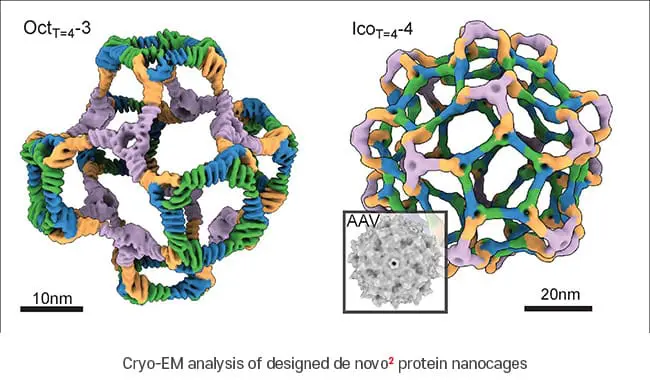
Researchers have made a crucial step forward in gene therapy by designing artificial proteins that mimic the structure of viruses using artificial intelligence models. Professor Sangmin Lee from POSTECH and Professor David Baker, the 2024 Nobel Chemistry Laureate from the University of Washington, collaborated on this innovative project published in Nature.
Using AI-driven computational design, the team created virus-like nanocages with complex structures, including tetrahedral, octahedral, and icosahedral shapes. These nanostructures comprise four types of artificial proteins and can hold up to three times more genetic material than conventional gene delivery vectors, such as adeno-associated viruses.
This advancement has the potential to accelerate the development of gene therapies and drive innovations in next-generation vaccines and other biomedical applications, with support from organizations including the Republic of Korea’s Ministry of Science and ICT and the Howard Hughes Medical Institute.
Introduction to Virus-Inspired Gene Therapy
The field of gene therapy has witnessed significant advancements in recent years, with researchers exploring innovative methods to deliver therapeutic genes to target cells. One such approach involves mimicking the intricate structures of viruses using artificial intelligence (AI) models. Viruses are uniquely designed to encapsulate genetic material within spherical protein shells, enabling them to replicate and invade host cells. Inspired by these complex structures, researchers have been developing artificial proteins modeled after viruses, known as “nanocages.” These nanocages mimic viral behavior, effectively delivering therapeutic genes to target cells.
The development of nanocages has been hindered by limitations such as small size, which restricts the amount of genetic material they can carry, and simple designs that fall short of replicating the multifunctionality of natural viral proteins. A research team led by Professor Sangmin Lee from POSTECH’s Department of Chemical Engineering and 2024 Nobel Chemistry Laureate Professor David Baker from the University of Washington employed AI-driven computational design to address these challenges. By leveraging AI, the team recreated the nuanced characteristics of viruses, including subtle asymmetries, and successfully designed nanocages in tetrahedral, octahedral, and icosahedral shapes for the first time.
The use of AI in designing nanocages has opened up new possibilities for gene therapy. The resulting nanostructures are composed of four types of artificial proteins, forming intricate architectures with six distinct protein-protein interfaces. Among these, the icosahedral structure stands out for its ability to hold three times more genetic material than conventional gene delivery vectors, such as adeno-associated viruses (AAV*1). This marks a significant advancement in gene therapy, enabling the delivery of larger and more complex therapeutic payloads to target cells.
The development of AI-designed nanocages has far-reaching implications for the field of gene therapy. With the ability to deliver larger and more complex therapeutic payloads, researchers can now explore new avenues for treating genetic diseases. The use of AI in designing nanocages also highlights the potential for artificial intelligence to drive innovation in biomedicine. As Professor Sangmin Lee noted, “Advancements in AI have opened the door to a new era where we can design and assemble artificial proteins to meet humanity’s needs.” This research can potentially accelerate the development of gene therapies and drive breakthroughs in next-generation vaccines and other biomedical innovations.
Design and Development of Nanocages
The design and development of nanocages involved a multidisciplinary approach, combining expertise in AI, protein engineering, and biomedicine. The research team used AI-driven computational design to recreate the nuanced characteristics of viruses, including subtle asymmetries. This approach enabled the team to design nanocages with complex architectures, including tetrahedral, octahedral, and icosahedral shapes.
The resulting nanostructures are composed of four types of artificial proteins, which form intricate architectures with six distinct protein-protein interfaces. The icosahedral structure, measuring up to 75 nanometers in diameter, stands out for its ability to hold three times more genetic material than conventional gene delivery vectors. Electron microscopy confirmed the AI-designed nanocages achieved precise symmetrical structures as intended. Functional experiments further demonstrated their ability to effectively deliver therapeutic payloads to target cells.
The development of nanocages has been supported by advances in protein engineering and biomedicine. The use of AI-driven computational design has enabled researchers to design and assemble artificial proteins with specific functions and properties. This approach has the potential to revolutionize the field of biomedicine, enabling the development of novel therapeutic agents and diagnostic tools.
The research team’s work on nanocages has been recognized internationally, with their study published in Nature on December 18 (local time). The study was supported by the Republic of Korea’s Ministry of Science and ICT under the Outstanding Young Scientist Program, the Nano and Material Technology Development Program, and the Global Frontier Research Program, with additional funding provided by the Howard Hughes Medical Institute (HHMI) in the United States.
Applications of Nanocages in Gene Therapy
The development of nanocages has significant implications for the field of gene therapy. With the ability to deliver larger and more complex therapeutic payloads, researchers can now explore new avenues for treating genetic diseases. The use of AI-designed nanocages enables the delivery of therapeutic genes to target cells with high efficiency and specificity.
Gene therapy involves the use of genes to prevent or treat diseases. The delivery of therapeutic genes to target cells is a critical step in this process. Conventional gene delivery vectors, such as adeno-associated viruses (AAV*1), have limitations in terms of their ability to carry large and complex therapeutic payloads. The development of nanocages has addressed these limitations, enabling the delivery of larger and more complex therapeutic payloads to target cells.
The applications of nanocages in gene therapy are diverse and far-reaching. Researchers can use nanocages to deliver therapeutic genes for the treatment of genetic diseases such as sickle cell anemia, cystic fibrosis, and muscular dystrophy. Nanocages can also be used to deliver genes that promote tissue repair and regeneration, enabling the development of novel therapies for conditions such as heart disease and cancer.
The use of nanocages in gene therapy also highlights the potential for artificial intelligence to drive innovation in biomedicine. As researchers continue to explore the applications of AI-designed nanocages, they may uncover new avenues for treating genetic diseases and promoting tissue repair and regeneration.
Future Directions and Challenges
The development of nanocages has significant implications for the field of gene therapy, but there are also challenges that need to be addressed. One of the major challenges is the scalability of nanocage production. As researchers move towards clinical trials, they will need to develop methods for large-scale production of nanocages.
Another challenge is the potential toxicity of nanocages. While the research team has demonstrated the safety and efficacy of AI-designed nanocages in preclinical studies, further research is needed to fully understand their potential toxicity and immunogenicity.
The development of nanocages also raises ethical considerations. As researchers explore the applications of AI-designed nanocages, they will need to consider the potential risks and benefits of using these technologies in humans. This includes ensuring that nanocages are designed and used in a way that respects human dignity and promotes social justice.
Despite these challenges, the development of nanocages has the potential to revolutionize the field of gene therapy. As researchers continue to explore the applications of AI-designed nanocages, they may uncover new avenues for treating genetic diseases and promoting tissue repair and regeneration. The use of artificial intelligence in designing nanocages also highlights the potential for AI to drive innovation in biomedicine, enabling the development of novel therapeutic agents and diagnostic tools.
Conclusion
The development of nanocages has significant implications for the field of gene therapy. With the ability to deliver larger and more complex therapeutic payloads, researchers can now explore new avenues for treating genetic diseases. The use of AI-designed nanocages enables the delivery of therapeutic genes to target cells with high efficiency and specificity.
The applications of nanocages in gene therapy are diverse and far-reaching. Researchers can use nanocages to deliver therapeutic genes for the treatment of genetic diseases such as sickle cell anemia, cystic fibrosis, and muscular dystrophy. Nanocages can also be used to deliver genes that promote tissue repair and regeneration, enabling the development of novel therapies for conditions such as heart disease and cancer.
As researchers continue to explore the applications of AI-designed nanocages, they may uncover new avenues for treating genetic diseases and promoting tissue repair and regeneration. The use of artificial intelligence in designing nanocages also highlights the potential for AI to drive innovation in biomedicine, enabling the development of novel therapeutic agents and diagnostic tools. With further research and development, nanocages have the potential to revolutionize the field of gene therapy and improve human health.
External Link: Click Here For More