

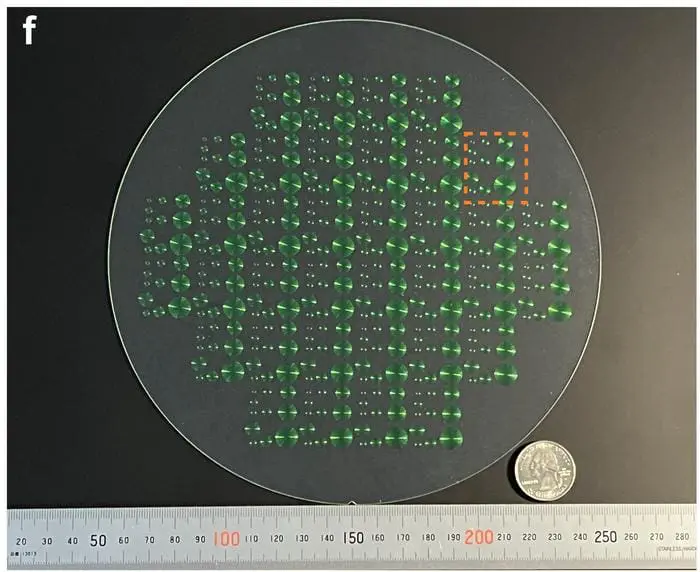
Researchers at the University of Tokyo and JSR Corp have developed a new method to create compact optical lenses using common semiconductor manufacturing equipment. Associate Professor Kuniaki Konishi from the Institute for Photon Science and Technology led the team in fabricating flat lenses called Fresnel zone plates, which have the potential to reshape optics for industries ranging from astronomy to healthcare and consumer electronics.
The lenses are made using a special type of photoresist or mask called a color resist, originally designed for use as color filters. Konishi’s team produced lenses capable of focusing visible light down to only 1.1 microns, around 100 times thinner than a human hair. While the current drawback is a low light-gathering efficiency of 7%, the team is working on ways to increase this fourfold. The technology has the potential to enable a new generation of compact optical devices and could have environmental and economic benefits by eliminating the need for toxic etching chemicals and reducing energy consumption.
Introduction to Thin Lenses
The development of compact optical lenses has been a longstanding goal in the field of optics, with potential applications ranging from astronomy to healthcare and consumer electronics. Recently, researchers at the University of Tokyo and JSR Corp. have made significant progress in this area by fabricating and testing flat lenses called Fresnel zone plates (FZPs) using common semiconductor manufacturing equipment. This breakthrough has the potential to enable a new generation of compact optical devices.
The FZPs developed by the research team are paper-thin optical lenses that can be mass-produced like microchips, making them a promising alternative to traditional lenses. The fabrication process involves coating, exposing, and developing a special type of photoresist or mask called a color resist, which was originally designed for use as color filters. This method allows for the production of lenses capable of focusing visible light down to only 1.1 microns, around 100 times thinner than a human hair.
The current drawback with the new FZPs is that they only have a light-gathering efficiency of 7%, meaning they produce excessively noisy images. However, the research team is already working on ways to increase this fourfold by changing the way they use the color resists. This would require a greater degree of control over the color resists’ physical properties than was afforded the researchers at the time of this study, though the ability to do this does exist.
Fabrication Process and Materials
The fabrication process used to create the FZPs is based on a common semiconductor lithography system, or stepper. This system uses a special type of photoresist or mask called a color resist, which was originally designed for use as color filters. The color resist is coated onto a substrate, exposed to light, and then developed to create the desired pattern. The resulting FZP is a paper-thin optical lens that can be used to focus visible light.
The use of color resists in the fabrication process has several advantages over traditional methods. For example, it eliminates the need for toxic etching chemicals and significantly reduces energy consumption. Additionally, the color resist can be easily patterned and shaped to create complex optical structures, making it an ideal material for the production of FZPs.
The research team used an i-line stepper to fabricate the FZPs, which is a type of lithography system that uses ultraviolet light to pattern the photoresist. The i-line stepper is commonly used in the production of semiconductors and other microelectronic devices, making it an ideal tool for the fabrication of FZPs.
Applications and Potential Benefits
The development of FZPs has the potential to enable a new generation of compact optical devices, with applications ranging from astronomy to healthcare and consumer electronics. For example, FZPs could be used to create ultrathin smartphones with high-quality cameras, or to develop portable medical imaging devices that can be used in remote or resource-poor areas.
The use of FZPs also has several environmental and economic benefits. For example, the fabrication process eliminates the need for toxic etching chemicals and significantly reduces energy consumption, making it a more sustainable option than traditional methods. Additionally, the use of color resists and i-line steppers makes it possible to produce FZPs at a lower cost than traditional lenses, which could make them more accessible to a wider range of applications.
Research and Development
The research team behind the development of FZPs is continuing to work on improving the light-gathering efficiency of the lenses, with the goal of increasing it fourfold. This would require a greater degree of control over the color resists’ physical properties than was afforded the researchers at the time of this study, though the ability to do this does exist.
The team is also exploring the potential applications of FZPs in various fields, including medicine and astronomy. For example, they are investigating the use of FZPs in medical imaging devices, such as endoscopes and microscopes, where their small size and high resolution could be particularly useful.
In conclusion, the development of FZPs is a significant breakthrough in the field of optics, with potential applications ranging from astronomy to healthcare and consumer electronics. The use of color resists and i-line steppers makes it possible to produce FZPs at a lower cost than traditional lenses, while also eliminating the need for toxic etching chemicals and reducing energy consumption. As research and development continue to improve the light-gathering efficiency and explore new applications for FZPs, it is likely that we will see these innovative lenses being used in a wide range of devices and industries in the near future.
External Link: Click Here For More


