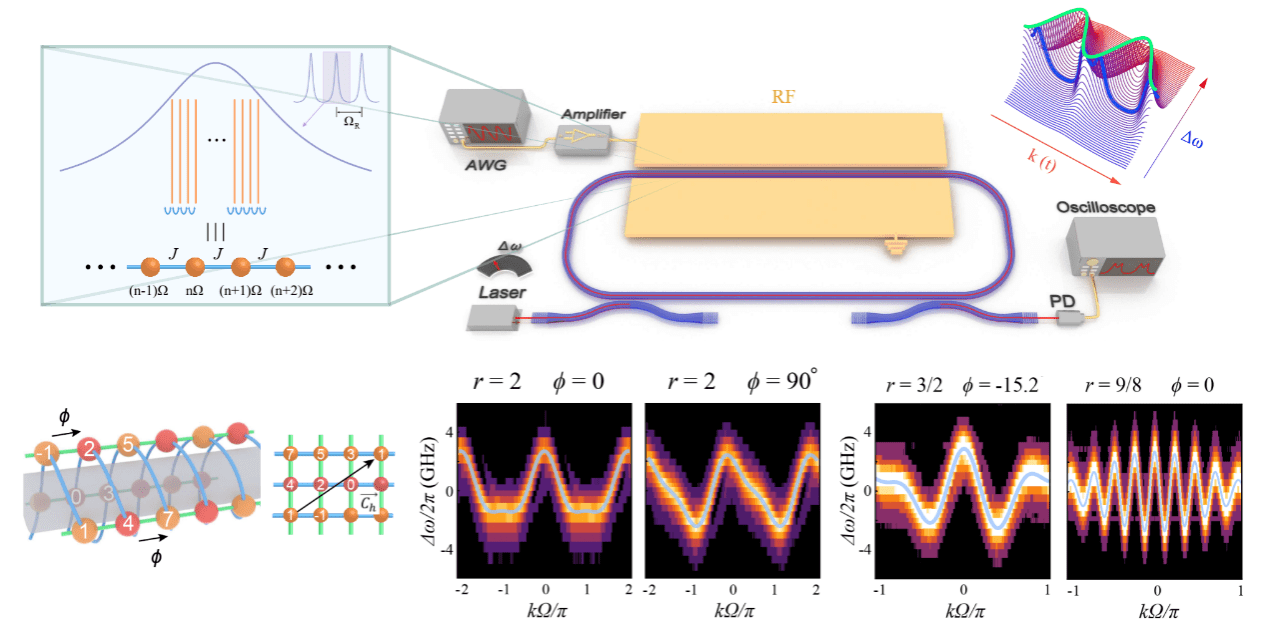
Researchers at the University of Science and Technology of China, led by Professor Li Chuanfeng, have advanced quantum photonics with the development of an on-chip photonic simulator. This innovative device can simulate complex frequency lattices with gauge potential, a crucial step forward in understanding low-dimensional materials.
The team utilized thin-film lithium niobate chips to create these lattices, leveraging their high electro-optic coefficient to achieve band structures. Professor Li Chuanfeng’s approach has garnered significant attention, with the ability to simulate arbitrary-range coupled frequency lattices and reduce required modulation frequencies by several orders of magnitude. This breakthrough has the potential to simplify design and fabrication challenges, making it a notable achievement in the field of quantum physics, with applications in the study of synthetic dimensions on photonic chips, as noted in the publication in Physical Review Letters.
Introduction to Photonic Simulators and Synthetic Frequency Dimensions
The field of quantum photonics has witnessed significant advancements in recent years, with a growing interest in developing effective simulators that can replicate the dynamics of real systems. Photonic systems have emerged as versatile candidates for quantum simulation due to their ability to control properties like polarization and frequency. However, creating frequency lattices that can simulate complex structures like atom chains and nanotubes has proven to be a challenge. These structures are crucial for understanding low-dimensional materials, which have unique properties that make them attractive for various applications.
Developing on-chip photonic simulators has been a driving force in addressing this challenge. Researchers have been exploring the use of thin-film lithium niobate chips, which are particularly suited for creating lattices in the frequency domain due to their high electro-optic coefficient. Researchers can observe band structures by periodically modulating an on-chip resonator, allowing for the simulation of structures with arbitrary-range coupling. This approach has shown great promise in alleviating the difficulties posed by high frequencies in on-chip synthetic dimensions.
The concept of synthetic frequency dimensions is based on the idea of creating artificial lattice structures that can mimic the behavior of real systems. By controlling the properties of photons, such as their frequency and polarization, researchers can create complex structures that are not easily accessible in natural systems. This approach has opened up new avenues for studying quantum phenomena and has the potential to lead to breakthroughs in our understanding of quantum mechanics.
The use of photonic simulators also offers several advantages over traditional simulation methods. For example, photonic simulators can be designed to be highly scalable, allowing for the simulation of complex systems that are not easily accessible using other methods. Additionally, photonic simulators can be used to study a wide range of quantum phenomena, from quantum entanglement to many-body localization.
Experimental Setup and Results
The experimental setup used by the research team involved the use of thin-film lithium niobate chips, which were periodically modulated to create a lattice structure in the frequency domain. The researchers observed band structures, which allowed for the simulation of structures with arbitrary-range coupling. The results showed that the method enabled coupling up to 8 and 9 times the lattice constant while reducing the required modulation frequency by over five orders of magnitude.
The use of low-frequency radio-frequency modulation offered a high degree of flexibility in choosing lattice points and regulating compound interaction. This approach significantly reduced the required frequencies by more than three orders of magnitude, translating to a reduction from near 100 GHz to around 10 MHz. This not only simplified the design and fabrication challenges but also lessened the demands on source and measurement equipment.
The experimental results demonstrated the effectiveness of the photonic simulator in creating complex frequency synthetic dimensions on thin-film lithium niobate optical chips. The reviewers highly praised the achievement, stating it “opens a new avenue within the area of studying synthetic dimensions on photonic chips.” The results have significant implications for the study of quantum phenomena and could lead to breakthroughs in our understanding of quantum mechanics.
The experimental setup also highlighted the importance of careful design and fabrication of the photonic simulator. The use of thin-film lithium niobate chips required precise control over the modulation frequency and amplitude, as well as the lattice structure. The researchers used advanced fabrication techniques to create the chips, which were then characterized using a range of experimental methods.
Photonic Simulators and Synthetic Dimensions
The concept of synthetic dimensions is based on the idea of creating artificial lattice structures that can mimic the behavior of real systems. By controlling the properties of photons, such as their frequency and polarization, researchers can create complex structures that are not easily accessible in natural systems. Photonic simulators offer a powerful tool for studying synthetic dimensions, allowing researchers to explore a wide range of quantum phenomena.
The use of photonic simulators also offers several advantages over traditional simulation methods. For example, photonic simulators can be designed to be highly scalable, allowing for the simulation of complex systems that are not easily accessible using other methods. Additionally, photonic simulators can be used to study a wide range of quantum phenomena, from quantum entanglement to many-body localization.
The concept of synthetic dimensions is closely related to the idea of quantum simulation, which involves the use of a controllable quantum system to mimic the behavior of another quantum system. Photonic simulators offer a powerful tool for quantum simulation, allowing researchers to explore a wide range of quantum phenomena in a highly controlled environment.
The study of synthetic dimensions using photonic simulators has significant implications for our understanding of quantum mechanics. By creating artificial lattice structures that can mimic the behavior of real systems, researchers can gain insights into the behavior of complex quantum systems. This could lead to breakthroughs in our understanding of quantum phenomena and could have significant implications for the development of new technologies.
Applications and Future Directions
The development of photonic simulators has significant implications for a wide range of applications, from quantum computing to materials science. By creating artificial lattice structures that can mimic the behavior of real systems, researchers can gain insights into the behavior of complex quantum systems. This could lead to breakthroughs in our understanding of quantum phenomena and could have significant implications for the development of new technologies.
One potential application of photonic simulators is in the study of quantum many-body systems. These systems are characterized by strong interactions between particles, which can lead to complex behavior that is not easily accessible using traditional simulation methods. Photonic simulators offer a powerful tool for studying quantum many-body systems, allowing researchers to explore a wide range of quantum phenomena in a highly controlled environment.
Another potential application of photonic simulators is in the development of new materials with unique properties. By creating artificial lattice structures that can mimic the behavior of real systems, researchers can gain insights into the behavior of complex materials. This could lead to breakthroughs in our understanding of material science and could have significant implications for the development of new technologies.
The future directions of photonic simulators are exciting and varied. Researchers are exploring a wide range of applications, from quantum computing to materials science. The development of more advanced fabrication techniques and experimental methods will be crucial for the continued advancement of photonic simulators. Additionally, the study of synthetic dimensions using photonic simulators has significant implications for our understanding of quantum mechanics and could lead to breakthroughs in our understanding of quantum phenomena.
Conclusion
In conclusion, the development of photonic simulators has significant implications for a wide range of applications, from quantum computing to materials science. By creating artificial lattice structures that can mimic the behavior of real systems, researchers can gain insights into the behavior of complex quantum systems. The use of thin-film lithium niobate chips and low-frequency radio-frequency modulation offers a powerful tool for studying synthetic dimensions, allowing researchers to explore a wide range of quantum phenomena in a highly controlled environment.
The study of synthetic dimensions using photonic simulators has significant implications for our understanding of quantum mechanics. By creating artificial lattice structures that can mimic the behavior of real systems, researchers can gain insights into the behavior of complex quantum systems. This could lead to breakthroughs in our understanding of quantum phenomena and could have significant implications for the development of new technologies.
The future directions of photonic simulators are exciting and varied. Researchers are exploring a wide range of applications, from quantum computing to materials science. The development of more advanced fabrication techniques and experimental methods will be crucial for the continued advancement of photonic simulators. Additionally, the study of synthetic dimensions using photonic simulators has significant implications for our understanding of quantum mechanics and could lead to breakthroughs in our understanding of quantum phenomena.
External Link: Click Here For More