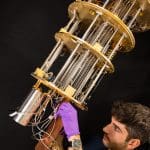
The University of Missouri has established the state’s first IBM Quantum Innovation Center, providing researchers and institutions with cloud access to advanced quantum computing through IBM’s platform. As part of the IBM Quantum Network, Mizzou joins over 250 international members, including universities, organizations, research laboratories, and startups.
Leaders and faculty lead the initiative from Mizzou’s College of Arts and Science and College of Engineering, who will use the technology to advance groundbreaking research in fields such as energy innovation and artificial intelligence. Cooper Drury, dean of the College of Arts and Science, and Marisa Chrysochoou, dean of the College of Engineering, are spearheading the effort.
Quantum computers operate fundamentally differently than traditional computers, using quantum bits or qubits to process complex problems exponentially faster than even the most powerful supercomputers. Researchers will use IBM’s cloud-based quantum computing systems, along with Qiskit software and support from IBM’s quantum team, to tackle challenges that traditional computers cannot handle efficiently.
Unlocking the Power of Quantum Computing: Mizzou Establishes IBM Quantum Innovation Center
The University of Missouri has taken a significant step forward in the field of quantum computing by establishing the state’s first IBM Quantum Innovation Center. This innovation center is part of the IBM Quantum Network, which provides researchers and institutions with access to advanced quantum computing through IBM’s cloud-based platform. As one of over 250 international members of the IBM Quantum Network, Mizzou is poised to unlock unprecedented computational abilities to tackle complex challenges, drive innovation, and inspire the next generation of researchers.
The initiative is spearheaded by leaders and faculty from Mizzou’s College of Arts and Science and College of Engineering, who will use the technology to advance groundbreaking research. The MU Division of Information Technology will play an integral role in helping prepare Mizzou’s users to take advantage of IBM’s quantum systems over the cloud. By leveraging the power of quantum computing, researchers at Mizzou aim to drive innovation in fields such as energy innovation and artificial intelligence.
A Rapidly Emerging Technology: Understanding Quantum Computing
Quantum computers operate fundamentally differently than traditional computers. Rather than relying on standard bits, they use quantum bits, or qubits, to process and solve complex problems exponentially. This property allows quantum computers to potentially solve certain problems faster than even the most powerful supercomputers. Although quantum computers aren’t expected to replace regular computers for everyday tasks, they are emerging as vital tools for tackling challenges that traditional computers cannot handle efficiently.
Quantum computing is poised to revolutionize fields from materials science to machine learning, healthcare, and life sciences. By harnessing the power of quantum mechanics, researchers can explore yet undiscovered computational territory that is inaccessible or very difficult for classical computers. This approach may not always yield an exact answer, but for many applications, a small margin of error is a fair trade for the extraordinary speed advantage.
Advancing Research and Education: The IBM Quantum Innovation Center
The IBM Quantum Innovation Center at Mizzou will bring together faculty expertise with the most sophisticated technologies to drive research and teaching on a range of topics. A cohort of faculty has been selected to start using the technology immediately, with engineering researchers focusing on topics such as quantum programming and semiconductors. Researchers from the College of Arts and Science will leverage the IBM partnership to study condensed matter and advance work in computational biophysics.
The center will also provide a robust quantum ecosystem through research initiatives, student education, and workforce development. By providing access to advanced quantum computing resources, Mizzou aims to empower researchers and students to explore new frontiers of knowledge and innovation. As Chi-Ren Shyu, a professor of electrical engineering and computer science, emphasized, faculty members don’t need to be experts in quantum physics to benefit from the technology.
Practical Applications: Unlocking New Possibilities
The IBM Quantum Innovation Center at Mizzou is poised to unlock new possibilities for researchers and students. By leveraging the power of quantum computing, researchers can tackle complex challenges that were previously inaccessible or required an impractical amount of time and resources. For instance, certain tasks that could take years to solve with classical supercomputers could be completed in just hours using future quantum computers.
The center will also provide a platform for interdisciplinary collaboration, bringing together experts from diverse fields to explore new applications of quantum computing. By advancing research and education in this rapidly emerging field, Mizzou aims to drive innovation and inspire the next generation of researchers and leaders.
External Link: Click Here For More