Researchers at the University of Melbourne have made significant strides in the field of quantum computing, specifically in the use of Majorana zero modes (MZMs) for fault-tolerant topological quantum computation. They have developed a method to track transitions within the low-energy subspace and predict the output of braids with hybridized Majorana modes. This could help accurately quantify and correct for Pauli-qubit errors in a time-dependent process. The team also demonstrated how dynamic hybridization can be used to map an arbitrary state about the Bloch sphere and implement an arbitrary controlled-phase gate. This research could revolutionize quantum computing and bring us closer to a fault-tolerant quantum computer.
What is the Potential of Majorana Zero Modes in Quantum Computing?
Quantum computing is a rapidly evolving field that promises to revolutionize the way we process information. One of the most promising avenues in this field is the use of Majorana zero modes (MZMs) for fault-tolerant topological quantum computation. MZMs are zero energy subgap states that form on the boundaries of topological superconductors. They have been theorized as a potential pathway toward fault-tolerant topological quantum computation.
The use of MZMs in quantum computing depends on the storing and manipulation of quantum information nonlocally. This nonlocality protects the topological quantum bits and gates from the effects of local perturbation, providing an exciting avenue towards fault-tolerant quantum computing. Promising platforms to host these exotic states range from semiconductor nanostructures to magnet-superconductor hybrid systems.
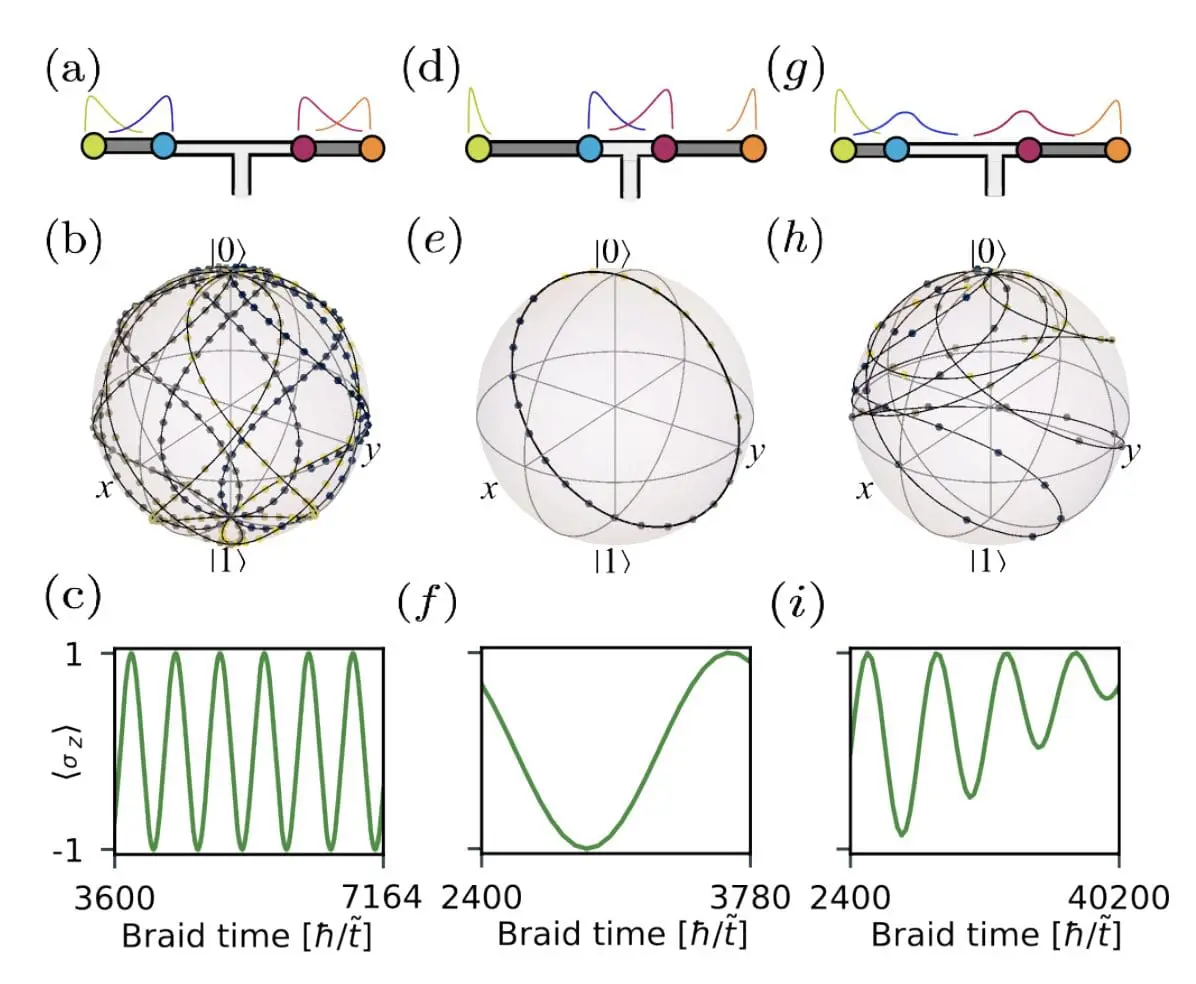
However, a challenge arises when Majorana modes get close to each other, leading to Majorana wavefunction overlap, known as hybridization. This overlap breaks the ground state degeneracy, leading to qubit errors in the braiding process. Braiding is an operation that changes the quantum state of MZMs, allowing for the encoding of unitary gates.
How Can We Overcome the Challenge of Majorana Hybridization?
The researchers at the University of Melbourne have presented an accessible method to track transitions within the low-energy subspace and predict the output of braids with hybridized Majorana modes. This method could allow one to accurately quantify and correct for Pauli-qubit errors in a time-dependent process. It could also accurately predict the timescales required for the implementation of quantum gates based purely on time-dependent hybridization.
The researchers utilized methods analogous to those used in Landau-Zener tunneling to make predictions for the effects of hybridization in dynamical braiding processes. They characterized the error for systems with multiple pairs of MZMs and time-dependent energy splitting. They also predicted and simulated the T-gate or magic gate, along with an arbitrary phase gate along the y-axis, demonstrating how dynamic hybridization may be utilized to map an arbitrary state about the Bloch sphere.
What is the Significance of This Research?
This research is significant because it provides a complete understanding of how hybridization changes the many-body ground state. This understanding is pivotal to well-define the way quantum operations are dynamically affected by the changing Majorana overlap throughout a braiding process.
The researchers also extended the scope of their method to implement an arbitrary controlled-phase gate purely through hybridization. This is a critical step for the successful operation of any quantum computer.
In conclusion, this research presents a promising pathway towards fault-tolerant topological quantum computation using Majorana zero modes. It provides a method to overcome the challenge of Majorana hybridization and paves the way for the implementation of quantum gates based purely on time-dependent hybridization. This could revolutionize the field of quantum computing and bring us one step closer to the realization of a fault-tolerant quantum computer.
What is the Future of Quantum Computing with Majorana Zero Modes?
The future of quantum computing with Majorana zero modes looks promising. The researchers at the University of Melbourne have demonstrated a method to track transitions within the low-energy subspace and predict the output of braids with hybridized Majorana modes. This method could be used to accurately quantify and correct for Pauli-qubit errors in a time-dependent process, and to accurately predict the timescales required for the implementation of quantum gates based purely on time-dependent hybridization.
The researchers also demonstrated how dynamic hybridization may be utilized to map an arbitrary state about the Bloch sphere. They extended the scope of their method to implement an arbitrary controlled-phase gate purely through hybridization. This is a critical step for the successful operation of any quantum computer.
In conclusion, the use of Majorana zero modes in quantum computing presents one of the most exciting avenues towards fault-tolerant quantum computation. This research provides a promising pathway towards this goal and paves the way for future advancements in the field of quantum computing.
How Does This Research Impact the Field of Quantum Computing?
This research has a significant impact on the field of quantum computing. It presents a promising pathway towards fault-tolerant topological quantum computation using Majorana zero modes. The researchers have demonstrated a method to overcome the challenge of Majorana hybridization, which is a critical step for the successful operation of any quantum computer.
The researchers also demonstrated how dynamic hybridization may be utilized to map an arbitrary state about the Bloch sphere. They extended the scope of their method to implement an arbitrary controlled-phase gate purely through hybridization. This could revolutionize the field of quantum computing and bring us one step closer to the realization of a fault-tolerant quantum computer.
In conclusion, this research provides a promising pathway towards fault-tolerant topological quantum computation using Majorana zero modes. It paves the way for future advancements in the field of quantum computing and has the potential to revolutionize the way we process information.
Computing”
Publication Date: 2024-03-04
Authors: Themba Hodge, Eric Mascot, Daniel Crawford, Stephan Rachel, et al.
Source: arXiv (Cornell University)
DOI: https://doi.org/10.48550/arxiv.2403.02481