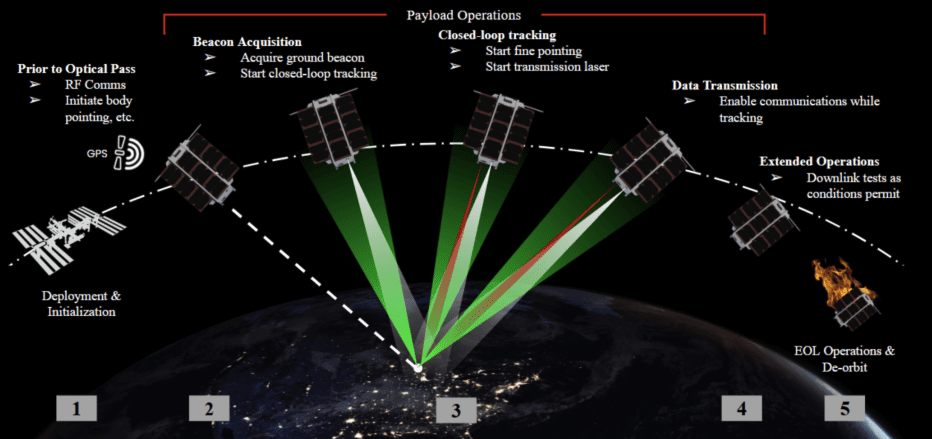
The University of Chicago’s PULSEA mission successfully designs a lowcost opensource CubeSat bus utilising dual BeagleBone Black Industrial units and Goddard’s cFS software architecture. This platform demonstrates feasibility for circular polarisation shift keyed satellite laser communication, meeting stringent requirements for accuracy, power and thermal management within volume and mass constraints.
The demand for accessible space technology continues to drive innovation in small satellite design, with CubeSat platforms becoming increasingly prevalent for both academic research and commercial applications. A team from the University of Chicago, alongside collaborators at StarSense Innovations, LLC, and the Pritzker School of Molecular Engineering, present a detailed account of their development of an open-source spacecraft bus for the Polarization-modUlated Laser Satellite Experiment (PULSE-A) CubeSat. This work, authored by Graydon Schulze-Kalt, Robert Pitu, Spencer Shelton, Catherine Todd, Zane Ebel, Ian Goldberg, Leon Gold, Henry Czarnecki, Mason McCormack, Larry Li, Zumi Riekse, Brian Yu, Akash Piya, Vidya Suri, Dylan Hu, Colleen Kim, John Baird, Seth Knights, Logan Hanssler, Michael Lembeck, and Tian Zhong, details the design and testing of a low-cost, configurable platform intended to facilitate advanced satellite-to-ground laser communication, while also providing a foundation for future missions requiring enhanced capabilities.
The spacecraft bus addresses two key objectives: fulfilling the specific requirements of the PULSE-A mission and offering a readily adaptable framework for subsequent projects. At its core, the system utilises two BeagleBone Black Industrial units, selected for their proven reliability and interconnected via the PC/104 header standard. Software architecture relies on the core Flight System (cFS) developed by the Goddard Space Flight Center, implemented in the C programming language, a decision reflecting the expertise within the University of Chicago’s science departments and simplifying development by the undergraduate flight software team.
The CubeSat structure utilises a modified 3U frame from Gran Systems, accommodating necessary ports and deployable elements. Internally, the avionics stack leverages the PC/104 standard quad rails, culminating in PULSE-A’s custom-designed Payload Box, which houses all payload components and associated fibre optic cabling. The work also details the iterative engineering processes and techniques employed to develop thermal control and dissipation mechanisms, operating within the constraints of volume, mass, and temperature range.
The University of Chicago’s Polarization-modUlated Laser Satellite Experiment (PULSE-A) successfully demonstrates the feasibility of circular polarization shift keyed laser communication between a satellite and ground stations. This achievement validates a low-cost, open-source CubeSat architecture and confirms the viability of student-led satellite development, establishing a foundation for future missions. Data from initial testing confirms the payload meets stringent requirements for pointing accuracy, component alignment, power demand, and thermal stability.
The spacecraft utilises dual BeagleBone Black Industrial units, small single-board computers, selected for their established reliability in space applications and interconnected via a PC/104 header, a standard for robust data transfer. Implementation of Goddard Space Flight Center’s core Flight System (cFS), a modular software framework, facilitates a flexible software architecture constructed in the C programming language. This approach leverages existing expertise within the University’s science departments and streamlines development by the undergraduate team, ensuring maintainability and scalability for future iterations.
The CubeSat structure employs a modified 3U frame, a standard size denoting approximately 30cm x 10cm x 10cm, accommodating necessary ports and deployable components while maintaining structural integrity. An internal avionics stack, utilising the PC/104 standard quad rails for power distribution, connects to a custom-designed Payload Box, ensuring secure and organised integration of the critical subsystems. This modular design simplifies integration and facilitates future upgrades and modifications, extending the mission’s lifespan.
Significant effort concentrates on developing effective thermal control and dissipation mechanisms, addressing the constraints of volume, mass, and power consumption, and ensuring reliable operation of the sensitive electronics in the harsh space environment. Iterative analysis and testing confirm the thermal control system effectively maintains components within their specified temperature limits, guaranteeing long-term performance and stability.
The project prioritises a low-cost, open-source bus architecture, designed concurrently with the payload to meet stringent requirements for pointing accuracy, alignment, power consumption, and thermal stability, fostering a collaborative environment for future space exploration. The University of Chicago team actively contributes to the development of expertise and training materials, fostering a new generation of space systems engineers and promoting knowledge sharing within the community. This commitment to open-source technology encourages collaboration and accelerates innovation.
PULSE-A’s design philosophy centres on creating a readily configurable platform for future missions, extending beyond the capabilities of other low-cost, open-source designs and providing a versatile foundation for a wide range of scientific investigations. The mission benefits from funding from the NASA CubeSat Launch Initiative, alongside support from various University departments and private donors, demonstrating a strong commitment to collaborative space exploration.
Future work focuses on refining the thermal management system, optimising the power budget, and enhancing the data processing capabilities of the onboard computer, ensuring the long-term reliability and performance of the satellite. The team also plans to explore advanced modulation techniques and error correction codes to improve the data transmission rate and robustness of the communication link, paving the way for high-bandwidth space-based communication systems. Furthermore, the project aims to disseminate the knowledge gained and the open-source designs to the wider community, fostering innovation and collaboration in the field of space exploration.
👉 More information
🗞 Development of an Open-Source Spacecraft Bus for the PULSE-A CubeSat
🧠 DOI: https://doi.org/10.48550/arXiv.2506.20014