Researchers from the University of Chicago, Stanford University, and the SLAC National Accelerator Laboratory have made significant advancements in superconducting devices. The team revisited niobium trilayer junctions, fabricating all-niobium transmons using only optical lithography. The devices showed coherence times up to 62 µs and an average qubit quality factor above 105. The team’s work overcomes previous limitations of niobium, offering increased operating temperatures and frequencies for Josephson junctions, the core component of superconducting devices. This research could pave the way for higher-temperature and higher-frequency quantum devices, transforming the field of quantum computing.
What are the Advancements in Niobium Trilayer Junction Qubits?
The research conducted by Alexander Anferov, KanHeng Lee, Fang Zhao, Jonathan Simon, and David I Schuster from the James Franck Institute, University of Chicago, Department of Physics, University of Chicago, Fermi National Accelerator Laboratory, Department of Applied Physics, Stanford University, and SLAC National Accelerator Laboratory, has led to significant advancements in the field of superconducting devices. The team has revisited niobium trilayer junctions and fabricated all-niobium transmons using only optical lithography. The devices were characterized in the microwave domain, measuring coherence times up to 62 µs and an average qubit quality factor above 105.
Niobium offers the benefit of increased operating temperatures and frequencies for Josephson junctions, which are the core component of superconducting devices. However, existing niobium processes are limited by more complicated fabrication methods and higher losses than now-standard aluminum junctions. The team combined recent trilayer fabrication advancements, methods to remove lossy dielectrics, and modern superconducting qubit design to overcome these limitations.
The higher superconducting gap energy of niobium also results in reduced quasiparticle sensitivity above 0.16 K, where aluminum junction performance deteriorates. The team’s low-loss junction process is readily applied to standard optical-based foundry processes, opening new avenues for direct integration and scalability. This paves the way for higher-temperature and higher-frequency quantum devices.
How Does Niobium Compare to Aluminum in Superconducting Devices?
Superconducting devices have developed on the basis of Josephson junctions, with applications ranging from quantum-limited amplification and metrology to digital logic. They are an attractive platform for scalable quantum computing architectures due to their design flexibility and wide range of coupling strengths. Increasingly complex and robust quantum circuits have been demonstrated with aluminum junctions. However, niobium is a tantalizing alternative superconductor due to its larger energy gap and thus higher critical temperature and pair-breaking photon frequency.
Taking advantage of this wider operating regime, niobium trilayer Josephson junctions became standard for single-flux-quantum circuits operating at liquid helium temperatures. Some early implementations of superconducting qubits were developed with niobium junctions. However, these initial niobium qubits only retained quantum state coherence for less than 400 ns, diminished by coupling to sources of dephasing and dissipation in the junction and the qubit environment.
What are the Challenges and Solutions in Niobium Junctions?
Minimizing loss sources is crucial in all sensitive quantum systems, but particularly for qubits, which must remain coherent over the duration of many gate operations. Significant effort has been dedicated to investigating and reducing sources of decoherence, demanding either adjustments of circuit geometry to limit or dilute coupling to spurious channels or reducing the use of lossy amorphous dielectric materials.
The need for insulated wiring contacts in these niobium trilayer junctions required growing passivating amorphous dielectric material in direct contact with the junction barrier, which likely degraded early qubit coherence and limited their use in quantum devices. Higher temperature junctions with low loss promise a transformative source of strong nonlinearity for high-frequency quantum devices and have since seen renewed interest from efforts to integrate digital and quantum logic and the exploration of tunnel barrier materials beyond the limitations of aluminum.
How Does the Improved Fabrication Method Work?
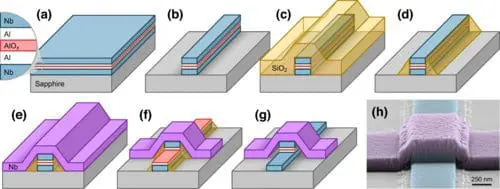
In their research, the team used an improved fabrication method to revisit niobium trilayer junctions as the core component of transmon qubits and explore their coherence properties. They described a method to form a temporary self-aligned sidewall-passivating spacer structure, which limits the amorphous spacer material to the smallest necessary region and can later be chemically removed to further reduce dielectric loss.
High-temperature spacer growth methods greatly reduce the critical current density of the junction barrier, allowing the team to utilize exclusively optical lithography to fabricate high-nonlinearity junctions for microwave qubits. The all-niobium qubits have lifetimes as high as 62 µs with an average qubit quality factor of 2.57*105, much closer to state-of-the-art qubits than past NbAlAlO x devices.
What are the Implications of these Advancements?
The advancements in niobium trilayer junction qubits have significant implications for the field of superconducting devices. The team observed that the higher superconducting gap energy results in reduced sensitivity to quasiparticles, particularly above 160 mK where conventional aluminum-junction qubit performance deteriorates.
These results demonstrate the reemergent relevance of niobium junctions for quantum devices. The improved fabrication method and the properties of niobium offer new possibilities for the development of higher-temperature and higher-frequency quantum devices. This research opens new avenues for direct integration and scalability, potentially transforming the field of quantum computing.
Publication Date: 2024-02-23
Authors: Alexander Anferov, Kan-Heng Lee, Fang Zhao, Jonathan Simon, et al.
Source: Physical review applied
DOI: https://doi.org/10.1103/physrevapplied.21.024047