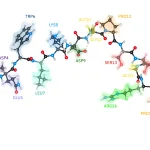
University of Chicago and Ohio State researchers demonstrated that crystal dislocations—typically seen as imperfections—can function as quantum interconnects. Their simulations showed nitrogen-vacancy (NV) centers in diamond retain, and sometimes improve, quantum properties when near these line defects. This offers a potential route for arranging qubits into ordered arrays for scalable quantum technologies.
Nitrogen-Vacancy Centers Align with Diamond Dislocations
Crystal dislocations, previously considered flaws, can function as scaffolds for arranging qubits due to their quasi-one-dimensional structure extending through the diamond. Simulations demonstrated nitrogen-vacancy (NV) centers are attracted to these dislocations and, crucially, maintain—or even improve—their quantum properties when located nearby. This stability is maintained because the NV centers preserve a viable optical cycle, allowing for spin state initialization and readout. Researchers found specific NV center configurations near dislocations exhibited enhanced quantum coherence times compared to those in pristine diamond. This improvement stems from symmetry breaking at the dislocation, creating “clock transitions” that shield the qubit from disruptive magnetic noise.
A substantial fraction of these arrangements were predicted to meet requirements for functional qubits, opening a pathway to scalable quantum interconnects.
First-Principles Simulations Model Dislocation Core Quantum Properties
First-principles simulations accurately modeled the quantum properties of defects within one-dimensional dislocation cores, an achievement enabled by GPU-accelerated computing and massively parallel codes. These large-scale calculations predicted that nitrogen-vacancy (NV) centers, important for solid-state qubits, can maintain stability—including charge, spin state, and optical cycles—when positioned near these dislocations. Detailed optical and magnetic resonance signatures were also predicted, offering guidance for experimental verification.
Enhanced Coherence via Dislocation-Induced “Clock Transitions”
Researchers identified a way to boost quantum coherence by leveraging imperfections in diamond crystals known as dislocations. Specific nitrogen-vacancy (NV) center arrangements near these dislocations exhibited significantly enhanced coherence times, exceeding those found in flawless diamond; this improvement is attributed to “clock transitions” resulting from broken symmetry at the defect. These “clock transitions” actively shield qubits from disruptive environmental magnetic noise, preserving their quantum state for longer periods. The simulations demonstrated a substantial fraction of NV center configurations near dislocations are viable for quantum operations, offering a pathway to ordered qubit arrays. This approach reimagines dislocations—typically seen as flaws—as “quantum highways” capable of hosting and linking chains of qubits.
Because dislocations form quasi-one-dimensional (1D) structures extending through a crystal, they provide a natural scaffold for arranging qubits into ordered arrays.
Cunzhi Zhang