Researchers from the University of Birmingham have developed a high-finesse suspended interferometric sensor designed to investigate macroscopic quantum mechanics. The sensor, which consists of a pair of suspended optical cavities, suppresses seismic noise and achieves a peak sensitivity of 0.5fm/Hz in the acoustic frequency band. The team believes that improvements in readout electronics and suspension parameters could enable the sensor to reach quantum radiation pressure noise. This could potentially be used for demonstrating macroscopic entanglement and testing quantum gravity models. The sensor could also improve gravitational wave detection and contribute to the development of laser technologies and atom trapping.
What is the New Interferometric Sensor and How Does it Work?
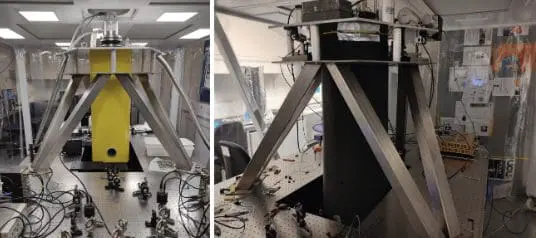
A team of researchers from the Institute for Gravitational Wave Astronomy and the School of Physics and Astronomy at the University of Birmingham have developed a high-finesse suspended interferometric sensor. This sensor is designed to investigate macroscopic quantum mechanics on a tabletop scale. The sensor consists of a pair of suspended optical cavities with finesse over 350,000, comprising 10 g fused silica mirrors. The interferometer is suspended by a four-stage light in-vacuum suspension with three common stages, which allows for the suppression of common mode motion at low frequency.
The seismic noise is further suppressed by an active isolation scheme, which reduces the input motion to the suspension point by up to an order of magnitude starting from 0.7Hz. In the current room-temperature operation, the researchers achieve a peak sensitivity of 0.5fm/Hz in the acoustic frequency band. This sensitivity is limited by a combination of readout noise and suspension thermal noise.
The team believes that additional improvements of the readout electronics and suspension parameters will enable them to reach the quantum radiation pressure noise. Such a sensor can eventually be utilized for demonstrating macroscopic entanglement and for testing semiclassical and quantum gravity models.
Why are Interferometric Devices Important?
Interferometric devices are excellent candidates for probing weak signals on the quantum scale. This is due to the impressive sensitivity achievable in such devices and their ability to form complex quantum systems. Interferometers see widespread use in the development of laser technologies, atom trapping, and extend beyond mere photons with atom interferometry used in novel tests of fundamental physics.
Laser interferometers make particularly impressive sensors of displacement due to the sharp intensity response induced by microscopic sub-wavelength displacements of the key optical components. When one of the mirrors in the interference path is attached to a moving body, its relative displacement can be measured with excellent precision.
One of the most prominent uses of laser interferometry is in the kilometer-scale facilities for detecting gravitational waves (GWs). The Advanced LIGO (aLIGO) and Advanced Virgo (AdV) gravitational wave observatories currently serve as the gold standard for precision displacement sensing, with aLIGO achieving a peak sensitivity of 2.10^-20m/Hz during the most recent completed observing run (O3).
What are the Limitations of Current Interferometric Devices?
For the displacement-sensing laser interferometer, the quantum nature of light imposes an undesirable limitation to the detector’s sensitivity. Through the formalism of Caves and Schumaker, we can analyze the nature of quantum noise in reference to the two so-called quadratures of the electromagnetic field: amplitude and phase, which form a conjugate pair.
The intrinsic and inescapable fluctuations in the two quadratures of light couple to the displacement measurement of the interferometer. In a simple Fabry-Perot interferometer, the phase quadrature fluctuations couple directly to the readout, resulting in the so-called quantum shot noise (QSN), whilst fluctuations in the amplitude quadrature induce a force on the cavity mirrors—the so-called quantum radiation pressure noise (QRPN).
The total quantum noise in a suspended simple Fabry-Perot cavity is minimized when κ=1, which gives rise to the concept of the standard quantum limit (SQL) as a bounding surface corresponding to the minimum noise level achievable in a given interferometer configuration. The SQL as a trade-off between the light acting as an imperfect probe (QSN) and the light disturbing the probed system leading to back action (QRPN) was first formulated in Ref.
How Can the New Sensor Improve Quantum Mechanics Research?
The newly developed interferometric sensor by the team at the University of Birmingham can be a game-changer in the field of quantum mechanics research. The sensor’s high sensitivity and ability to suppress seismic noise make it an excellent tool for investigating macroscopic quantum mechanics on a tabletop scale.
The sensor’s peak sensitivity of 0.5fm/Hz in the acoustic frequency band, although currently limited by readout noise and suspension thermal noise, can be improved with further enhancements in the readout electronics and suspension parameters. This could potentially enable the sensor to reach the quantum radiation pressure noise.
The sensor can eventually be utilized for demonstrating macroscopic entanglement and for testing semiclassical and quantum gravity models. This could provide valuable insights into the field of quantum mechanics and contribute to the development of new theories and models.
What are the Future Applications of the New Sensor?
The new interferometric sensor has a wide range of potential applications in the field of quantum mechanics and beyond. Its high sensitivity and ability to suppress seismic noise make it an excellent tool for probing weak signals on the quantum scale.
One of the most promising applications of the sensor is in the field of gravitational wave detection. The sensor’s high sensitivity and precision could potentially improve the detection capabilities of gravitational wave observatories, contributing to our understanding of the universe.
The sensor could also be used in the development of laser technologies and atom trapping, further expanding its potential applications. Moreover, the sensor could play a pivotal role in the development of particle physics and cosmology, contributing to the search for dark matter particles, the quantization of spacetime, and the study of entanglement.
Publication Date: 2024-04-08
Authors: J. Smetana, Tianliang Yan, Vincent Boyer et al.
Source: Sensors
DOI: https://doi.org/10.3390/s24072375