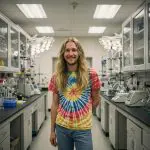

University of Arizona researchers Christos Gagatsos and Bane Vasic have received a total of $2 million in grants to advance quantum computing technologies. Gagatsos was awarded $1.4 million from the U.S. Army Research Office to explore quantum error correction for magnetic field sensing, while Vasic secured $600,000 from the National Science Foundation to develop QLDPC codes for stabilizing quantum computers.
Their work addresses challenges in reducing high error rates in quantum systems, which are sensitive to external factors like temperature and sound. Potential applications of their research span fields such as navigation, medical imaging, agriculture, drug development, and cybersecurity.
Researchers at the University of Arizona’s College of Engineering have been awarded $2 million in federal grants to propel advancements in quantum computing, a technology poised to revolutionize numerous sectors. Recognizing that the sensitivity of quantum systems to environmental disturbances currently limits their widespread adoption due to high error rates, the researchers are focusing on innovative error correction methods.
Assistant Professor Christos Gagatsos secured $1.4 million from the U.S. Army Research Office to explore quantum error correction in magnetic field sensing, which has the potential to transform magnetometry for applications in navigation, medical imaging, and geolocation. Professor Bane Vasic received $600,000 from the National Science Foundation to investigate Quantum Low-Density Parity-Check (QLDPC) codes. These codes aim to stabilize quantum computers by enabling the entanglement of distant qubits, offering a more efficient error correction method than current topological codes and paving the way for large-scale quantum computing.
The researchers emphasize that their work simultaneously advances fundamental quantum science and develops practical technologies that could solve complex problems currently beyond the reach of classical computers, potentially leading to a new era of computing and technological capabilities.
More information
External Link: Click Here For More