Researchers from the University of Alberta have explored the use of Floquet engineering in holonomic quantum computing. The team used ultracold 87Rb atoms to induce periodic driving of a family of Hamiltonians, leading to the holonomic evolution of degenerate spin states. The study found that while Floquet engineering eliminates the need for explicit degeneracies, it also inherits many of the same limitations present in degenerate systems. The team also discussed the implications of this protocol on the practicality and fault-tolerance of this method in the cold-atom context and for generic Floquet-driven platforms.
Investigation of Floquet Engineered NonAbelian Geometric Phase for Holonomic Quantum Computing
A team of researchers from the Department of Physics and Theoretical Physics Institute at the University of Alberta, including Logan W Cooke, Arina Tashchilina, Mason Protter, Joseph Lindon, Tian Ooi, Frank Marsiglio, Joseph Maciejko, and Lindsay J LeBlanc, have conducted an investigation into Floquet engineered nonAbelian geometric phase for holonomic quantum computing.
Holonomic Quantum Computing and Floquet Engineering
Holonomic quantum computing functions by transporting an adiabatically degenerate manifold of computational states around a closed loop in a control parameter space. This cyclic evolution results in a nonAbelian geometric phase, which may couple states within the manifold. Realizing the required degeneracy is challenging and typically requires auxiliary levels or intermediate level couplings. One potential way to circumvent this is through Floquet engineering, where the periodic driving of a nondegenerate Hamiltonian leads to degenerate Floquet bands and subsequently nonAbelian gauge structures may emerge.
Experiment with Ultracold 87Rb Atoms
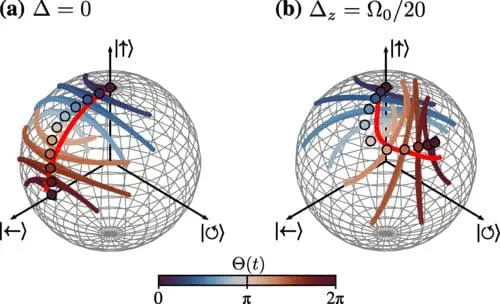
The team conducted an experiment with ultracold 87Rb atoms, where atomic spin states were dressed by modulated RF fields to induce periodic driving of a family of Hamiltonians linked through a fully tuneable parameter space. The adiabatic motion through this parameter space leads to the holonomic evolution of the degenerate spin states in SU2, characterized by a nonAbelian connection. The team studied the holonomic transformations of spin eigenstates in the presence of a background magnetic field, characterizing the fidelity of these single-qubit gate operations.
Results and Implications
Results indicate that while the Floquet engineering technique removes the need for explicit degeneracies, it inherits many of the same limitations present in degenerate systems. Measurements were made in the presence of drifting background magnetic fields, the impact of which would normally be negligible over the time scales of each gate. However, due to the dynamics introduced by the Floquet driving, this uncontrolled background has a substantial impact on the holonomy and its geometric nature. The team quantified this impact and discussed the implications it has on the practicality of this protocol and its fault-tolerance, both in the cold-atom context and more generally for generic Floquet-driven platforms.
Source: “Investigation of Floquet engineered non-Abelian geometric phase for holonomic quantum computing” by Logan Cooke, Arina Tashchilina, Mason Protter, Joseph Lindon, Tian Ooi, F. Marsiglio, Joseph Maciejko, Lindsay J. LeBlanc, published on January 16, 2024. DOI: 10.1103/physrevresearch.6.013057