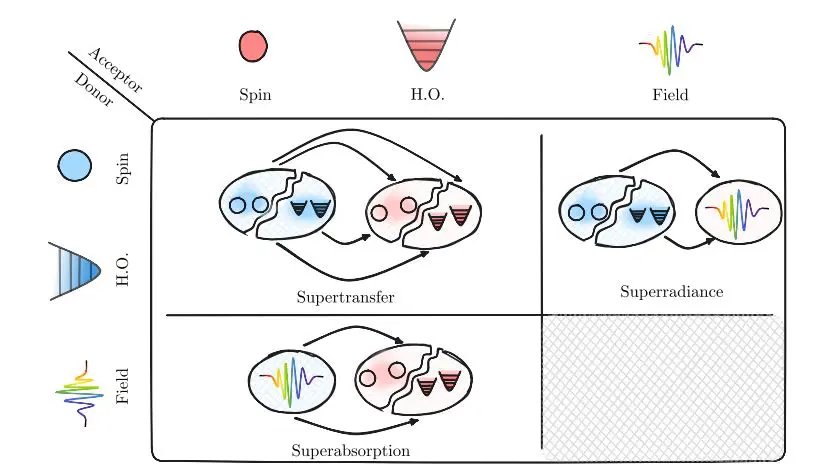
Collective effects, crucial to advancements in areas like energy storage and light harvesting, govern how materials absorb, emit, and transfer energy, yet these processes have traditionally been understood through separate frameworks. Adesh Kushwaha from the University of Sydney, Erik M. Gauger from Heriot-Watt University, and Ivan Kassal from the University of Sydney, alongside their colleagues, now present a unifying theory that elegantly describes all three types of collective behaviour, superradiance, subradiance, and energy transfer, within a single, consistent model. This work resolves longstanding discrepancies between different approaches, demonstrating how collective effects previously understood in the context of spins can be generalised to apply to a wider range of systems, including those involving harmonic oscillators. By establishing a common theoretical ground, the team reveals how to engineer robust collective effects that remain stable even in the presence of disorder and noise, promising more resilient technologies for the future.
Scientists have established a unified framework for understanding collective effects that enhance or suppress dynamic processes such as absorption, emission, and transfer, collectively termed CEEAT. This work resolves inconsistencies in how these effects have been defined across different research communities and extends the understanding of these phenomena to systems beyond traditional spin systems. The research demonstrates that CEEAT arises when excitations are suitably delocalised across donor and acceptor aggregates, or both, fundamentally altering the rate of transitions between them.
Foundations of Superradiance and Collective Emission
Research into superradiance and related phenomena has spanned decades, encompassing a wide range of investigations into light-matter interactions and energy transfer. Early experiments established the fundamental principles of superradiance, while subsequent studies explored its enhancement through techniques like cavity mediation. Researchers have also identified analogous effects in thermal emitters, demonstrating the broad applicability of the concept. Understanding collective emission from ensembles of emitters has been a central focus, with investigations into the role of dipole-dipole interactions and the formation of coherent states.
A significant area of investigation concerns energy transfer and light harvesting, particularly in systems mimicking natural photosynthesis. Maintaining coherence and delocalization is crucial for efficient energy transfer, and scientists have addressed the challenges posed by disorder in these systems. The concept of polaritons, hybrid light-matter excitations, has emerged as a key element in mediating long-range energy transfer and enhancing light-matter interactions. Researchers have also explored bridge-mediated transfer mechanisms and studied the electronic structure and dynamics of molecules involved in energy transfer.
Theoretical and computational approaches play a vital role in understanding these phenomena, with stochastic methods and quantum master equations used to model the dynamics of open quantum systems. Molecular dynamics and quantum chemistry provide insights into the electronic structure and dynamics of molecules involved in energy transfer. Materials and nanostructures are crucial for enhancing superradiance and energy transfer, with quantum dots, perovskites, nanowires, and diamond membranes being actively investigated as potential platforms. This comprehensive research reflects a vibrant and interdisciplinary field with applications in light harvesting and quantum technologies.
Collective Effects Govern Excitation Dynamics and Rates
Scientists have established a unified framework for understanding collective effects that enhance or suppress dynamic processes such as absorption, emission, and transfer. This work resolves inconsistencies in how these effects have been defined across different research communities and extends the understanding of these phenomena to systems beyond traditional spin systems. The research demonstrates that these collective effects arise when excitations are suitably delocalised across donor and acceptor aggregates, or both, fundamentally altering the rate of transitions between them. The team identified that collective effects modify the rate of transitions between a donor and an acceptor, detailing categories including superradiance, subradiance, superabsorption, and subtransfer.
Superradiance and supertransfer represent enhancements to emission and transfer rates, while subradiance and subabsorption demonstrate suppressed rates. Experiments have confirmed superradiance in gaseous systems, and more recent observations have validated superabsorption. Indications of subradiance were reported decades ago, with more direct evidence emerging recently. The study reveals that collective effects can be engineered to be robust against disorder and noise through careful control of interactions within aggregates. This robustness is crucial for developing resilient quantum devices and technologies. Researchers have shown that these effects occur when excitations are delocalised on donor aggregates, acceptor aggregates, or both, and that the scaling of rate enhancements can vary. This work provides a common framework for understanding and predicting these effects across diverse physical systems and paves the way for new applications in areas such as light harvesting, ultra-narrow lasers, and quantum batteries.
Unified Theory of Collective Radiative Effects
This research establishes a unified framework for understanding collective effects, superradiance and subradiance, which are crucial to advancements in areas like energy storage and light harvesting. Scientists have successfully described these effects, previously defined differently across various scientific communities, using a common theoretical approach based on Dicke states. This allows for generalization of known collective effects, extending them beyond traditional spin systems to encompass aggregates of harmonic oscillators and other physical systems. The team demonstrated how the rate of dynamic processes, such as absorption, emission, and transfer, are affected by collective behaviour, revealing scaling laws dependent on the number of interacting units.
They showed that the emission rate can vary significantly, ranging from suppression to enhancement, depending on the initial state of the system and the specific collective mode involved. Importantly, the research explains how to engineer collective effects that are robust against disorder and noise, a critical step towards creating more reliable and resilient devices. The authors acknowledge that the observed scaling laws are dependent on the specific system under consideration and that the behaviour can change depending on the initial conditions. While the framework provides a powerful tool for understanding and predicting collective effects, further research is needed to explore the full range of possibilities and to optimise these effects for specific applications.
🗞 Unifying Collective Effects in Emission, Absorption, and Transfer
🧠 ArXiv: https://arxiv.org/abs/2511.22335