Boson sampling represents a promising route towards demonstrating quantum advantage, and recent advances have already shown its potential in fields ranging from simulation to machine learning. Luca Bianchi from the University of Florence, Carlo Marconi from the Istituto Nazionale di Ottica del Consiglio Nazionale delle Ricerche, and Laura Ares from Paderborn University, along with their colleagues, now present a unified approach that merges distinct forms of boson sampling into a single protocol. This new method combines the strengths of discrete and continuous variable techniques, allowing researchers to utilise more complex states of light, such as squeezed photons, within advanced sampling procedures. The team develops analytical tools to describe how multiple photons and light modes interact, enabling exploration of different photonic platforms and demonstrating the generation of strong quantum correlations through nonlinear interactions, ultimately paving the way for more powerful and versatile quantum sampling devices.
Alternative Platforms for Boson Sampling
Boson sampling is a promising approach to demonstrating quantum advantage, a computational speedup over classical computers for specific tasks. This method utilizes the unique properties of bosons, particles that follow Bose-Einstein statistics, to perform calculations beyond the reach of conventional machines. Current experiments rely on generating and detecting single photons, but these systems encounter challenges with photon loss and imperfect detection, limiting their size and reliability. These limitations motivate researchers to explore alternative physical platforms, seeking systems with improved coherence, lower loss, and more efficient detection.
Recent theoretical work proposes unified boson sampling, which expands the standard model to include both creation and annihilation operators acting on the input quantum state. This generalization allows for the simulation of a wider range of quantum circuits and potentially increases the complexity of the resulting probability distributions. The theoretical framework predicts that unified boson sampling maintains the computational difficulty of standard boson sampling, meaning it remains challenging for classical computers to simulate efficiently. Consequently, unified boson sampling offers a promising route towards achieving a more robust and scalable demonstration of quantum advantage. This research investigates the feasibility and potential benefits of implementing unified boson sampling using integrated photonic circuits, which provide a compact and stable platform for manipulating single photons, potentially overcoming many of the limitations faced by free-space experiments. The team aims to design and fabricate a photonic chip capable of generating the complex quantum states required for unified boson sampling, and to demonstrate the generation of probability distributions characteristic of quantum computation, ultimately establishing a pathway towards a practical and scalable quantum advantage demonstration.
Gaussian Boson Sampling Theoretical Analysis
This document presents a detailed theoretical analysis of Gaussian boson sampling (GBS), a promising approach to quantum computation using squeezed states of light and linear optics. GBS is considered a potential path to demonstrating quantum advantage, solving problems intractable for classical computers. The work delves deeply into the mathematical and physical foundations of GBS, employing sophisticated tools from Lie algebra theory, symplectic geometry, and generating functions to describe the symmetries and transformations of quantum states and operators, providing a rigorous foundation for the analysis. The research explores techniques for optimizing the resources used in GBS, such as squeezing levels, and validating the results obtained.
It also addresses the challenges of imperfections in real-world GBS experiments, focusing on error mitigation and detection. Furthermore, the document investigates the connection between GBS and classical algorithms for computing related quantities, like the hafnian. By comparing the complexity of GBS to classical algorithms, the research provides insights into the potential for quantum advantage.
Unified Boson Sampling, Entanglement and Scalability
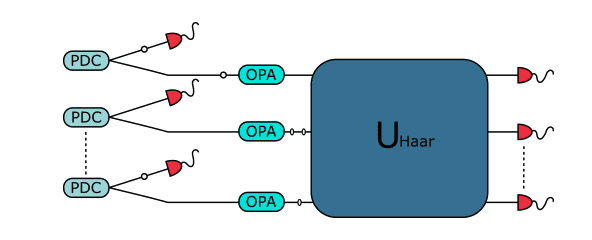
This research presents a unified model of boson sampling, termed unified boson sampling (UBS), which integrates both Gaussian and scattershot approaches into a single framework. By developing a generating function formalism and leveraging the theory of symplectic groups, the team has created analytical tools to precisely characterise this new sampler and compute key quantum properties. Numerical simulations demonstrate the distinctiveness of UBS, assessing its complexity and scalability with varying numbers of modes, photons, and squeezing intensities. The study further quantifies the entanglement generated within the UBS apparatus using logarithmic negativity, highlighting the contributions of both photon numbers and squeezing parameters. Importantly, the authors propose a feasible experimental setup utilising currently available technology to realise this protocol. While the research acknowledges limitations in the computational time required for simulations as the system scales, it offers a significant advancement in boson sampling by providing a more versatile and analytically tractable model, paving the way for exploring interfaces between different photonic processing platforms and potentially enhancing quantum computational capabilities.
👉 More information
🗞 Unified boson sampling
🧠 ArXiv: https://arxiv.org/abs/2509.02058