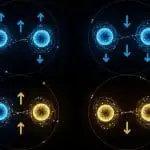
A team of researchers, including Gabriel T Landi, Michael J Kewming, Mark T Mitchison, and Patrick P Potts, have developed a unified toolkit to describe current fluctuations in open quantum systems. These fluctuations, characterized by a stochastic and correlated output current, provide crucial information about the quantum system. The toolkit brings together different fields in physics and offers various analytical and numerical tools for computing quantities of interest. The research connects with various topical fields, including waiting-time statistics, quantum metrology, and thermodynamic uncertainty relations, and is expected to open new avenues for further exploration in this field.
What is the Significance of Current Fluctuations in Open Quantum Systems?
The study of current fluctuations in open quantum systems is a critical area of research in the field of quantum physics. These fluctuations are characterized by an output current that takes the form of a stochastic and correlated time series. This output current provides crucial information about the underlying quantum system. The tools used to describe these current fluctuations are scattered across different communities. Quantum opticians often use stochastic master equations, while a prevalent approach in condensed-matter physics is provided by full counting statistics. However, these are simply different sides of the same coin.
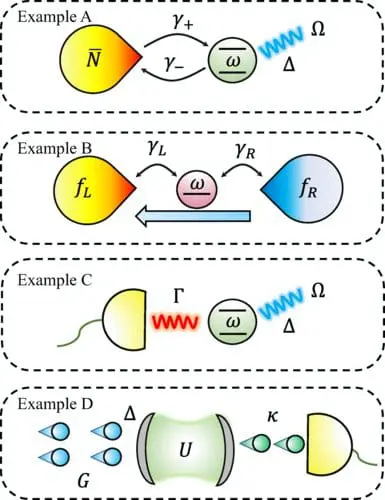
The goal of the research conducted by Gabriel T Landi, Michael J Kewming, Mark T Mitchison, and Patrick P Potts was to provide a unified toolkit for describing current fluctuations. This not only provides novel insights by bringing together different fields in physics but also yields various analytical and numerical tools for computing quantities of interest. The researchers illustrated their results with various pedagogical examples and connected them with topical fields of research such as waiting-time statistics, quantum metrology, thermodynamic uncertainty relations, quantum point contacts, and Maxwell’s demons.
How are Quantum Systems Measured Continuously?
Continuously measured quantum systems are characterized by an output current in the form of a stochastic and correlated time series. This output current conveys crucial information about the underlying quantum system. The researchers used various tools to describe these current fluctuations, including stochastic master equations and full counting statistics. These tools, while used by different communities within the field of physics, are essentially different sides of the same coin.
The researchers’ goal was to provide a unified toolkit for describing these current fluctuations. This toolkit not only provides novel insights by bringing together different fields in physics but also offers various analytical and numerical tools for computing quantities of interest. The researchers illustrated their results with various pedagogical examples, connecting them with topical fields of research.
What are the Tools Used to Describe Current Fluctuations?
The tools used to describe current fluctuations in open quantum systems are scattered across different communities. Quantum opticians often use stochastic master equations, while a prevalent approach in condensed-matter physics is provided by full counting statistics. However, these are simply different sides of the same coin.
The researchers aimed to provide a unified toolkit for describing these current fluctuations. This toolkit not only provides novel insights by bringing together different fields in physics but also yields various analytical and numerical tools for computing quantities of interest. The researchers illustrated their results with various pedagogical examples, connecting them with topical fields of research.
How Does This Research Connect with Other Fields of Study?
The research conducted by Gabriel T Landi, Michael J Kewming, Mark T Mitchison, and Patrick P Potts connects with various topical fields of research. These include waiting-time statistics, quantum metrology, thermodynamic uncertainty relations, quantum point contacts, and Maxwell’s demons.
The researchers illustrated their results with various pedagogical examples, connecting them with these topical fields of research. This not only provides novel insights by bringing together different fields in physics but also yields various analytical and numerical tools for computing quantities of interest.
What is the Future of Research in Current Fluctuations in Open Quantum Systems?
The research conducted by Gabriel T Landi, Michael J Kewming, Mark T Mitchison, and Patrick P Potts provides a unified toolkit for describing current fluctuations in open quantum systems. This toolkit not only provides novel insights by bringing together different fields in physics but also yields various analytical and numerical tools for computing quantities of interest.
The researchers illustrated their results with various pedagogical examples, connecting them with topical fields of research. This research opens up new avenues for further exploration and understanding of current fluctuations in open quantum systems. The unified toolkit provided by the researchers will be instrumental in future research in this field.
Publication Date: 2024-04-02
Authors: Gabriel T. Landi, Michael J. Kewming, Mark T. Mitchison, Patrick P. Potts, et al.
Source: PRX Quantum 5, 020201
DOI: https://doi.org/10.1103/PRXQuantum.5.020201