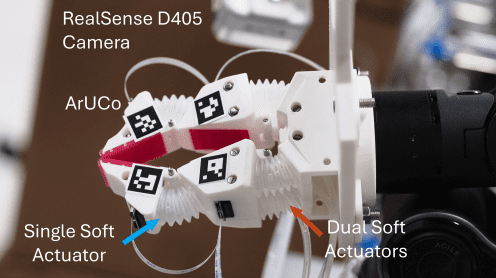
On April 18, 2025, researchers presented a comprehensive analysis of manipulability and compliance in modular soft-rigid hybrid fingers, introducing a unified framework applicable to both hydraulic and pneumatic systems. This study validates its approach using DexCo and Edgy-2 hands, revealing key trade-offs in dexterity and stiffness.
The paper introduces a unified framework to analyze manipulability and compliance in modular soft-rigid hybrid fingers for hydraulic and pneumatic actuation systems. Using Jacobian-based formulations, it maps actuator inputs to joint and task-space responses, modeling hydraulic actuators under incompressible assumptions and pneumatic ones with nonlinear pressure-volume relations.
The framework evaluates manipulability ellipsoids and compliance matrices across actuation modes, validated using DexCo (hydraulic) and Edgy-2 (pneumatic) hands. Results reveal actuation-dependent trade-offs in dexterity and passive stiffness, offering insights for structure-aware design and actuator selection in soft-rigid fingers.
A Unified Framework for Analyzing Soft-Rigid Hybrid Robotic Fingers
Robotic manipulation has long been a cornerstone of advancements in robotics, with applications ranging from industrial automation to medical surgery. However, achieving dexterity and adaptability comparable to human hands remains a significant challenge. Recent research has focused on modular soft-rigid hybrid robotic fingers that combine the flexibility of soft materials with the precision of rigid components. This paper introduces a novel framework for analyzing the manipulability and compliance of such hybrid fingers, particularly those actuated by hydraulic and pneumatic systems.
This research provides a generalized mathematical approach to
This research provides a generalized mathematical approach to modelling the relationship between actuator forces and task-space performance. It offers a systematic way to evaluate and optimize robotic finger designs. The findings have implications for improving the adaptability and reliability of robotic manipulation in real-world applications.
This innovation’s heart is a Jacobian-based formulation that maps actuator forces to task-space performance. This mathematical tool enables researchers to analyze how different actuation modalities—hydraulic versus pneumatic—affect the dexterity and compliance of robotic fingers. The framework accounts for both directional dexterity, which refers to the ability of a robotic finger to manipulate objects in various orientations, and passive compliance, which measures its adaptability to external forces. This approach bridges a critical gap in current research by providing a consistent evaluation method across different actuation types.
Experiments were conducted on two prototype fingers: the DexCo hand and the Edgy-2 finger to validate the framework. These tests demonstrated the framework’s ability to predict task-space performance accurately, highlighting key trade-offs between actuation modality, structural configuration, and control sensitivity. For instance, hydraulic actuation was found to offer greater precision but at the cost of slower response times, while pneumatic systems provided faster actuation with reduced force control. These insights underscore the importance of selecting the right actuation type based on specific application requirements.
The findings from this research have significant implications
The findings from this research have significant implications for the design and optimization of modular robotic systems. By enabling engineers to predict how different configurations will perform in real-world scenarios, the framework facilitates more informed decision-making during the design process. Moreover, the ability to evaluate passive compliance offers new opportunities for improving the adaptability of robotic fingers in dynamic environments.
While this research represents an important advancement, future work is needed to further refine the framework and explore its applications in more complex systems. The development of such tools will continue to play a critical role in advancing the field of robotic manipulation and enabling new possibilities for human-robot collaboration.
🗞 Unified Manipulability and Compliance Analysis of Modular Soft-Rigid Hybrid Fingers
🧠 DOI: https://doi.org/10.48550/arXiv.2504.13800