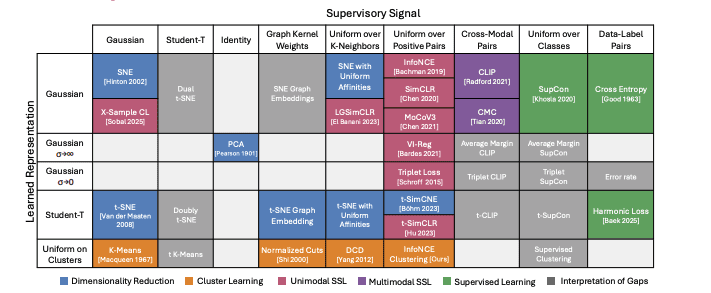
On April 23, 2025, researchers Shaden Alshammari, John Hershey, Axel Feldmann, William T. Freeman, and Mark Hamilton published I-Con: A Unifying Framework for Representation Learning, introducing a novel information-theoretic approach that connects over 23 diverse methods in machine learning. Their framework reveals a hidden geometric structure underlying techniques such as clustering, dimensionality reduction, and contrastive learning, enabling the creation of state-of-the-art unsupervised image classifiers with an impressive +8% improvement on ImageNet-1K.
The research introduces an information-theoretic framework unifying over 23 machine learning methods across clustering, spectral techniques, dimensionality reduction, contrastive, and supervised learning by minimizing integrated KL divergence between supervisory and representation distributions. This framework enables the creation of novel loss functions and state-of-the-art unsupervised image classifiers achieving +8% improvement on ImageNet-1K. Additionally, it provides principled debiasing methods for contrastive representation learners.
Researchers constantly explore new methods to improve model performance and adaptability in the rapidly evolving field of machine learning. Among recent advancements is I-Con, a novel framework that unifies various approaches to representation learning, effectively bridging the gap between supervised and unsupervised techniques.I-Con operates by aligning conditional distributions for each data point, aiming to minimize the divergence between these distributions across all points. This approach ensures that the model’s predictions closely match target distributions. Unlike traditional Maximum Likelihood Estimation (MLE), which focuses on a single divergence measure, I-Con averages this divergence over all data points, making it versatile for both labeled and unlabeled data.
One significant advantage of I-Con is its reduced reliance on hyperparameters such as entropy penalties or exponential moving average (EMA) stabilization. This self-balancing loss function allows the model to adjust its certainty levels autonomously, simplifying the tuning process and enhancing adaptability.
I-Con’s flexibility is evident in its ability to transform clustering methods by altering the supervisory signal. For example, changing the supervisory signal from Gaussian distances to graph adjacencies can shift K-Means into Spectral Clustering, demonstrating how different choices of the supervisory signal yield varied clustering techniques with distinct strengths.
I-Con offers a unified framework that simplifies the design of supervisory signals for tasks like unsupervised image classification. Its adaptability across data types, from images to text, suggests broad applicability. Additionally, the potential for adaptive covariances in Gaussian kernels could lead to more nuanced models, though this may introduce complexity.
In conclusion, I-Con represents a promising step toward creating flexible and efficient machine learning models. By offering a unified approach that enhances representation learning without being encumbered by excessive hyperparameters, I-Con has the potential to impact the field of machine learning significantly.
👉 More information
🗞 I-Con: A Unifying Framework for Representation Learning
🧠 DOI: https://doi.org/10.48550/arXiv.2504.16929