The behaviour of materials near a ferroelectric transition remains a significant challenge in condensed matter physics, and researchers continually seek to understand the underlying mechanisms driving these transitions. I. Khayr, N. Somun, S. Hameed, and colleagues from the University of Minnesota, along with Z. Van Fossan, X. He, and R. Spieker, investigate this phenomenon in the widely studied materials potassium tantalate (KTaO) and strontium titanate (SrTiO). Their work combines advanced experimental techniques with theoretical modelling to reveal how applying strain influences the vibrational modes within these materials, providing new insights into the nature of the ferroelectric transition. The team demonstrates a clear violation of established relationships between vibrational energies and material properties, suggesting the presence of complex interactions, and identifies a surprisingly low stress level required to induce a transition in strontium titanate, resolving long-standing questions and offering valuable knowledge applicable to a broad range of materials exhibiting similar behaviour.
Stress, Strain, and Ferroelectric Material Properties
This supplementary materials document provides comprehensive supporting evidence for research investigating the effects of stress and strain on the structural and ferroelectric properties of potassium tantalate (KTO) and strontium titanate (STO). It extends beyond simple data presentation, offering detailed descriptions of experimental techniques like Raman spectroscopy and neutron scattering, rigorous calibration of stress/strain measurements, and theoretical calculations. The document proactively addresses potential concerns and validates methods, ensuring a thorough understanding of the findings. Researchers employed Raman spectroscopy, neutron scattering, and X-ray diffraction to meticulously study the materials under stress, carefully calibrating stress/strain measurements using multiple techniques to ensure accuracy. Theoretical calculations complement the experimental results, providing insights into the underlying mechanisms driving the observed behavior and presenting a comprehensive dataset for full evaluation of the findings.
Stress-Induced Ferroelectric Transitions in Titanates
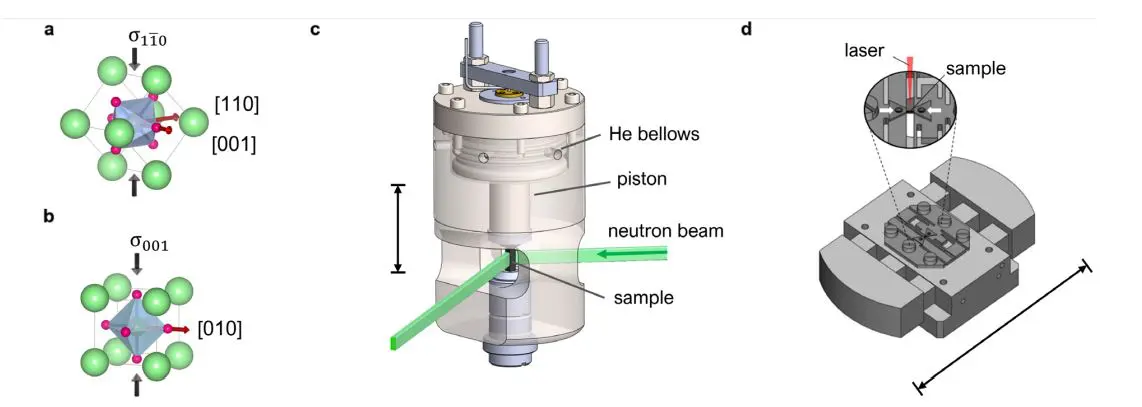
This work investigates the behavior of strontium titanate (STO) and potassium tantalate (KTO) as they approach a ferroelectric transition, employing a combination of inelastic neutron scattering, Raman spectroscopy, and theoretical calculations. Researchers applied compressive stress along specific crystallographic directions of single crystals of STO and KTO, utilizing high-force pneumatic strain cells for neutron scattering and piezoelectric devices for Raman measurements, and distinguished between insulating KTO and STO, and metallic, oxygen-vacancy-doped STO. Neutron scattering data revealed that phonon properties in KTO remain largely unchanged as the polar transition is approached, with the soft TO phonon mode exhibiting a slight hardening under stress. In contrast, undoped STO undergoes a cubic-to-tetragonal transition near 100 K, splitting the soft TO phonon into two modes.
High-resolution measurements were necessary to resolve these modes, and analysis did not reveal significant changes with applied stress. Metallic STO samples, however, showed initial softening of the polar phonons with strain, reversing before reaching zero energy, coinciding with the onset of Raman activity. The lifetime of the soft phonon remained constant throughout the stress range in both materials, challenging conventional understanding of ferroelectric transitions and highlighting the role of long-range interactions and anharmonicity.
First-Order Transitions in Strontium and Potassium Tantalates
This research delivers a comprehensive understanding of the structural phase transitions in strontium titanate (STO) and potassium tantalate (KTO), resolving long-standing questions about their behavior near ferroelectric transitions. Scientists employed inelastic neutron scattering, Raman spectroscopy, and theoretical calculations to study how soft polar phonons evolve under applied stress. Results demonstrate that both KTO and STO undergo first-order phase transitions, evidenced by the fact that these crucial phonon modes remain at nonzero energy, even as the materials transition between phases. Neutron scattering data reveal that phonon properties in KTO do not substantially change as the polar transition is approached, aligning with previous dielectric measurements.
Importantly, phonon energies remain nonzero across the transition, indicating the significant role of long-range lattice interactions and anharmonicity. In contrast, undoped STO exhibits a cubic-to-tetragonal transition near 100 K, splitting the soft phonon into two modes that remain largely independent of applied stress. However, in metallic, oxygen-vacancy-doped STO, a first-order transition occurs at a remarkably low stress level, with initial softening observed before an upturn, coinciding with the emergence of long-range polar order. Comparisons between experimental data and theoretical calculations reveal discrepancies, suggesting that current models do not fully capture the influence of long-range interactions.
Abrupt Transition, Persistent Polar Phonons Observed
This research successfully investigates the nature of the structural phase transition in strontium titanate and potassium tantalate, materials closely related to ferroelectricity. By combining inelastic neutron scattering, Raman spectroscopy, and theoretical calculations, scientists determined that the transition is first-order, meaning it occurs abruptly rather than gradually. Crucially, the team observed that the soft polar phonons, vibrations within the material linked to the transition, remain underdamped and retain energy even during the phase change, further supporting this finding. The study also reveals a significant discrepancy between experimental results and established theoretical predictions. Specifically, the observed phonon energies strongly violate the Lyddane-Sachs-Teller relation, a well-known connection between phonon frequencies and dielectric properties. This violation suggests the presence of slow, long-range fluctuations within the materials that are not captured by current calculations, providing substantial insight into these model systems and paving the way for further exploration of complex ferroelectric systems and refining theoretical models to account for the observed long-range fluctuations.
🗞 Uniaxial strain tuning of polar lattice vibrations in KTaO and SrTiO
🧠 ArXiv: https://arxiv.org/abs/2511.10623