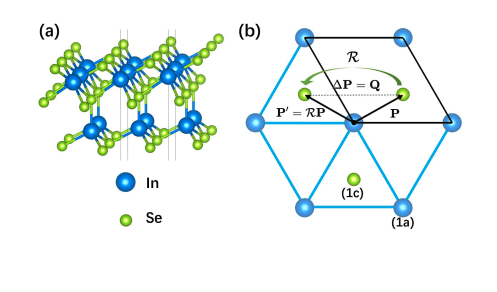
In their April 16, 2025, article titled Generalized Neumann’s Principle as a Unified Framework for Fractional Quantum and Conventional Ferroelectricity, researchers Hongsheng Pang and Lixin He present a novel theoretical framework that extends Neumann’s principle to unify fractional quantum ferroelectricity with conventional ferroelectricity. Their work offers a systematic method for identifying such phenomena across crystallographic groups, providing deeper insights into the control of polarization in materials.
Monolayer InSe exhibits in-plane polarization despite symmetry constraints, traditionally considered forbidden. Ji et al. proposed fractional ferroelectricity (FQFE), suggesting it violates Neumann’s principle. The authors introduced a generalized Neumann’s principle, unifying FQFE and conventional ferroelectricity under one framework. They developed a systematic method to identify all symmetry-allowed FQFE cases across 32 crystallographic point groups. Additionally, they demonstrated that FQFE can be switched via coupling with conventional polarization, using HfZnN as an example to reveal the underlying mechanism and propose strategies for identifying similar materials.
Quantum materials are a novel class of substances whose unique properties arise from quantum mechanical effects. These materials are at the heart of contemporary scientific exploration, with the potential to transform electronics, energy storage, and computing. Recent investigations have uncovered phenomena such as high-temperature superconductivity and topological insulators, which could lead to significant technological advancements.
Scientists are leveraging advanced computational techniques to study quantum materials. Numerical atomic orbital methods enable researchers to simulate the electronic structures of these materials with remarkable precision. This approach not only identifies new properties but also accelerates the discovery process by reducing reliance on physical experimentation.
Recent research has identified quantum materials with exceptional electronic behaviors. For example, certain compounds exhibit giant Rashba-type spin splitting, a property that could improve spintronic devices, leading to more efficient data storage and processing. Additionally, advancements in understanding ferroelectricity in thin films are opening avenues for next-generation memory technologies.
The implications of this research are far-reaching. By harnessing the unique properties of quantum materials, scientists aim to develop technologies that are faster, more energy-efficient, and capable of performing tasks currently beyond our capabilities. As research progresses, these innovations could redefine industries and drive technological progress in unprecedented ways.
In conclusion, the study of quantum materials is unlocking new possibilities for technology. With ongoing advancements in computational methods and material discovery, the future holds promising developments that could transform sectors ranging from electronics to energy storage. This field remains a critical area of focus as we address the challenges of an increasingly technological world.
👉 More information
🗞 Generalized Neumann’s Principle as a Unified Framework for Fractional Quantum and Conventional Ferroelectricity
🧠 DOI: https://doi.org/10.48550/arXiv.2504.12555