Understanding material loss represents a crucial challenge in improving the performance of superconducting quantum circuits, and a team led by Guy Moshel from the Technion, Israel Institute of Technology, and Sergei Masis from Karlsruher Institut für Technologie now presents a new approach to characterise these losses. The researchers developed a framework for accurately measuring loss mechanisms using internal quality factor measurements of tantalum superconducting resonators, working across a range of temperatures and readout powers.
This method provides a valuable tool for optimising the fabrication process of superconducting circuits, and the team’s analytical model captures loss behaviour without relying on complex simulations, allowing for easier interpretation and calibration. Importantly, their measurements reveal previously unobserved frequency-dependent trends, suggesting that current understanding of loss mechanisms in these systems may need refinement.
Loss Mechanisms in Superconducting Qubits
Advancements in quantum computing depend on superconducting circuits, which offer a promising platform for building powerful quantum processors. However, maintaining the delicate quantum states of qubits is challenging, as these states are easily disrupted by energy loss within the circuits. Researchers are focused on pinpointing and minimizing these loss mechanisms to improve qubit performance and unlock the full potential of quantum technology. Currently, identifying the precise sources of loss in superconducting materials is complex. Observed loss levels are often significantly higher than expected from basic material properties and external factors, suggesting subtle defects, interfaces, and contaminants create unintended pathways for energy dissipation.
Tantalum, a material increasingly favored for superconducting qubits, still requires a deeper understanding of its loss characteristics to further optimize its performance. This research introduces a new analytical model to accurately characterize loss in tantalum-based superconducting resonators. By meticulously measuring the internal quality factor of these resonators across a wide range of temperatures and microwave power levels, the team has developed a framework for isolating and quantifying different loss contributions. This allows researchers to move beyond empirical estimations and gain a fundamental understanding of how loss occurs within the material.
The team fabricated a series of tantalum resonators on sapphire wafers, carefully controlling the fabrication process and characterizing the resulting structures. Through precise measurements and model fitting, they observed frequency-dependent trends in key parameters related to loss. These findings suggest that the standard understanding of loss mechanisms, particularly those involving two-level systems, defects within the material that can absorb and re-emit energy, may be incomplete, opening new avenues for material optimization and the development of more robust quantum circuits.
Ta Resonators Reveal Loss Mechanisms and Calibration
The team applies a methodology to a series of α-Ta resonators spanning a wide frequency range, providing a means to probe loss mechanisms during the fabrication of this emerging material for superconducting quantum circuits. An analytical model captures the observed loss behaviour without relying on complex numerical simulations, enabling straightforward interpretation and calibration of the results. This approach facilitates a deeper understanding of material properties and their impact on quantum circuit performance.
Tantalum Loss Mechanisms and Two-Level Systems
Results have been reproduced across diverse fabrication methods and substrates, underscoring the potential of tantalum as an important material for quantum hardware. However, the sources of loss in high-quality-factor tantalum devices remain poorly understood and present a major obstacle to further improvement. A detailed and accurate model for the loss mechanisms in tantalum is necessary. This work systematically investigates the contributions of two-level systems and other loss mechanisms in tantalum superconducting resonators. By varying the readout power and temperature, precise characterization of subtle differences between the loss mechanisms in the resonators was achieved.
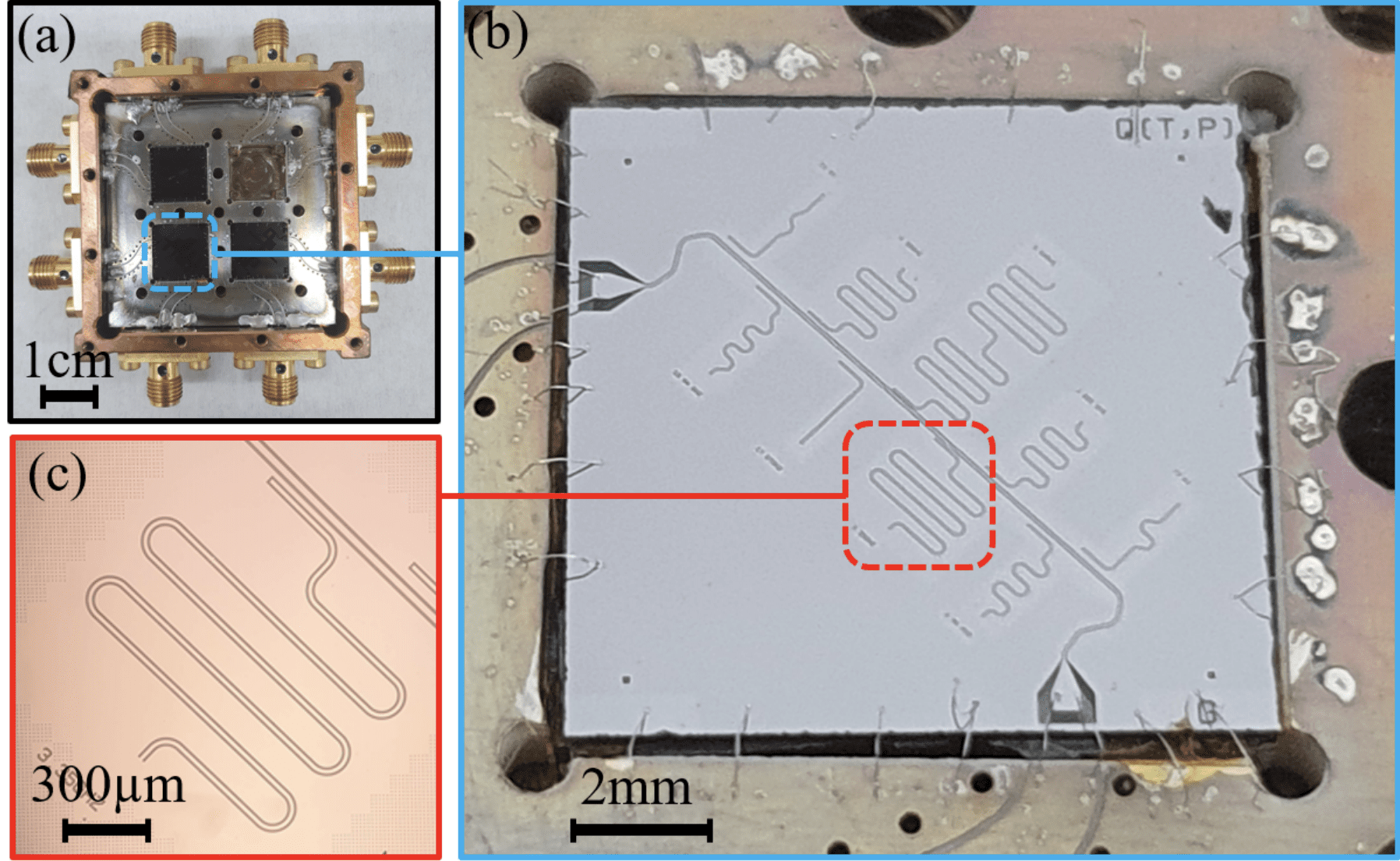
This work expands on previous research, incorporating the spatial variation of the electric field in the resonators, improving the fit quality without adding parameters. Measurements across a wide frequency range allowed observation of frequency trends in the model parameters and shed light on the underlying physics of the two-level system loss, specifically the frequency dependence of the density of states. A 2-inch, 420μm thick sapphire wafer was sputtered with a 170nm thick α-Ta layer, cleaned by sequential sonication, coated with photo-resist, exposed with a laser writer, and developed. A hard bake was performed, and the tantalum was wet-etched.
The smoothness of the resulting tantalum structures was examined using a scanning electron microscope. The wafer was diced into chips and mounted on a copper box, secured using thermally conductive varnish. A silver-coated printed circuit board was electrically and thermally anchored to the copper box using indium solder. The chip was connected to the board using aluminum wire bonds. Finally, the box was sealed and mounted inside a dilution cryostat, with care taken to ensure good thermal anchoring and repel stray magnetic fields.
Patterned transmission line resonators were coupled to a common feedline. The complex transmission signal was measured to find the lineshapes of the base mode of each resonator. By fitting each lineshape, the resonance frequency and the internal and external Q-factors were extracted using a network analyzer. For the temperature scans, the system was allowed to thermalize at each temperature point before performing the power scans. The microwave power inside the feedline was calculated from the known input power.
The average stored energy in the resonators was converted to voltage for use in the model. The electric field distribution in the transmission line resonators was calculated, describing the voltage and current profiles. The average stored energy in the resonator per cycle was calculated, and the loaded quality factor was separated into different loss channels.
Tantalum Resonator Loss Characterization and Turnover Temperature
This research presents a new framework for accurately characterizing loss in superconducting circuits, specifically focusing on two-level systems. The team developed an analytical model, applicable across a range of temperatures and readout powers, to understand how these losses occur in tantalum resonators. By measuring the internal quality factor of these resonators, they successfully distinguished between different loss channels and identified a turnover temperature, around 700mK for tantalum, where two-level system loss becomes dominant over quasiparticle loss. This finding is comparable to previous measurements in aluminum and advances understanding of loss mechanisms in superconducting materials.
The model effectively captures the observed behaviour of the resonators across a wide range of conditions, demonstrating its physical validity with a limited number of parameters. Measurements at extremely low readout powers and higher temperatures revealed some deviations from the model’s predictions, suggesting that the assumption of a continuous spectrum of two-level systems may not be entirely accurate; the discreteness of these systems could be a contributing factor. Further investigation is needed to fully account for these discrepancies and refine the model, potentially by incorporating the discrete nature of two-level systems. Future work could also explore these loss mechanisms in other materials to broaden the applicability of this framework and improve the performance of superconducting quantum circuits.
👉 More information
🗞 Material Loss Model Calibration for Tantalum Superconducting Resonators
🧠 DOI: https://doi.org/10.48550/arXiv.2507.12141