

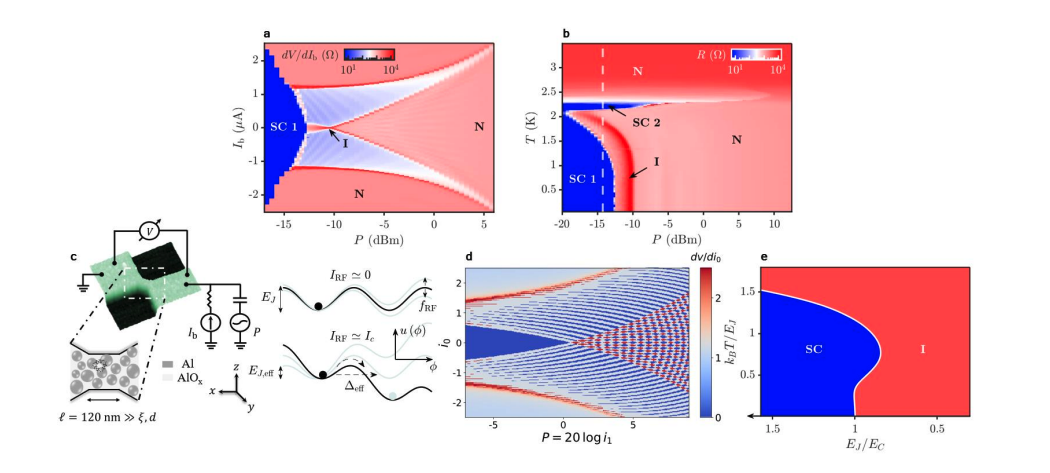
Superconductivity, the ability of materials to conduct electricity with zero resistance, typically weakens with increasing temperature or magnetic field, but can surprisingly reappear under certain conditions, a phenomenon known as reentrant superconductivity. S. Avraham, S. Sankar, and S. Sandik, along with colleagues at their respective institutions, now demonstrate this reentrant behaviour in a naturally occurring array of Josephson junctions formed within granular aluminum. The team reveals that radio frequency (RF) power acts as a crucial control, allowing them to tune the material between a superconducting state and an insulating state, and even to observe the emergence of superconductivity at higher temperatures. This ability to manipulate the material’s properties, and to simulate complex interactions within a relatively simple system, offers a new platform for understanding fundamental principles in condensed matter physics and exploring the behaviour of strongly correlated materials.
Superconductivity, characterised by dissipationless current flow and the expulsion of magnetic fields, typically weakens at higher temperatures or in strong magnetic fields. However, reentrant superconductivity, the reappearance of this state at elevated temperatures, challenges this expectation. This phenomenon usually arises in materials with complex electronic interactions, and understanding its origins remains a significant challenge in condensed matter physics. Researchers investigate reentrant superconductivity and the transition between superconducting and insulating states within naturally occurring arrays of Josephson junctions, structures that provide a unique environment for studying these effects. By carefully tuning these arrays with radio frequency (RF) power, the team aims to explore how superconductivity, insulating behaviour, and applied electromagnetic radiation interact.
Giant Shapiro Steps and SIT Analysis
This document provides detailed supplemental information and analysis supporting the main research findings. It delves into the experimental setup, data analysis, and interpretation of results related to the observation of giant Shapiro steps, reentrant superconductivity, and the superconductor-insulator transition (SIT) in a naturally occurring Josephson junction array. The authors meticulously address potential issues like overheating, material imperfections, and measurement limitations, providing evidence to support their conclusions. The observed giant Shapiro steps, which indicate coherent quantum behaviour, exhibit a finite width.
Detailed analysis of voltage and current measurements reveals slight deviations from ideal steps, attributed to variations in junction properties within the array. The authors demonstrate negligible overheating at low RF frequencies, ensuring observed phenomena aren’t caused by temperature increases, but overheating becomes relevant at higher frequencies. They conclude that the observed SIT and reentrant superconductivity can be interpreted in a regime where overheating is minimal. The team estimated the material’s resistance in the normal state by forcing it into a non-superconducting state at high currents.
They found that the resistance in the insulating state increases exponentially at low temperatures, then plateaus, likely due to limitations in the measurement equipment. They also examined how the insulating state’s resistance changes with RF frequency, observing a lower saturation temperature at lower frequencies due to increased power dissipation and electron heating. The document includes a schematic of the measurement setup and references key theoretical papers related to Josephson junctions, superconductivity, and the SIT. The authors provide strong evidence that their observations of giant Shapiro steps and the SIT aren’t artifacts of overheating or measurement limitations. They acknowledge the role of imperfections in the junction properties but suggest they aren’t the primary driver of the observed phenomena. This supplemental information strengthens the conclusions of the main research paper by providing detailed data analysis and addressing potential concerns.
Radio Frequency Control Reveals Reentrant Superconductivity
Researchers have demonstrated reentrant superconductivity, the reappearance of superconductivity at elevated temperatures, in a granular aluminum material, a system naturally behaving as an array of Josephson junctions. This breakthrough utilizes radio frequency (RF) power to precisely tune the material’s superconducting properties, transitioning it between superconducting, insulating, and normal states. Experiments reveal a remarkable ability to control the material’s behaviour, achieving a ten-fold increase in resistance when transitioning to a strong insulating state, a value significantly higher than previously reported in similar systems. The team observed a clear superconductor-to-insulator transition as a function of applied RF power at 50 mK, and crucially, discovered pronounced temperature-dependent reentrant superconductivity within the insulating regime.
At low temperatures, the system behaves as a phase-locked Josephson junction array, exhibiting giant Shapiro steps, clear signatures of coherent quantum behaviour. However, at higher temperatures, the material displays reentrant superconductivity induced by the screening of long-range interactions, a phenomenon explained by a complex interplay of many interacting electrons. This granular aluminum material, fabricated as a nanobridge with dimensions of 120 nm in length, 200 nm in width, and 55 nm in thickness, consists of nanoscale grains with a size of 2 nm, coupled by 1 nm insulating layers. The unique properties of this material, combined with the new RF tuning approach, allow researchers to explore both single-junction physics and many-body correlated effects within the same system. The findings emphasize the potential of granular superconductors as controlled platforms for developing novel quantum devices and exploring emergent quantum phenomena in strongly correlated systems, opening new avenues for advancements in quantum technology.
RF Tuning Reveals Reentrant Superconductivity
This research demonstrates reentrant superconductivity in granular aluminum, a material exhibiting properties similar to an array of Josephson junctions. The team successfully tuned this superconductivity using radio frequency (RF) power, transitioning the material between a coherent superconducting state and an insulating state. This tuning arises from the modulation of the energy required for electron pairing by the applied RF power, and remarkably, superconductivity reappears at higher temperatures due to the suppression of energy needed to overcome electrostatic repulsion between electrons. The findings are significant because the system allows researchers to observe both the behaviour of individual Josephson junctions and the effects of correlations between them, effectively serving as a simulator for complex phenomena in condensed matter physics.
By controlling the material with RF power, the researchers can explore different regimes of quantum fluctuations and investigate the interplay between single-junction behaviour and many-body effects. The authors acknowledge that a complete understanding of the experimental observations requires further analysis, particularly to reconcile the different predictions of theoretical models used to interpret the data. Future work may focus on refining these models and exploring the full range of quantum behaviour accessible in this tunable system.
🗞 Reentrant superconductivity and superconductor-to-insulator transition in a naturally occurring Josephson junction array tuned by RF power
🧠 ArXiv: https://arxiv.org/abs/2509.02063


