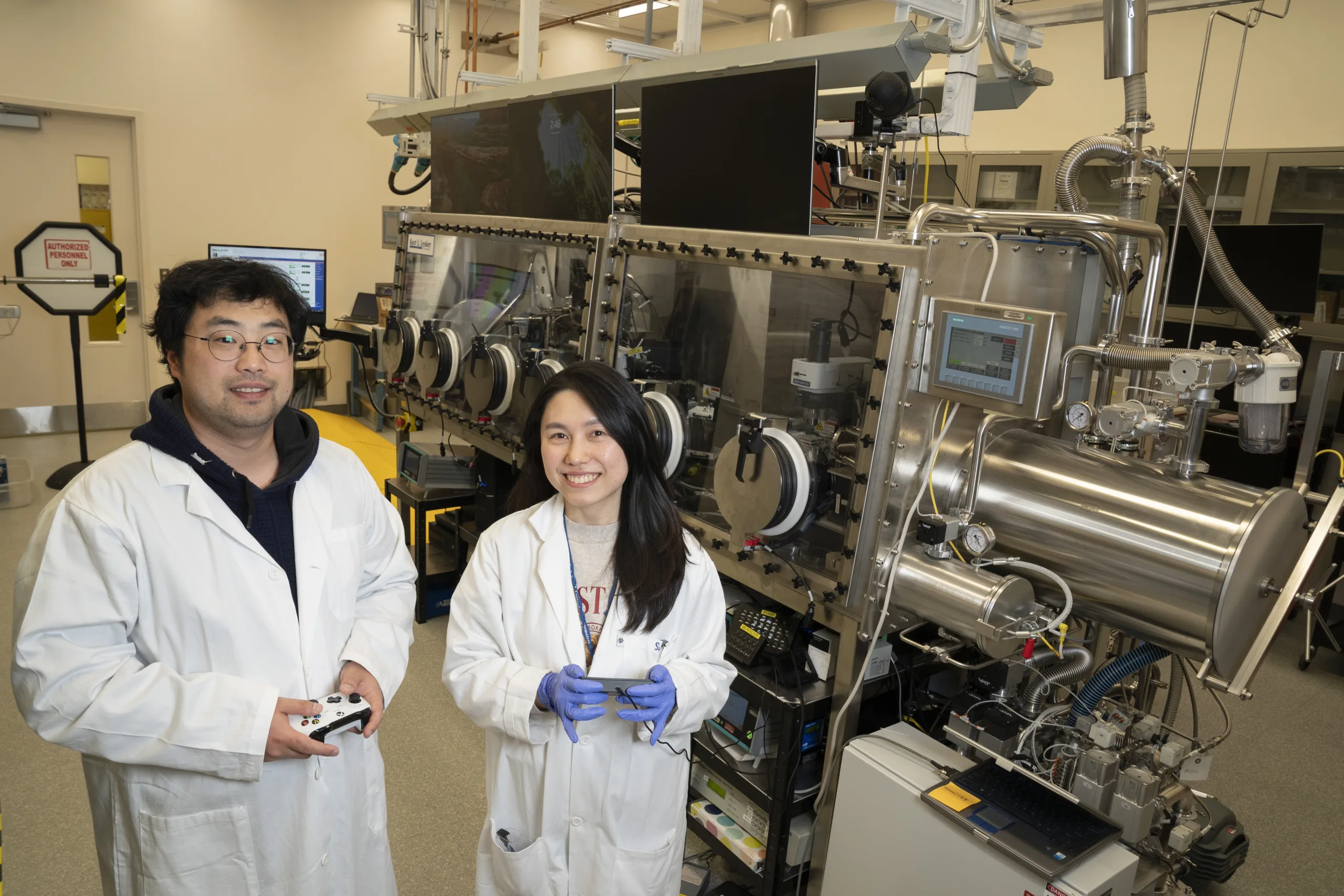
A study led by University of Maryland (UMD) researchers, including You Zhou, Liuxin Gu, and Lifu Zhang, in collaboration with the U.S. Department of Energy’s Brookhaven National Laboratory, has revealed a new device that could enable energy-efficient and secure telecommunications. The device uses light to power a full transmission, improving speed and energy efficiency. Early tests show the device consumes significantly less energy than conventional optical switches. The team used the Quantum Material Press at the Center for Functional Nanomaterials to build the device. The research aims to further increase energy efficiency and enable quantum communications for enhanced data security.
Energy-Efficient and Secure Telecommunications: A Quantum Leap
A recent study led by researchers at the University of Maryland (UMD) has unveiled a new device that could revolutionize the future of telecommunications. The device, which processes information using a small amount of light, promises to deliver energy-efficient and secure communications. The research, conducted in collaboration with the U.S. Department of Energy’s (DOE) Brookhaven National Laboratory, was published in the journal Nature Photonics.
Traditional optical switches, which are responsible for transmitting information via telephone signals, rely on light as a transmission medium and electricity as a processing tool. This dual reliance necessitates an additional energy set for data interpretation. However, the new device, engineered by You Zhou, an assistant professor in UMD’s Department of Materials Science and Engineering (MSE), uses only light to power a full transmission. This could significantly enhance the speed and energy efficiency of telecommunications and computation platforms.
Quantum Materials and Energy Efficiency
Early tests of this technology have shown significant energy improvements. While conventional optical switches require between 10 to 100 femtojoules to enable a communication transmission, Zhou’s device consumes one hundred times less energy, which is only one tenth to one femtojoule. This energy efficiency is achieved through the use of a material’s property known as “non-linear response,” which allows for information processing using small amounts of light.
The device was built using the Quantum Material Press (QPress) at the Center for Functional Nanomaterials (CFN), a DOE Office of Science user facility at Brookhaven Lab. The QPress is an automated tool for synthesizing quantum materials with layers as thin as a single atom. This collaboration has significantly enhanced the sample fabrication process, according to Suji Park, a staff scientist in the Electronic Nanomaterials Group at CFN.
Quantum Communications: A New Frontier for Data Security
The next challenge for Zhou’s research team is to increase energy efficiency down to the smallest amount of electromagnetic energy. This is a key hurdle in enabling quantum communications, which offer a promising alternative for data security.
In an era of increasing cyberattacks, the need for sophisticated protection against hackers has grown. Conventional communication channels can be read and copied without leaving a trace, leading to thousands of breaches affecting millions of users. Quantum communications, however, offer a promising alternative. They encode information using light, which cannot be intercepted without altering its quantum state. Zhou’s method to improve materials’ nonlinearity is a step closer to enabling these technologies.
The Future of Telecommunications
The study, supported by the DOE Office of Science and the National Science Foundation, represents a significant step towards a future where telecommunications are both energy-efficient and secure. The development of this new device, which uses light to power a full transmission, could revolutionize the telecommunications and computation platforms.
The research also highlights the potential of quantum materials and quantum communications in enhancing data security. As cyberattacks become increasingly prevalent, the need for sophisticated protection against hackers grows. Quantum communications, which encode information using light, offer a promising alternative. The work of Zhou and his team brings us one step closer to a future where data security is no longer a concern.
External Link: Click Here For More