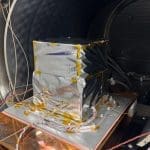
Scientists at the University of Massachusetts Amherst and the University of California Santa Barbara have demonstrated technology that could significantly reduce the size of quantum computers, moving components from room-sized systems toward designs comparable to a deck of cards. The research addresses a critical barrier to scaling quantum computing and enabling portable optical clocks, both of which currently rely on large, complex optics and vacuum chambers. Researchers successfully replaced these bulky lasers with small photonic chips, demonstrating control of trapped ions used as qubits for data processing and the basis for highly precise timekeeping. “If you want scalability or portability with quantum technology, you need the laser systems to all be on chip too,” says Robert Niffenegger, assistant professor of electrical and computer engineering. “We could have millions of qubits on one chip in a way that is not possible if you needed rooms full of lasers and optics.” The team’s findings, published in Nature Communications, show the system already achieves high-fidelity qubit state preparation and measurement.
Stabilized Photonics Replace Bulky Quantum System Optics
The team successfully demonstrated key laser components necessary for an integrated quantum computing system-on-a-chip, potentially reducing the footprint of quantum hardware from expansive laboratory setups to devices comparable in size to a deck of cards. This advancement directly addresses the limitations of current quantum technology, which is hampered by its large size, complexity, and sensitivity. The largest and most demanding elements of existing quantum systems are the optics, typically involving multiple lasers and elaborate vibration and temperature control systems to maintain ultrastable optical cavities; these cavities are essential for precisely controlling trapped ions used in both quantum computing and optical clocks. The research demonstrates that these large precision lasers can, for the first time, be substituted with small photonic chips capable of controlling trapped ions for qubit and clock operations, achieving high-fidelity qubit state preparation and measurement.
Niffenegger emphasized the importance of integration, stating, “To build something truly useful, something beyond what a traditional supercomputer can do, you’re going to need an integrated quantum system on a chip.” A significant challenge lay in maintaining laser stability without the traditional bulky isolation systems, a hurdle overcome by actively compensating for drift through intertwined calibrations and experiments; “It did feel like wrangling a bull,” Niffenegger admitted. The team’s long-term goal is to combine the ion trap, laser, and optical cavity onto a single chip, paving the way for functional, large-scale quantum computers and portable optical clocks capable of high precision, even in space.
On-Chip Laser Control Achieves High-Fidelity Qubit Operations
The pursuit of scalable quantum computing currently faces significant hurdles stemming from the sheer size and sensitivity of existing systems; the largest components, particularly the optics, demand extensive vibration isolation and temperature control, hindering portability and widespread deployment. This advancement isn’t simply about shrinking components, it’s about enabling entirely new architectures for quantum systems. The team successfully replaced bulky, precision lasers with their chip-based counterparts and demonstrated their ability to control trapped ions, the fundamental building blocks of many quantum computers, performing operations necessary for qubit state preparation and measurement. Beyond computing, this technology promises to revolutionize optical clocks, devices that leverage trapped ions to measure time with unprecedented accuracy. Niffenegger envisions a future where these clocks, currently limited by their size and fragility, become portable enough for deployment in space. “This is really the only way to get a precision optical clock into space,” he states, suggesting applications ranging from testing fundamental physics to enhancing deep space navigation.
If you want scalability or portability with quantum technology, you need the laser systems to all be on chip too.
The team successfully demonstrated the replacement of bulky, precision lasers with small photonic chips, a feat previously considered a major obstacle to widespread adoption. This isn’t merely about reducing physical space; it’s about fundamentally altering the architecture of quantum systems, moving toward the integration seen in traditional computing’s evolution from massive mainframes to smartphones. Beyond computational power, this technology has implications for optical clocks, which rely on the same trapped-ion technology to measure time with unprecedented accuracy.
To build something truly useful, something beyond what a traditional supercomputer can do, you’re going to need an integrated quantum system on a chip.
This isn’t merely about reducing size; it’s about enabling the density required for truly powerful quantum processors. The researchers have already achieved “the high-fidelity qubit state preparation and measurement required for quantum computing” with their initial designs, and are now focused on further improvements for quantum sensing applications.
If you’re serious about getting to that scale, you have to look at how traditional computers have scaled through integration.