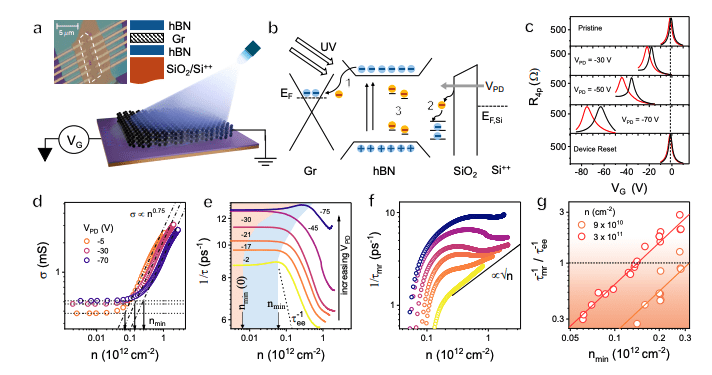
Graphene continues to attract intense interest as a material capable of hosting novel electronic phenomena, and recent research focuses on understanding how electrons flow through it like a fluid, a property known as charge hydrodynamics. Akash Gugnani, Aniket Majumdar, and colleagues at the Indian Institute of Science, working with Kenji Watanabe, Takashi Taniguchi, and others at the National Institute for Materials Science, now demonstrate a method for actively controlling this fluid-like behaviour in graphene. The team successfully tunes the flow of electrons by manipulating disorder within the material using ultraviolet light and electric fields, achieving a dynamic control previously unattainable in graphene devices. This breakthrough allows researchers to move between regimes where electron flow is dominated by collisions with impurities and where it exhibits true viscous characteristics, offering a powerful new strategy for exploring and harnessing fundamental charge transport mechanisms in next-generation electronics.
Creating high-quality graphene devices, encapsulated within insulating layers of hexagonal boron nitride, has been crucial for this research. This work addresses the challenge of controlling disorder, imperfections within the material, by utilising a combination of ultraviolet (UV) radiation and electric fields to precisely introduce and manipulate it within a single graphene device. The research aims to achieve a transition between distinct transport regimes, providing a platform to investigate how disorder and viscous behaviour interact in two-dimensional electron systems.
Fluid Electron Transport in Two-Dimensional Materials
Research into graphene and other two-dimensional materials increasingly focuses on understanding how electrons behave as fluids, exhibiting properties like viscosity. This hydrodynamic electron transport differs from traditional, diffusive transport where electrons simply bounce around randomly. The behaviour of electrons is strongly influenced by disorder, imperfections that disrupt smooth flow. Researchers are also investigating deviations from the Wiedemann-Franz law, a relationship between thermal and electrical conductivity, as a potential indicator of this fluid-like behaviour. Identifying the dominant scattering mechanisms, impurities, vibrations, or interactions between electrons, is essential for fully understanding these transport properties.
Research extends beyond graphene to explore heterostructures, combinations with other materials like hexagonal boron nitride, and how these combinations impact electron flow. Key findings demonstrate that hydrodynamic behaviour in graphene is real, but complex, significantly affected by disorder and other factors. While disorder generally disrupts electron flow, moderate levels can enhance hydrodynamic behaviour by increasing interactions between electrons. Electron viscosity in graphene depends on temperature, carrier density, the level of disorder, and the strength of electron-electron interactions.
Deviations from the Wiedemann-Franz law often serve as evidence of hydrodynamic behaviour, indicating a breakdown of traditional models. Hexagonal boron nitride is frequently used as a substrate due to its insulating properties and smooth surface, and combining these materials can create unique transport properties. Promising research directions include developing methods to precisely control the type and concentration of disorder in graphene, allowing researchers to tune its transport properties and optimise its performance in devices. Exploring new combinations of graphene with other two-dimensional materials could lead to heterostructures with unique transport properties.
A deeper understanding of how electron-electron interactions affect transport in graphene is also needed. Developing more accurate theoretical models to capture the complex behaviour of electrons in graphene is crucial. Further research should investigate the impact of defects and impurities on the electronic structure and transport properties of graphene, explore the potential of graphene-based devices for applications such as sensors, transistors, and energy storage, and develop new techniques for characterizing the transport properties of graphene and other two-dimensional materials. In conclusion, research into graphene and other two-dimensional materials is a vibrant and complex field, offering exciting opportunities for both fundamental research and technological innovation.
UV Light Dynamically Controls Graphene Electron Flow
Researchers have demonstrated a novel method for dynamically controlling how electrons flow in graphene. By combining ultraviolet (UV) light and an electric field, they successfully tuned the material between viscous, streamlined flow and more chaotic, diffusive flow, at room temperature. This represents a significant step towards harnessing the full potential of graphene in future electronic devices. The team encapsulated graphene within layers of hexagonal boron nitride, a material known for its insulating properties and ability to create high-quality graphene devices. This research overcomes the challenge of controlling disorder by using UV light to precisely introduce and remove temporary defects within the boron nitride layers.
These defects act as traps for electrons, effectively controlling the amount of scattering that disrupts the smooth flow of charge carriers. The experiments reveal that increasing the level of disorder with UV light dramatically increases the rate at which electrons collide with imperfections in the material, pushing the system towards diffusive behaviour and restoring a classical relationship between thermal and electrical conductivity. Conversely, reducing the disorder allows the graphene to exhibit a more viscous flow, where electrons maintain momentum over longer distances. This tuning process is both reversible and dynamic, allowing researchers to switch between the two flow regimes repeatedly. The ability to control electron flow in this manner opens up possibilities for designing new types of electronic devices with enhanced performance and functionality. The research provides crucial insights into the fundamental physics governing electron transport in two-dimensional materials and paves the way for future innovations in nanotechnology.
UV Control Reveals Graphene’s Disorder Transition
This research demonstrates a new method for dynamically controlling the flow of electrons in graphene. By combining ultraviolet (UV) radiation with an electric field, the team successfully tuned the level of disorder within the graphene, allowing them to observe a transition between different types of electronic flow. Specifically, they observed how increasing disorder impacts the material’s ability to conduct heat and electricity, and how this relates to the behaviour of electrons within the graphene layer. The findings establish a non-invasive technique for precisely manipulating disorder in high-quality graphene devices, offering insights into the fundamental mechanisms governing charge transport. This control enabled the observation of a tunable charged fluid, confirming theoretical predictions about the interplay between momentum-conserving and momentum-relaxing scattering in graphene.
👉 More information
🗞 Dynamically tunable hydrodynamic transport in boron nitride-encapsulated graphene
🧠 ArXiv: https://arxiv.org/abs/2508.10846