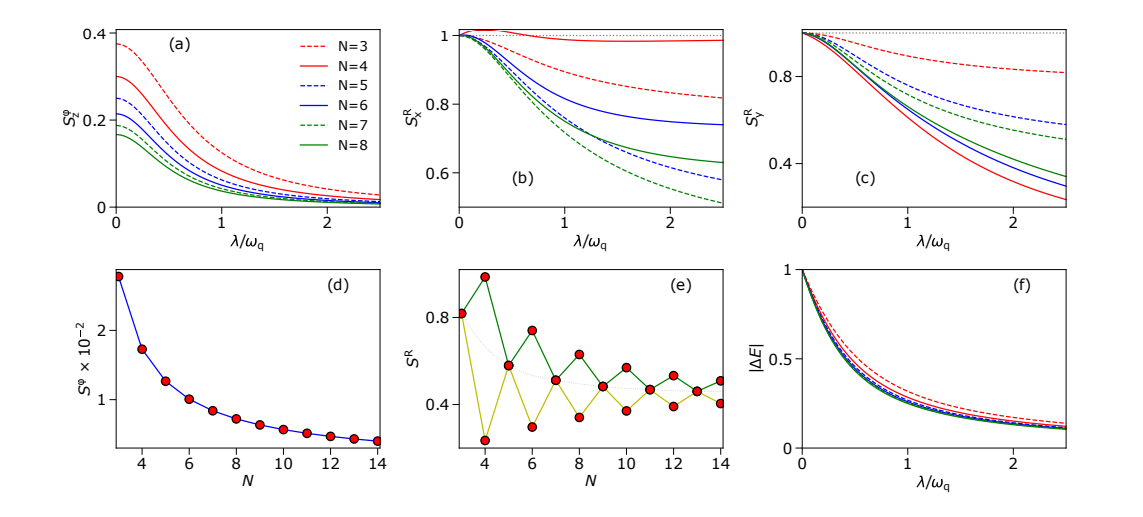
Achieving stable quantum computation demands extending the time quantum bits retain information, a challenge currently limiting the development of practical quantum computers. Roberto Stassi, Shilan Abo, and Daniele Lamberto, from the Universit`a di Messina, alongside Ye-Hong Chen from Fuzhou University and Adam Miranowicz et al. from Adam Mickiewicz University, now present a theoretical breakthrough in protecting quantum information. Their work investigates a chain of superconducting quantum bits linked by particularly strong interactions, demonstrating that this arrangement dramatically enhances coherence. By treating pairs of these physical quantum bits as a single, more robust ‘logical’ qubit, the researchers show that both the loss of phase information and the loss of energy are significantly slowed, paving the way for more reliable quantum calculations.
Superconducting Qubits with Ultrastrong Interactions
Scientists are working to increase the coherence of quantum bits, a crucial step towards building practical quantum computers. Their research investigates systems of superconducting qubits arranged in chains, utilizing alternating ultrastrong XX and YY interactions. By combining pairs of these physical qubits into a single, logical qubit, the team demonstrates a significant enhancement in coherence, exceeding that of individual qubits. This approach aims to create a more stable and reliable platform for quantum computation, addressing a key challenge in the field of quantum technology. The investigation focuses on leveraging the unique properties of these interacting qubits to extend coherence times and improve the overall performance of quantum algorithms.
Qubit Design, Coherence and Connectivity Enhancement
This research centers on superconducting quantum circuits, specifically transmon qubits, and their application to quantum information processing. A major focus is on enhancing qubit coherence and connectivity to build more complex and scalable quantum systems. The research explores techniques to improve qubit design, develop effective coupling mechanisms, refine control and readout methods, and explore novel quantum phenomena to achieve this goal. Key concepts underpinning this work include qubit coherence, the length of time a qubit maintains its quantum state, and connectivity, which describes how qubits are linked together.
The team also investigates ultrastrong coupling, a regime where the interaction strength between qubits is comparable to or greater than their individual frequencies, and utilizes specific types of qubit-qubit interactions, namely YY and XX coupling. This research benefits from support from initiatives like the Quantum Leap Flagship Program and draws upon the field of circuit quantum electrodynamics. The research explores new materials and circuit designs to improve qubit performance and scalability. Refining techniques to precisely control and measure qubit states is a critical area of focus, alongside investigating and harnessing quantum effects for improved performance. The ultimate goal is to develop quantum computers for applications such as quantum simulation, materials science, and drug discovery.
Enhanced Coherence via Qubit Chain Interactions
Scientists have achieved a significant breakthrough in extending the coherence of quantum bits, a crucial step towards building practical quantum computers. Their work investigates a system of interconnected qubits arranged in a chain, alternating between ultrastrong XX and YY interactions. By treating pairs of these physical qubits as a single, logical qubit, the team demonstrates a substantial enhancement in coherence, exceeding that of individual physical qubits. Specifically, the research reveals that increasing either the strength of the interactions between qubits or the number of physical qubits within the chain effectively suppresses decoherence.
The team shows that the rate of pure dephasing, a major source of quantum errors, can be driven to zero by optimizing these parameters. Furthermore, the relaxation rate, which governs energy loss from the system, is reduced to half that of a single physical qubit. This suppression of both dephasing and relaxation translates directly into longer coherence times, allowing quantum information to be preserved for extended periods. The team’s analysis demonstrates that the alternating XX and YY interactions are key to this improved coherence. Unlike the standard quantum Ising model, which relies solely on XX interactions, this alternating configuration effectively mitigates both pure dephasing and relaxation.
The research establishes a pathway towards more robust quantum computation by leveraging the interplay between qubit interactions and environmental noise. The team proposes a circuit design utilizing three flux qubits, realizing the ultrastrong XX and YY interactions through Josephson junctions and shared capacitors. This design offers a promising platform for experimental realization and further exploration of the observed coherence enhancements. The results demonstrate a system more resilient to symmetry-breaking noise, a critical vulnerability of the Ising model, and pave the way for more stable and reliable quantum computations.
Enhanced Coherence in Qubit Chains Demonstrated
This work demonstrates a significant advancement in the pursuit of stable quantum computation through the design of a novel qubit system. Researchers have theoretically investigated a chain of qubits interacting with alternating XX and YY ultrastrong interactions, demonstrating that this configuration markedly enhances coherence. By treating pairs of physical qubits as a single logical qubit, the team showed that both pure dephasing and relaxation, major sources of quantum information loss, are substantially suppressed compared to individual qubits. Specifically, increasing either the strength of the interactions or the number of physical qubits in the chain further extends the logical qubit’s coherence time, with dephasing potentially suppressed to zero and relaxation reduced by half.
This improved coherence originates from the inherent symmetries within the alternating interaction Hamiltonian when operating in the ultrastrong coupling regime. The research confirms that high-fidelity single- and two-qubit operations are achievable within this framework, paving the way for universal quantum computation. While the findings represent a substantial step forward, the authors acknowledge that experimentally realizing strong YY coupling remains a challenge, despite recent theoretical progress in circuit design. Future research will focus on validating these predictions through experiments, particularly using flux qubits well-suited for ultrastrong coupling, and extending this noise protection scheme to transmon qubits, which currently exhibit the longest coherence times among superconducting artificial atoms.
🗞 Noise Protected Logical Qubit in a Open Chain of Superconducting Qubits with Ultrastrong Interactions
🧠 ArXiv: https://arxiv.org/abs/2509.17903