The precise control of ultracold polar molecules demands microwave fields possessing both exceptional strength and minimal noise, a challenge now addressed by research led by Shrestha Biswas, Sebastian Eppelt, and Christian Buchberger, alongside colleagues including Xing-Yan Chen, Andreas Schindewolf, and Michael Hani. Their work details the development of a robust microwave setup capable of generating fields with an intensity of 6. 9kV/m and an exceptionally low noise profile, crucial for extending the lifetime of fragile molecular states to up to ten seconds. This innovative system not only delivers strong, clean signals but also allows for dynamic tuning of field polarization, enabling researchers to observe previously hidden molecular phenomena like field-linked resonances and create complex molecular structures. By achieving these advances in microwave control, the team significantly enhances the study of ultracold polar molecules and opens new avenues for exploring fundamental physics and potential applications in diverse scientific fields.
Microwave fields with strong field strength, ultralow phase-noise and tunable polarization are crucial for stabilizing and manipulating ultracold polar molecules, which have emerged as a promising platform for quantum sciences. This work presents the design, characterization, and performance of a robust microwave setup tailored for precise control of molecular states, achieving a high electric field intensity of 6. 9kV/m. This capability enables researchers to explore and exploit the unique properties of ultracold polar molecules for applications in fundamental physics and quantum technologies.
Ultracold Polar Molecule Microwave Control System
This document details the design, construction, and characterization of a specialized microwave system used for trapping and manipulating ultracold polar molecules. The system incorporates a carefully designed antenna, a stable microwave source, and sophisticated control electronics, achieving precise control over the microwave field’s polarization and minimizing noise. Electromagnetic simulations were used to optimize the antenna’s performance, and careful fabrication techniques ensured its precise construction. Low-noise amplifiers boost the microwave signal without introducing significant interference, and shielding, including a Faraday cage and filters, minimizes external electromagnetic interference. Cryogenic cooling further reduces thermal noise, enhancing the system’s overall performance.
Strong Microwave Control of Ultracold Molecules
This work details the development of a robust microwave system for precise control of ultracold polar molecules, achieving a high electric field intensity of 6. 9kV/m in the near-field. This strong field enables a Rabi frequency of 71MHz for rotational transitions in sodium-potassium molecules, crucial for manipulating their quantum states. The system incorporates a low-noise signal source and controlled electronics, delivering ultralow noise and dynamically tunable polarization, and further reduces noise by more than 20 dB at a 20MHz offset frequency. These capabilities enabled the evaporative cooling of a molecular sample to deep degeneracy, a state where quantum effects become prominent, and allowed observation of field-linked resonances and the creation of field-linked tetramers.
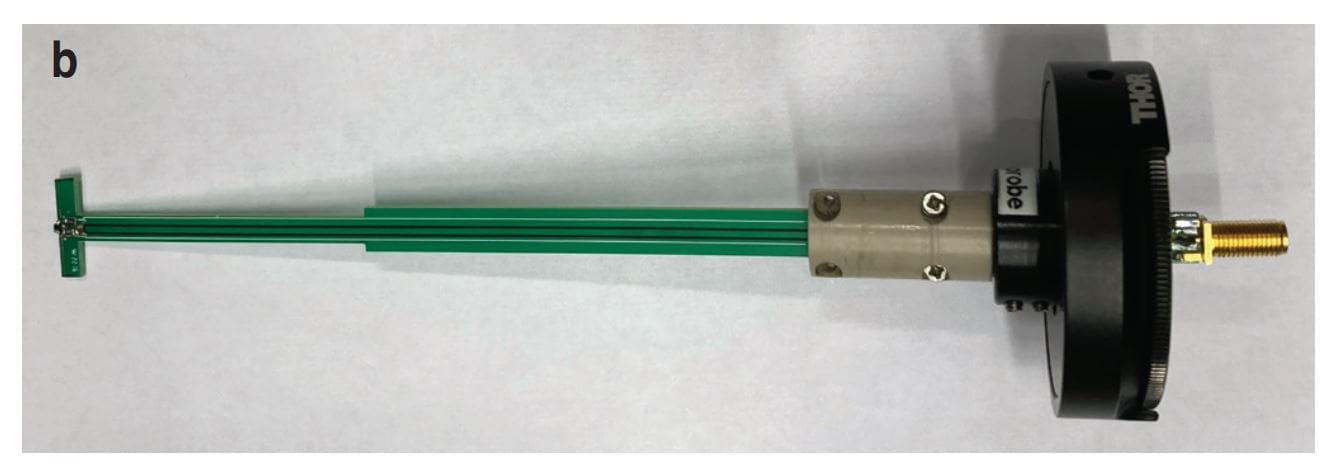
Researchers developed a practical method for measuring microwave field strength and polarization using a homemade dipole probe, and characterized noise levels down to -170 dBc/Hz with a commercial spectrum analyser and a custom notch filter. The system utilizes a blue-detuned microwave field to couple molecular ground and rotationally excited states, creating dressed states that shield molecules from collisions, effectively preventing inelastic losses. Researchers achieved this by optimizing the antenna design, a rectangular dual-feed waveguide, and carefully controlling the field parameters.
Ultracold Polar Molecules Controlled with Microwave Fields
This research presents a significant advance in the control and manipulation of ultracold polar molecules, achieved through the development of a robust microwave system. 9kV/m and achieving a remarkably low noise level of -170 dBc/Hz, enabling prolonged molecular lifetimes exceeding ten seconds. These capabilities facilitated several key breakthroughs, including the evaporative cooling of molecular samples to deep quantum degeneracy, the observation of field-linked resonances, and the creation of field-linked tetramers. The team also demonstrated a practical method for measuring microwave field strength and polarisation using a simple dipole probe. While acknowledging that further improvements could involve three-dimensional field control or enhanced shielding, the current system represents a substantial step forward in the study of ultracold polar molecules and has potential applications in other areas of ultracold atom and molecule research, as well as experiments involving NV-centres.
👉 More information
🗞 Generation of strong ultralow-phase-noise microwave fields with tunable ellipticity for ultracold polar molecules
🧠 ArXiv: https://arxiv.org/abs/2512.03007