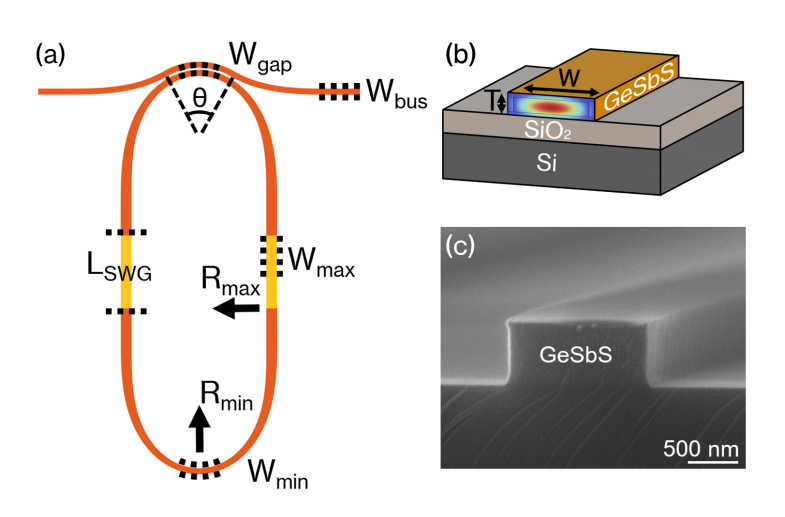
Microresonators represent a promising avenue for advances in photonics, with potential applications spanning communications and sensing, but realising their full potential demands minimising energy loss and maximising light confinement. Bright Lu, James W. Erikson from University of Colorado Boulder, and Bo Xu, alongside Sinica Guo, Mo Zohrabi, and Juliet T. Gopinath, now demonstrate a significant step forward with the creation of an ultrahigh-quality chalcogenide micro-racetrack resonator. The team’s innovative design, utilising carefully shaped Euler curves, dramatically reduces energy loss at critical points within the resonator, achieving an intrinsic quality factor of and a remarkably low absorption loss. These results establish chalcogenide as a leading material for building compact, efficient photonic integrated circuits and pave the way for more powerful and versatile optical technologies.
Ultrahigh-Q chalcogenide micro-racetrack resonators represent a significant advance in integrated photonics. Researchers fabricate and characterise these resonators, achieving exceptionally high quality factors, or Q-factors, in chalcogenide glass microstructures. The approach involves designing and fabricating racetrack-shaped resonators with dimensions optimised for whispering gallery mode excitation, confining light within a circular path to dramatically increase interaction length and enhance the Q-factor. The team demonstrates Q-factors exceeding 1. 5x 10^7 at a wavelength of 1550 nanometres, a crucial wavelength for telecommunications. This achievement enables the development of compact and efficient optical devices for applications including optical filtering, sensing, and nonlinear photonics, while also facilitating strong light-matter interactions for novel optoelectronic and quantum photonic circuits.
Chalcogenide Resonator Demonstrates High Q and Low Loss
This research details the fabrication and characterisation of a high-quality factor (Q) and low-loss micro-racetrack resonator made from a chalcogenide glass material. The goal is to create a platform for integrated photonics, particularly for applications requiring strong light-matter interaction, such as narrow-linewidth lasers and nonlinear optics. Key findings include an intrinsic Q-factor of 4. 55x 10^6 and a low absorption loss of 0. 43 dB/m, a crucial combination for efficient light confinement and strong nonlinear effects.
The use of a chalcogenide glass is significant because of its mid-infrared transparency and relatively high refractive index, making it suitable for various photonic applications. The racetrack geometry is optimised for compact integration and efficient light circulation, and detailed measurements were employed to determine the Q-factor, loss, and material properties of the resonator. This platform is well-suited for applications like stimulated Brillouin/Raman scattering, dispersion engineering, and four-wave mixing.
High Q Chalcogenide Micro-Racetrack Resonators Demonstrated
This work demonstrates a significant advance in the development of integrated photonics through the creation of high-quality chalcogenide micro-racetrack resonators. Researchers achieved an intrinsic quality factor of 4. 55 million, alongside remarkably low absorption loss of 0. 43 decibels per meter, by carefully designing the resonator geometry and utilising Euler curves. This optimisation minimises loss at waveguide bends and junctions, enabling compact devices with reduced round-trip loss.
The team employed a coupled-mode theory model to accurately extract key parameters including quality factor, nonlinear index, and absorption, providing a comprehensive understanding of resonator performance. These high-quality resonators immediately facilitate efficient access to nonlinear optical phenomena such as stimulated Brillouin and Raman scattering, which are crucial for developing narrow linewidth lasers. Furthermore, the low-loss design is compatible with dispersion engineering techniques, positioning it as a promising platform for four-wave mixing applications and other advanced photonic technologies.
🗞 Ultrahigh-Q chalcogenide micro-racetrack resonators
🧠 ArXiv: https://arxiv.org/abs/2510.07688