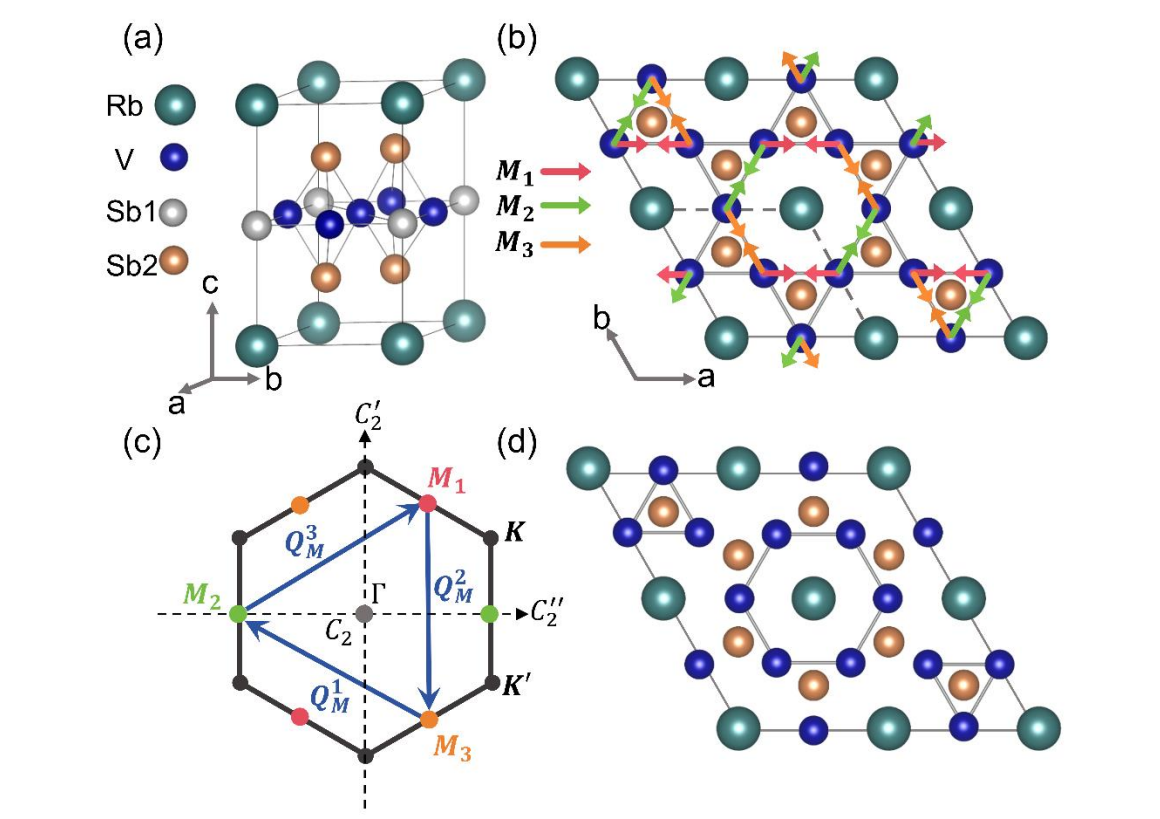
The interplay of light and matter in unusual materials called frustrated Kagome metals holds the potential to reveal previously hidden states of matter, but understanding how these materials respond to extremely rapid changes remains a significant challenge. Mengxue Guan, Xiaodong Zhou, and Jingyi Duan, along with colleagues, now demonstrate a microscopic mechanism driving symmetry breaking in the Kagome metal RbV3Sb5 when it is hit with a laser pulse. Their simulations reveal that selectively exciting a specific vibrational mode, or phonon, dynamically breaks fundamental symmetries within the material’s structure, lifting geometric frustration and unexpectedly stabilizing a magnetic state. This spin-driven pathway, distinct from previous explanations, generates a substantial anomalous Hall effect and establishes a crucial foundation for understanding the complex relationship between spin, lattice structure, and charge in these exotic, non-equilibrium materials.
Kagome Metal Dynamics with Ultrafast Lasers
This research details how ultrafast laser pulses interact with the Kagome metal RbV3Sb5, revealing a pathway to control its electronic and magnetic properties. Kagome metals possess a unique crystal structure resembling a traditional Japanese weaving pattern, giving rise to intriguing electronic and magnetic behaviors, including the potential for superconductivity and charge density waves (CDWs). Scientists are using extremely short bursts of light to investigate and manipulate the CDW state in RbV3Sb5, uncovering a fascinating interplay between light, lattice vibrations, and emergent quantum phenomena. The material exhibits a charge density wave state, where electrons rearrange to create a periodic modulation of electron density.
Researchers identified an Intermediate Structural Distortion (ISD) phase, a specific distorted structure arising from the CDW, characterized by a breathing motion of the lattice. Exciting the material with ultrafast laser pulses drives specific vibrational modes, or phonons, related to the CDW, creating a transient state distinct from both the pristine and ISD phases. This transient state is a temporary, non-equilibrium condition of the material, allowing scientists to observe its dynamic behavior. The laser pulse selectively excites phonon modes associated with the CDW, and researchers can control which mode is excited by changing the laser’s polarization.
By observing the lattice distortion evolving in time, they capture snapshots of the atomic structure during the transient state. Crucially, the transient state exhibits time-reversal symmetry breaking, meaning the material behaves differently if time is reversed. This symmetry breaking manifests as changes to the material’s electronic band structure, the emergence of a net spin moment, and a non-zero Berry curvature, indicating topological electronic properties. The researchers predict that this state will exhibit an anomalous Hall effect, where a voltage is generated perpendicular to both the current and the applied field, even without an external magnetic field.
The Kagome lattice is inherently frustrated, making it difficult to satisfy all magnetic interactions simultaneously, but the laser-induced distortion lifts this frustration and leads to spin polarization. This research demonstrates the ability to create and control novel quantum states of matter using light, with the time-reversal symmetry breaking state combining topological electronic properties with magnetism. The ability to manipulate the CDW and induce this symmetry breaking opens possibilities for controlling the material’s electronic and magnetic properties, potentially leading to applications in spintronics, topological electronics, and other advanced technologies. This work contributes to a deeper understanding of the interplay between lattice dynamics, electronic structure, and magnetism in strongly correlated materials, effectively sculpting the electronic and magnetic properties of a complex material with light.
Laser Breaks Symmetry in RbV3Sb5 Studied
Scientists have used detailed simulations to investigate how laser light breaks symmetry in the material RbV3Sb5, revealing the microscopic mechanism driving this phenomenon. They employed density functional theory, a computational framework for modeling the electronic structure and dynamics of materials with high precision. These calculations were performed using sophisticated computational tools, allowing for high-throughput analysis. To simulate the interaction of light with the material, the team implemented time-dependent density functional theory, tracking the evolution of the electronic and atomic structure under laser excitation.
The simulations focused on selectively exciting a single phonon mode, a collective vibration of the atoms in the lattice, to observe its impact on the material’s symmetry and magnetic properties. Researchers meticulously accounted for electron-phonon coupling, the interaction between electrons and lattice vibrations, using established methods and parameters. By analyzing the simulated atomic displacements and electronic structure, the team demonstrated that selective excitation of this phonon mode dynamically breaks both rotational and time-reversal symmetries within the material’s charge density wave superlattice. This symmetry breaking lifts geometric frustration and stabilizes a non-equilibrium ferrimagnetic phase, accompanied by a sizable intrinsic anomalous Hall effect, providing a detailed microscopic foundation for understanding the material’s response to strong laser fields. This work establishes a clear link between light-induced lattice vibrations and the emergence of a ferrimagnetic state, offering a pathway to control and manipulate the material’s electronic and magnetic properties.
Phonon Excitation Drives Symmetry Breaking in RbV3Sb5
Scientists have uncovered a microscopic mechanism driving symmetry breaking in the Kagome metal RbV3Sb5 using first-principles simulations. The work reveals that selectively exciting a single quantum mechanical (QM) phonon mode within the 2x2x1 charge density wave (CDW) superlattice dynamically breaks both threefold rotational and time-reversal symmetries. This phonon excitation induces an anisotropic lattice distortion, relieving geometric frustration and stabilizing a non-equilibrium ferrimagnetic phase. Experiments demonstrate that this symmetry breaking is rooted in the selective excitation of a specific phonon mode, leading to a simultaneous disruption of rotational and time-reversal symmetries within the material’s structure.
The resulting anisotropic electronic hopping among the three sublattices of the Kagome lattice stabilizes the ferrimagnetic state. Simulations show that the induced net spin moment, coupled with spin-orbit coupling, generates finite Berry curvature in momentum space, directly resulting in an intrinsic anomalous Hall effect. Researchers found that the distortion is localized to a single QM mode, defining a specific vibrational pattern within the 2x2x1 CDW superlattice. This selective excitation is key, as it drives the observed symmetry breaking without requiring external perturbations or long-range magnetic order. Simulated spectra reproduce key features observed in previous experiments, providing a promising foundation for field-tunable symmetry breaking and the exploration of emergent quantum phases in Kagome lattice systems. This work establishes a clear link between phonon excitation and the emergence of a ferrimagnetic state, offering a pathway to control and manipulate the material’s electronic and magnetic properties.
Optical Phonons Drive Kagome Magnetism
This research establishes a microscopic understanding of how light can break symmetry in the quantum material RbV3Sb5, revealing a pathway distinct from previously understood mechanisms. Through detailed simulations, scientists demonstrate that selectively exciting a specific vibrational mode, or phonon, within the material’s structure dynamically disrupts both rotational and time-reversal symmetries. This disruption relieves geometric frustration inherent in the material’s Kagome lattice and establishes a novel, non-equilibrium ferrimagnetic phase, accompanied by a substantial intrinsic anomalous Hall effect. These findings highlight a spin-driven mechanism for symmetry breaking, contrasting with earlier interpretations that relied on orbital currents or external influences. By optically controlling lattice symmetry, researchers can manipulate the electronic properties of the material, offering a means to tune its Fermi surface topology.
🗞 Ultrafast symmetry modulation and induced magnetic excitation in the Kagome metal RbV3Sb5
🧠 ArXiv: https://arxiv.org/abs/2511.06389