

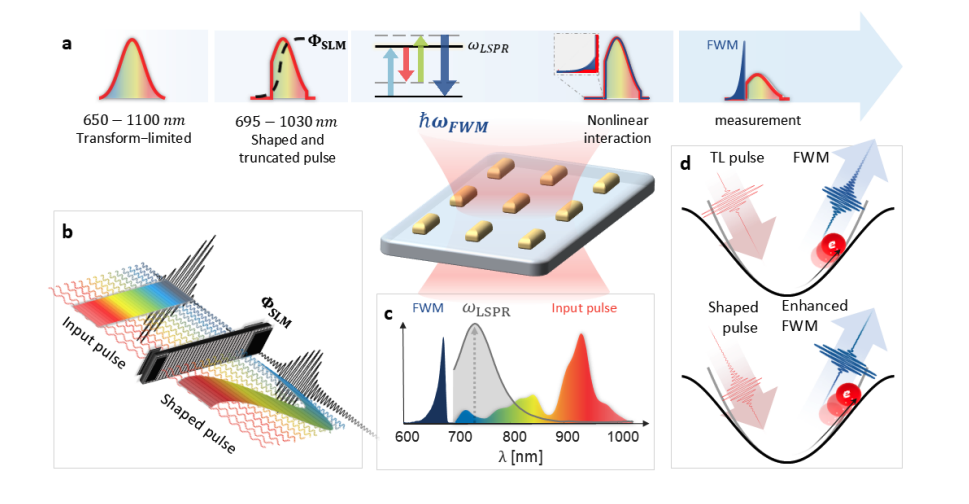
The manipulation of light at the attosecond and femtosecond timescales offers increasingly refined control over material properties and nonlinear optical processes. Researchers are now demonstrating that carefully sculpted ultrafast pulses, beyond the conventional limits of pulse duration, can significantly enhance resonant interactions with matter. A team led by Omri Meron, Snir Nehemia, Uri Arieli, and Haim Suchowski, all from the Condensed Matter Physics Department at Tel Aviv University, details this phenomenon in their recent work, titled “Shaping Ultrafast Pulses for Enhanced Resonant Nonlinear Interactions”. Their investigation into four-wave mixing within plasmonic nanostructures reveals that specific spectral phase shaping, utilising an arctangent function, can induce both dispersion compensation and, unexpectedly, an antisymmetric polarisation response, leading to substantial amplification of multiphoton processes and offering a pathway to dramatically improve high-order harmonic generation.
The coherent control of nonlinear optical processes within resonant plasmonic nanostructures reveals significant enhancements in four-wave mixing through the precise manipulation of ultrafast laser pulses. Researchers employ arctangent spectral-phase shaping, a technique altering the frequency components of a pulse to modify its temporal and spectral characteristics, to achieve refined control over light-matter interactions at the nanoscale. This approach uncovers two distinct mechanisms responsible for boosting nonlinear efficiency.
Specifically, the team demonstrates that shaping pulses with an arctangent phase corrects for dispersion, a phenomenon where different wavelengths within a pulse travel at varying speeds, leading to pulse broadening and reduced efficiency. Simultaneously, this shaping creates constructive interference between multiphoton pathways, where multiple photons combine to initiate a nonlinear process. This interference arises from an induced antisymmetric polarization within the nanostructures, effectively re-directing energy towards desired nonlinear outcomes. Theoretical analysis corroborates these observations, elucidating the physical origins of both enhancement regimes and providing a clear explanation for the observed behaviour.
The experimental setup meticulously crafts the spectral phase
The experimental setup meticulously crafts the spectral phase of sub-10 femtosecond pulses – pulses lasting less than a millionth of a billionth of a second – and directs these shaped pulses onto resonant plasmonic nanostructures. These materials, engineered to strongly interact with light at specific frequencies, exhibit enhanced electromagnetic fields when illuminated. By carefully analysing the resulting four-wave mixing signal, a process where four photons interact to generate a new photon with a different frequency, the team identifies and characterises the two enhancement regimes, confirming that the observed improvements are not attributable to experimental artefacts.
The findings predict an exponential scaling of enhancement with harmonic order, referring to the frequency multiple of the input light generated in the nonlinear process. This suggests a powerful strategy for dramatically boosting high-order harmonic generation, a technique used to create extreme ultraviolet and X-ray radiation, and has implications for attosecond science – the study of incredibly fast processes at the atomic level – and advanced imaging techniques. By understanding how to manipulate the spectral phase of light to control nonlinear interactions in resonant systems, researchers unlock new possibilities for generating and controlling light at extreme frequencies and time scales, moving beyond simply compensating for limitations in laser technology.
One regime functions by compensating for material dispersion, a well-understood principle in pulse shaping, thereby optimising nonlinear efficiency. However, a counterintuitive enhancement mechanism is also observed, where the arctangent phase induces an antisymmetric polarization response within the nanostructures, effectively driving constructive interference between multiphoton pathways. This unexpected behaviour highlights the complex interplay between pulse shaping and resonant excitation, demonstrating that carefully designed spectral phases actively drive enhanced nonlinear processes.
Crucially, the models predict exponential scaling of both
Crucially, the models predict exponential scaling of both effects with harmonic order, suggesting a powerful strategy for dramatically enhancing high-order harmonic generation in resonant systems. This potentially enables new avenues for attosecond science and nonlinear spectroscopy. These results extend the understanding of coherent control beyond non-resonant interactions, demonstrating its applicability to resonant systems where dispersion typically limits efficiency. The discovery of the antisymmetric polarization-driven enhancement offers a novel approach to manipulating nonlinear optical processes, paving the way for the design of more efficient and versatile nanophotonic devices.
🗞 Shaping Ultrafast Pulses for Enhanced Resonant Nonlinear Interactions
🧠 DOI: https://doi.org/10.48550/arXiv.2507.00568


