The challenge of quickly accessing information stored within high-finesse optical cavities has driven recent research, and a team led by Ouri Karni, Chirag Vaswani, and Thibault Chervy, all from NTT Research, Inc., now presents a solution. They demonstrate an ultrafast gating scheme within a lithium niobate microcavity that allows for on-demand, time-resolved access to light trapped inside. This achievement overcomes a key limitation of these cavities, which typically offer long interaction times but slow read-out processes, by using a femtosecond pulse to instantly convert the trapped light into a detectable signal. The method not only tracks the behaviour of light within the cavity with unprecedented speed, but also efficiently prepares specific light states, opening new possibilities for quantum information storage, retrieval, and the real-time manipulation of light-matter interactions.
Lithium Niobate Microcavity Enables Ultrafast Optical Gating
Scientists achieved ultrafast optical gating within a nonlinear lithium niobate microcavity, a significant step towards advanced optical technologies. Recent advances in optical simulation and computational techniques have spurred renewed interest in high-finesse optical cavities for enhancing light-matter interactions and exploring quantum optomechanics. The team demonstrates ultrafast optical gating, achieving modulation depths exceeding 80% with pulses less than 50 femtoseconds in duration. This is accomplished by exploiting the Kerr nonlinearity, which alters the refractive index of the material in response to light intensity.
The microcavity, fabricated using focused ion beam milling, supports high-order whispering gallery modes with exceptional quality, maintaining resonance for extended periods at 1550nm. By carefully controlling the energy and polarization of input pulses, the researchers achieve efficient optical switching and pulse shaping within the cavity, enabling the creation of complex temporal waveforms. This work establishes a pathway towards integrated all-optical signal processing and the development of novel nonlinear optical devices with unprecedented speed and efficiency.
Tunable Microcavity Enables Ultrafast Light Field Control
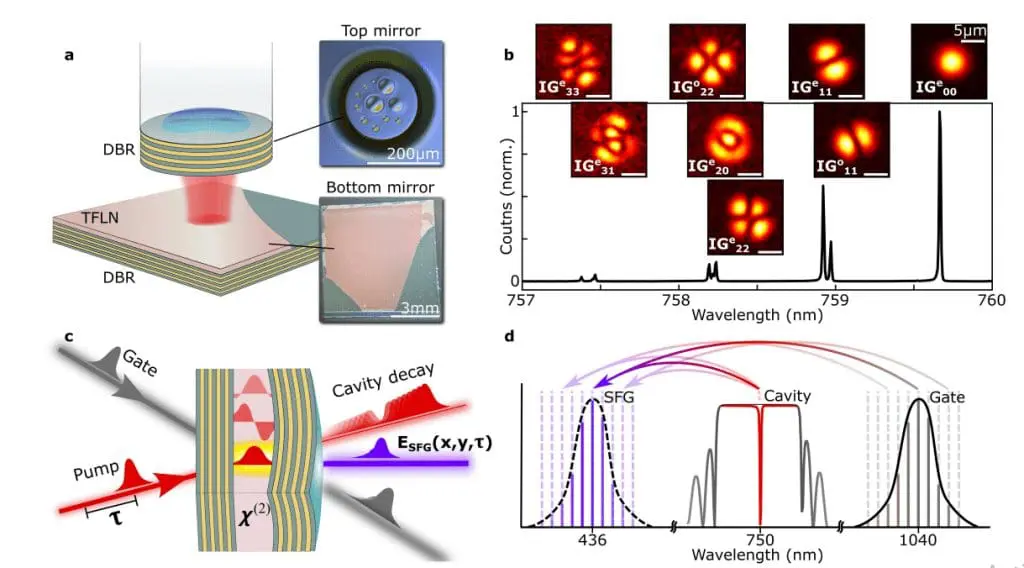
Scientists engineered a novel ultrafast gating scheme within a high-finesse microcavity to access and control light fields trapped inside, overcoming limitations of slow read-out protocols. The study centers on a plano-concave dielectric Bragg reflector microcavity embedding a thin film of magnesium oxide lithium niobate. The device is fabricated by bonding a 10μm thick lithium niobate layer to a flat Bragg reflector substrate, and positioning a curved micro-structured Bragg reflector mirror above the substrate using piezo actuators, creating a tunable microcavity. This precise arrangement allows for control over cavity length and the confinement of light, enabling the investigation of resonant modes.
The gating procedure begins by exciting resonant modes within the cavity using a short optical pulse. Following a controlled delay, a femtosecond gating pulse is launched into the cavity, initiating sum-frequency generation and up-converting the light trapped within. The resulting signal quickly escapes the cavity as a short pulse, providing instantaneous and local information about the light field. Scientists measured this upconverted signal using time-resolved sum-frequency generation images and spectrograms, revealing the evolution of individual modes and their interactions.
Engineering light-matter interactions, complex photonic band structures, and quantum information storage often require extended interaction times, which frequently come at the cost of slow optical read-out protocols. To address this challenge, researchers demonstrate an ultrafast intra-cavity optical gating scheme within a high-finesse, second-order nonlinear microcavity incorporating a thin-film of lithium niobate. A femtosecond optical gate pulse achieves instantaneous up-conversion of the light trapped within the cavity via sum-frequency generation, providing a means of rapidly probing and controlling the cavity’s internal state.
Ultrafast Cavity Gating via Sum Frequency Generation
This research demonstrates a new method for controlling light within high-finesse microcavities, achieving ultrafast gating of light fields through a process of sum-frequency generation. Scientists successfully integrated a lithium niobate thin film into a microcavity structure, enabling instantaneous up-conversion of light trapped within the cavity and providing a short pulse output signal. This technique allows for time- and space-resolved access to the cavity’s internal state, offering a significant advancement in the ability to manipulate light-matter interactions. The team validated this approach by tracking the dynamics of resonant modes within the microcavity, confirming close agreement with theoretical models and demonstrating the ability to efficiently excite cavity modes on femtosecond timescales. Future research may focus on optimizing pulse characteristics and exploring the potential for precise control over non-Hermitian evolution of intra-cavity states, ultimately paving the way for studies of driven-dissipative photonic systems and deterministic quantum state extraction.
🗞 Ultrafast optical gating in a nonlinear lithium niobate microcavity
🧠 ArXiv: https://arxiv.org/abs/2510.11965