

Researchers utilised time-resolved X-ray spectroscopy to investigate charge order in overdoped bismuth strontium copper oxide. They discovered 400 nm light effectively disrupts charge order, unlike 800 nm light, due to differing photon energies and electronic excitation. Recovery time matched underdoped cuprates, suggesting a universal instability and highlighting lattice interaction importance.
The behaviour of charge order – a periodic modulation of electron density – within high-temperature superconductors continues to challenge physicists seeking to fully understand these materials. Recent research, detailed in ‘Ultrafast Orbital-Selective Photodoping Melts Charge Order in Overdoped Bi-based Cuprates’, demonstrates a wavelength-dependent response of charge order to intense laser pulses. Specifically, the team, comprising Xinyi Jiang, Qizhi Li, Qingzheng Qiu, Li Yue, Junhan Huang, Yiwen Chen, Byungjune Lee, Hyeongi Choi, Xingjiang Zhou, Tao Dong, Nanlin Wang, Hoyoung Jang and Yingying Peng, from institutions including Peking University, the Chinese Academy of Sciences and POSTECH, utilised time-resolved X-ray spectroscopy to observe how different wavelengths of light affect charge order in a bismuth-based cuprate superconductor. Their findings reveal that excitation with shorter wavelengths effectively disrupts charge order, while longer wavelengths fail to do so, offering insight into the electronic processes governing these complex materials and potentially enabling ultrafast control of their emergent properties.
Ultrafast Optical Control of Charge Order in Overdoped Cuprate Superconductors
High-temperature superconductivity, exhibited by certain ceramic materials known as cuprates, remains a significant challenge in condensed matter physics. Understanding the interplay between competing electronic states within these materials is crucial for optimising their superconducting properties. Recent research utilising ultrafast optical spectroscopy has revealed nuanced behaviour of charge order (CO) – a periodic modulation of electronic charge – within the overdoped high-temperature superconductor Bi₂Sr₂CaCu₂O₈₊δ.
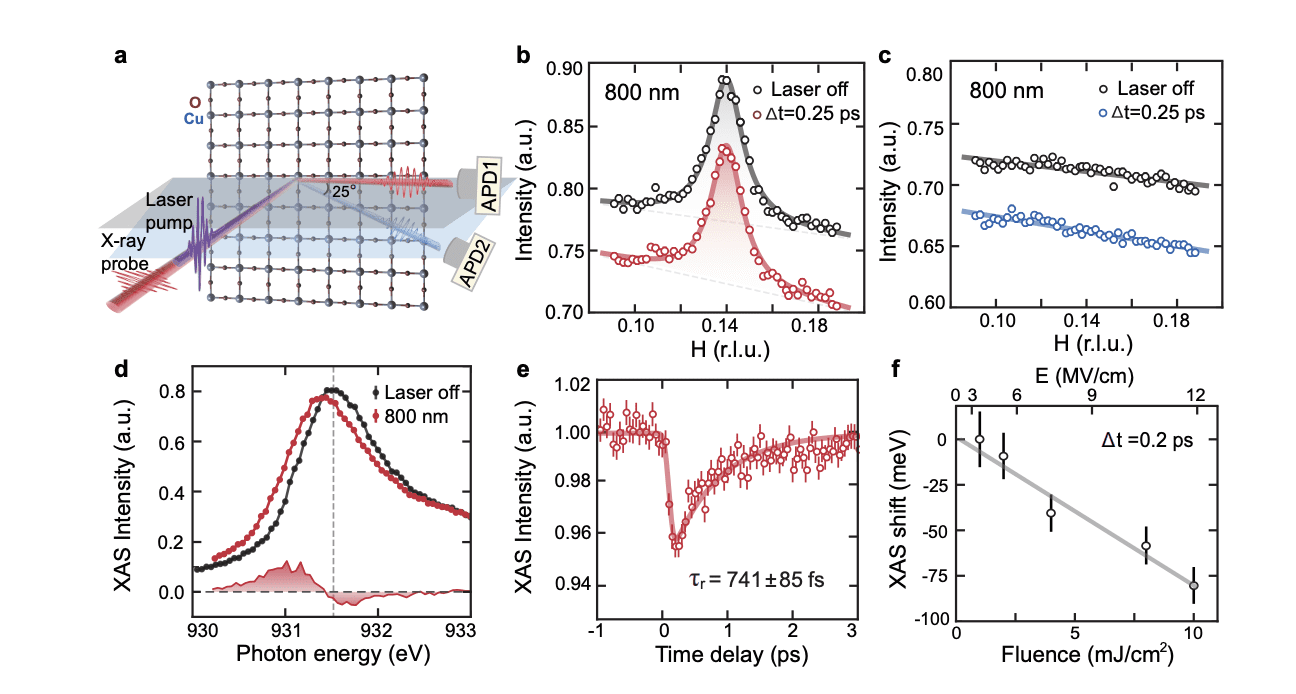
The study demonstrates a strong dependence of CO response on the wavelength of incident light. Illumination with 400 nm light effectively suppresses CO, while 800 nm light induces no discernible change. This differential response arises from the photon energy; 400 nm photons possess sufficient energy to excite electrons across the charge-transfer gap. This excitation promotes electrons from the Zhang-Rice singlet band – a correlated electronic state arising from the interplay of copper and oxygen orbitals – to higher energy states such as the upper Hubbard band or apical oxygen states. The lower energy 800 nm photons lack the necessary energy to induce this transition.
Remarkably, the recovery of CO following optical suppression occurs on a timescale of approximately 3 picoseconds. This timescale aligns with observations in underdoped cuprates, suggesting a common underlying electronic instability governs CO formation in both doping regimes. However, a key distinction emerges when considering the energy required to disrupt CO. Suppressing CO in the overdoped material necessitates approximately ten times more laser fluence – the energy per unit area – compared to underdoped materials. This indicates a strengthened role of the lattice structure in stabilising CO within the overdoped regime, demanding greater energy input to disrupt the periodic charge modulation.
Momentum-resolved measurements further reveal that CO dynamics are not spatially uniform. Variations in the temporal evolution of scattered light intensity at different momentum transfer vectors (Q = 0.14 reciprocal lattice units (r.l.u.) and Q = 0.08 r.l.u.) demonstrate a dynamic, spatially dependent CO structure. This suggests that the CO is not a static, homogeneous entity, but rather a fluctuating pattern with variations across the material.
The research establishes a mechanism of orbital-selective photodoping, whereby specific electronic states can be preferentially excited by tuning the wavelength of incident light. This provides a pathway for manipulating emergent phases in strongly correlated materials.
Future research will extend these ultrafast measurements to directly investigate the interplay between CO and superconductivity. Specifically, researchers aim to observe changes in the superconducting gap symmetry or critical current when manipulating CO with light. The ultimate goal is to elucidate how controlling CO can lead to the development of more efficient and robust superconducting devices.
👉 More information
🗞 Ultrafast Orbital-Selective Photodoping Melts Charge Order in Overdoped Bi-based Cuprates
🧠 DOI: https://doi.org/10.48550/arXiv.2506.04697


