

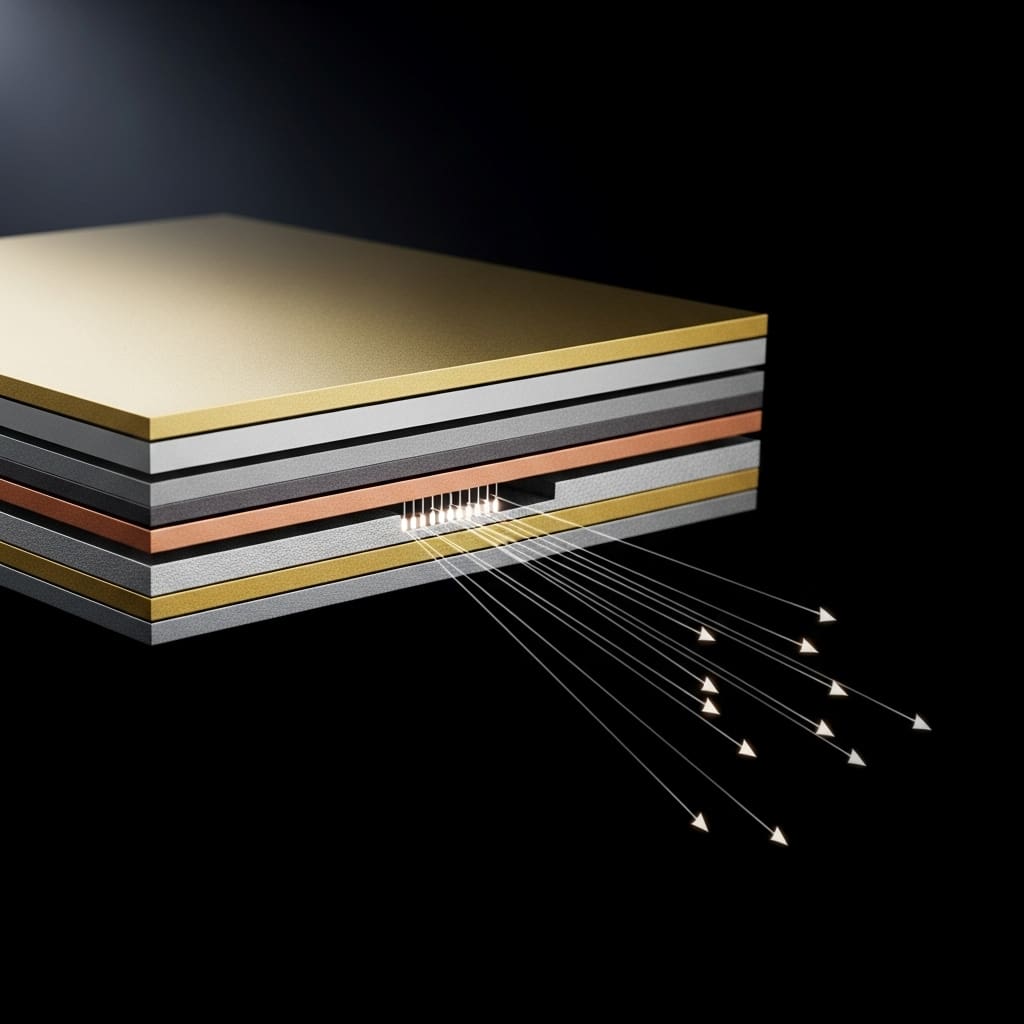
The pursuit of efficient spin-based technologies relies heavily on understanding and controlling the behaviour of magnetism at extremely short timescales. Suchetana Mukhopadhyay, David Muradas-Belinchon, and Francesco Foggetti, alongside colleagues from the S. N. Bose National Center for Basic Sciences and Uppsala University, investigate how engineered barriers can improve spin transport in graphene-based heterostructures. Their research addresses critical challenges in spintronics, such as interfacial impedance and unwanted modifications caused by the interaction between materials. By introducing insulating titanium oxide barriers, the team demonstrates a method for tuning ultrafast magnetization dynamics and enhancing spin detection in cobalt-based systems. This work offers a pathway towards more effective control of spin angular momentum, potentially leading to advancements in spin-orbitronic devices.
Graphene, Ferromagnets and Titanium Oxide Interfaces
The approach involves introducing TiOx barrier layers to mediate the interface between graphene and the 3d transition metal ferromagnet. This aims to reduce impedance mismatch and minimise defect formation, thereby improving spin transport properties. Specific contributions focus on demonstrating the effectiveness of TiOx layers in modulating the interfacial spin current. Through careful material deposition and characterisation, the research details how the TiOx barrier layer impacts the magnetic and electronic properties of the heterostructure. The work presents evidence of modified spin conduction across the interface, indicating a reduction in impedance mismatch. Furthermore, the study highlights the potential for tuning the interfacial coupling through precise control of the TiOx layer thickness and composition.
Graphene Barriers Control Ultrafast Cobalt Magnetization
Researchers are investigating graphene and cobalt systems to advance ultrahigh-speed spintronics, focusing on controlling magnetization dynamics and understanding interfacial interactions. The study utilizes single-layer graphene integrated with titanium oxide and cobalt, aiming to separate the effects of spin pumping and magnetic proximity effects. Time-resolved magneto-optical Kerr effect measurements were employed to observe femtosecond to nanosecond spin dynamics, revealing how barrier engineering can tune ultrafast magnetic parameters. The experimental procedure involved systematically varying the thickness of the titanium oxide barrier layer to modulate damping in the cobalt film.
This allowed researchers to assess the strength of spin pumping, a process where angular momentum is transferred from the cobalt into the graphene. Results indicate a high interfacial spin transparency, approaching half of its theoretical maximum when using an ultrathin barrier layer, and importantly, eliminating magnetic proximity effects. Analysis of the thickness-dependent damping revealed that appropriately chosen ultrathin titanium oxide layers can prevent alterations to the interface caused by the ferromagnetic cobalt. This preservation of the interface facilitates efficient spin detection within the graphene and enhances control over the dissipation of spin angular momentum at the graphene/ferromagnetic interface.
The research highlights the potential of these heterostructures for advanced spintronic applications. The interaction between cobalt’s dz2 orbitals and graphene’s out-of-plane pπ bands leads to strong interfacial pd hybridization and charge transfer, a key aspect of the observed phenomena. Spin angular momentum transfer is also achieved through the injection of spin-polarized carriers across the interface, contributing to the overall control of spin dynamics within the system. These findings demonstrate the complex interplay of charge and spin transfer processes at the graphene/ferromagnet interface.
Graphene Barriers Tune Ultrafast Cobalt Magnetization
Scientists achieved significant control over ultrafast magnetization dynamics by engineering interfaces between graphene and cobalt using titanium oxide barrier layers. The research team meticulously investigated these heterostructures, demonstrating systematic tunability of magnetic parameters through precise barrier engineering. All-optical time-resolved magneto-optical Kerr effect measurements, probing femtosecond to nanosecond spin dynamics, revealed how varying the thickness of the titanium oxide layer impacts the magnetic response of the cobalt. Experiments revealed that the interfacial spin transparency approaches half of its theoretical physical limit when employing an ultrathin barrier, simultaneously eliminating magnetic proximity effects that can compromise interface integrity.
The study focused on quantifying spin pumping, a process where angular momentum is transferred from a precessing magnetisation into an adjacent material. Measurements confirm a strong dependence of damping modulation in the cobalt layer on barrier thickness, indicating efficient spin current transport. Data shows that appropriately chosen ultrathin barrier layers effectively prevent alterations to the graphene caused by the ferromagnetic metal, thereby facilitating efficient spin detection. This breakthrough delivers a pathway to enhance control over spin angular momentum dissipation at graphene/ferromagnetic interfaces, crucial for advanced spintronic devices.
Further analysis of the graphene/titanium oxide/cobalt heterostructures revealed the impact of the barrier on ultrafast demagnetization. Scientists recorded a decrease in damping enhancement as the barrier thickness increased, identifying a length scale where pure spin current transport dominates. Superdiffusive spin transport calculations corroborated these findings, accurately modelling the transfer of spin current across the titanium oxide barrier. The team’s work unambiguously demonstrates efficient spin pumping across a tunneling barrier in a graphene/ferromagnetic system, preserving the integrity of the graphene layer and opening new possibilities for spintronic applications.
The precise control achieved over magnetic damping and ultrafast demagnetization time through barrier thickness modulation represents a significant advancement. Measurements confirm a high spin-mixing conductance even with an ultrathin titanium oxide barrier, suggesting the potential for highly efficient spin current generation and detection. This research establishes a foundation for designing novel spintronic devices with enhanced performance and functionality, leveraging the unique properties of graphene and the controlled spin dynamics at these engineered interfaces.
👉 More information
🗞 Tunnel-Barrier-Engineered Ultrafast Demagnetization and Spin Transport in Graphene-Based Heterostructures
🧠 ArXiv: https://arxiv.org/abs/2601.09284


