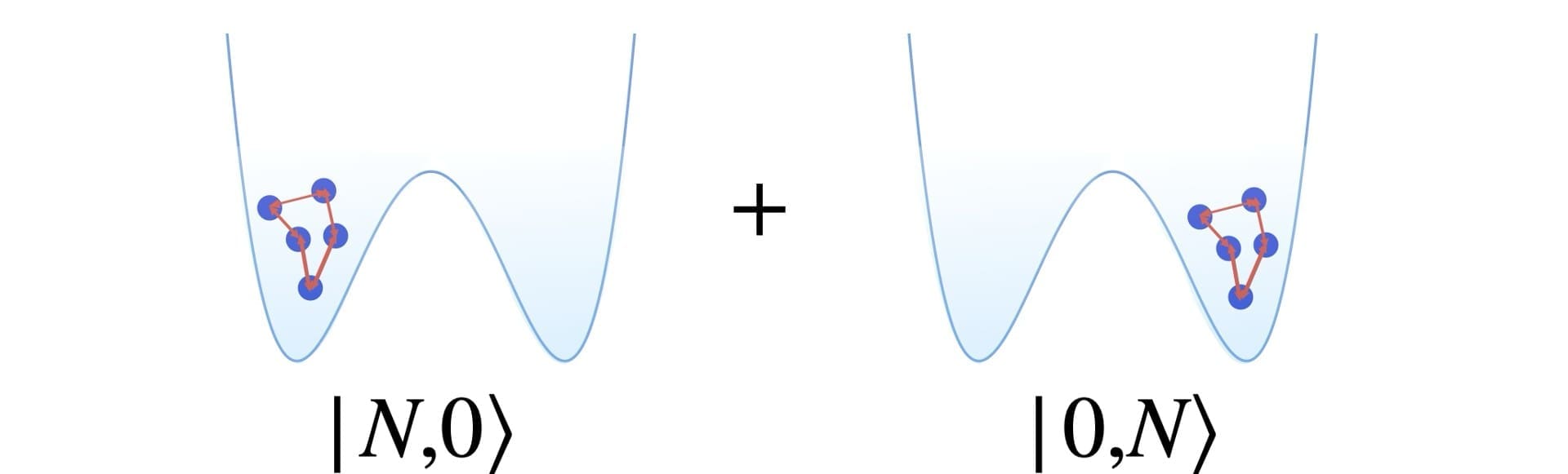
Researchers at the University of Liège have developed a novel protocol combining geometry and quantum control to rapidly generate NOON states, which are quantum superpositions of ultra-cold atoms. These states, previously time-consuming to create, can now be produced in milliseconds with near-perfect fidelity, enabling practical applications in quantum metrology and information technologies. The breakthrough addresses the challenge of energy bottlenecks by smoothing the system’s evolution, significantly accelerating the process and paving the way for quantum sensors and computing advancements.
Quantum Superhighway for Ultrafast NOON States
NOON states represent a critical advancement in quantum physics, exemplifying quantum superposition where particles exist in multiple states simultaneously. These states are pivotal for technologies like ultra-sensitive sensors and quantum computers, offering unprecedented precision and computational capabilities.
Traditionally, creating NOON states posed significant challenges due to the time-intensive processes involved. Researchers faced bottlenecks that hindered practical applications, necessitating a more efficient approach.
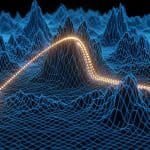
The University of Liège team addressed these challenges by pioneering an innovative method utilizing counter-diabatic driving and optimal geodesic paths. This approach bypasses traditional energy bottlenecks, reducing creation time from minutes to milliseconds. Counterdiabatic driving ensures particles transition smoothly between states without dissipating energy, while optimal geodesic paths minimize the steps required to achieve the desired quantum superposition.
This method maintains high fidelity in NOON state generation, ensuring particles remain in their intended quantum states throughout the process. Reducing creation time enhances practicality for applications such as quantum metrology and computing, where precision and speed are critical. By streamlining the energy landscape, researchers achieved a more efficient process that aligns with real-world technological demands.
The integration of geometry and quantum control represents a significant advancement in manipulating quantum systems. This approach not only accelerates NOON state creation but also ensures stability and reliability, making it suitable for broader applications in quantum technology. The ability to generate these states quickly and accurately marks a substantial step forward in harnessing quantum phenomena for practical use.
This innovative method has revolutionized the creation of NOON states with ultracold atoms. By integrating counter-diabatic driving with optimal geodesic paths, researchers have successfully bypassed traditional energy bottlenecks that previously hindered efficient state formation.
Counterdiabatic driving involves applying external influences to guide quantum systems smoothly through transitions, preventing energy dissipation and ensuring particles transition efficiently. Mathematical models determine Optimal geodesic paths by identifying the most efficient routes in parameter space, minimizing unnecessary steps and detours.
This approach has reduced NOON state creation time from minutes to milliseconds, significantly enhancing practicality for applications such as quantum metrology and computing. The method maintains high fidelity, ensuring particles remain in their intended superpositions without errors, which is crucial for system integrity.
The breakthrough addresses a significant challenge in quantum technology by making NOON states more accessible and efficient. Future steps may explore scalability to more significant particle numbers and different atom types while considering any limitations that might arise from this method. This advancement solves a specific problem and opens new avenues for quantum technology, promising enhanced performance and broader applicability.
Practical Applications in Quantum Technologies
The University of Liège team’s innovative method has significant implications for practical applications in quantum technologies. Their approach addresses key challenges in fields such as quantum metrology and computing by enabling faster and more reliable NOON state creation.
In quantum metrology, the ability to generate NOON states quickly enhances measurement precision, which is essential for applications like gravitational wave detection and magnetic field sensing. Similarly, in quantum computing, ultrafast NOON state creation improves processing speeds and efficiency, contributing to advancements in computational power.
The method’s high fidelity ensures that particles remain in their intended superpositions without errors, maintaining system integrity. This reliability is crucial for real-world applications where precision and accuracy are paramount.
Looking ahead, this method’s scalability to larger particle numbers and different atom types presents exciting possibilities for further innovation. While challenges such as potential limitations in scalability or error correction may arise, these can be addressed through continued research and development.
Overall, the University of Liège team’s breakthrough represents a significant step forward in quantum technology, offering enhanced performance and broader applicability. Their work solves specific problems and opens new avenues for exploration and innovation in the field.
More information
External Link: Click Here For More