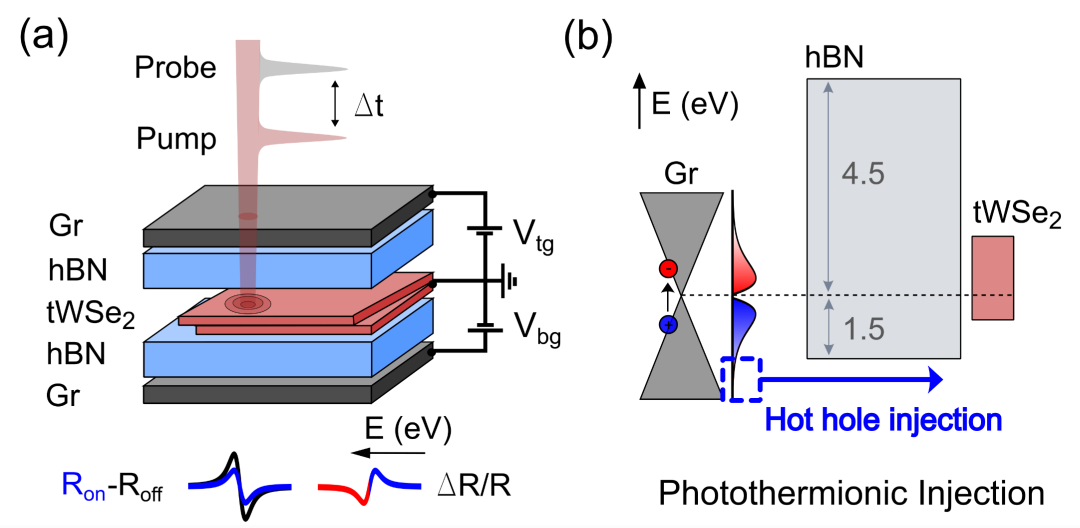
Van der Waals heterostructures offer exciting possibilities for exploring novel electronic states, and recent work investigates how these materials behave when excited by extremely short bursts of laser light. Yiliu Li, Esteban Rojas-Gatjens, and Yinjie Guo, all from Columbia University, along with Birui Yang, Dihao Sun, Luke Holtzman, and colleagues, now demonstrate a remarkably fast way to control charge within these structures. Their research reveals a process called photo-thermionic injection, where light triggers the injection of charge carriers from graphite gates into a twisted bilayer of tungsten diselenide. This method allows for ultrafast “doping” of the material, effectively changing its electronic properties, and the team shows they can precisely control this process by adjusting the light’s energy and intensity, opening new avenues for manipulating and studying correlated electronic phases in two-dimensional materials.
Photodoping Detail, Modeling, and Reproducibility Evidence
This supplementary information provides extensive supporting evidence and detailed explanations for recent research on photodoping in van der Waals heterostructures, demonstrating the reproducibility of observed effects and ensuring transparency through open data and methods. Researchers aimed to establish a clear understanding of the photodoping mechanism and its dependence on experimental parameters. Detailed theoretical modeling, using a Transfer Matrix Model and a simplified model connecting laser intensity and gate voltage to photo-generated carriers, helps interpret experimental data and extract key parameters governing the photodoping process. Supporting data confirms device functionality and reproducibility across multiple samples. Detailed characterization of a second device confirms that the observed effects are not limited to a single sample, while transient reflectance maps reveal the dynamic response of both devices, further supporting the reproducibility of the photodoping effect. This comprehensive approach establishes a strong foundation for understanding and controlling charge carriers in these complex materials.
Transient Reflectance Maps Moiré Structure Dynamics
Scientists have developed a sophisticated method to investigate the non-equilibrium dynamics of van der Waals heterostructures, specifically twisted bilayer tungsten diselenide. The research pioneers a technique employing femtosecond laser excitation to induce and monitor photo-doping within the moiré structure, revealing a novel mechanism for controlling charge carriers. Researchers constructed a multilayer device incorporating graphite gates and hexagonal boron nitride spacers, enabling precise control over the electronic environment. The core of the method involves transient reflectance experiments, where a pump laser induces changes in the sample and a weaker probe laser tracks the dynamics of photo-induced charge carriers.
By systematically varying the pump photon energy and intensity, scientists investigated the influence of excitation on the system’s response, discovering that photo-excitation of the graphite electrodes results in hole injection into the tungsten diselenide bilayers via a photo-thermionic emission process. Detailed analysis of pump fluence-dependent measurements, at both early and longer time delays, revealed a shift in spectral features, confirming the hole injection mechanism. Numerical simulations corroborated the experimental findings, demonstrating that the observed hole injection is consistent with thermionic emission over the hexagonal boron nitride barrier. The injected holes accumulate with each laser pulse, creating a measurable modulation of the electron density and enabling dynamic control of the correlated insulating state.
Photodoping Controls Charge in Twisted Bilayer Material
Scientists have demonstrated a novel photodoping mechanism in twisted bilayer tungsten diselenide, a two-dimensional material with intriguing electronic properties. The research establishes that optical excitation of graphite electrodes injects holes, positive charge carriers, into the semiconductor material, transiently altering its electronic state. This hole injection occurs via photo-thermionic emission, where energetic carriers overcome the energy barrier presented by the intervening hexagonal boron nitride layer. Experiments utilizing transient reflectance spectroscopy reveal three distinct signatures confirming this photo-induced hole injection, including shifts in gate voltages at which optical signatures of correlated insulating states appear, indicating a change in the material’s charge density.
Furthermore, a persistent optical signal lasting for at least 2. 5 microseconds demonstrates charge diffusion and local charge buildup from pulse to pulse, confirming the accumulation of injected holes. The emergence of a photoinduced absorption feature suggests a transition towards an insulating state induced by the increased charge carrier density. The team precisely controlled the amount of injected holes by tuning the laser wavelength, excitation intensity, and gate voltage, demonstrating precise control over the material’s doping. Numerical simulations corroborate the experimental findings, showing that the hole injection is dominated by thermionic emission. This breakthrough establishes a pathway for optically modulating the doping density of moiré superlattices, potentially enabling new functionalities in nanoscale electronic devices.
Photodoping Controls Charge Density in Bilayers
This research demonstrates a novel method for controlling charge density in layered materials, specifically twisted bilayer tungsten diselenide, through photo-thermionic injection. Scientists achieved ultrafast photodoping by using light to induce hole injection from graphite gates within the device structure, a process occurring on picosecond timescales, significantly faster than conventional electrostatic gating. This injection was confirmed through multiple spectroscopic signatures, including shifts in gate voltages and persistent optical signals indicative of charge accumulation. Importantly, the team established precise control over the injected hole population by tuning the energy and intensity of the light source, as well as the applied electric field, highlighting the potential of utilizing the entire van der Waals device stack to actively manipulate the electronic properties of two-dimensional materials. Future work may focus on exploring this mechanism in other layered materials and device architectures, potentially leading to new avenues for ultrafast optoelectronic devices and the exploration of exotic quantum phases.
🗞 Ultrafast Charge-Doping via Photo-Thermionic Injection in van der Waals Devices
🧠 ArXiv: https://arxiv.org/abs/2510.21008