

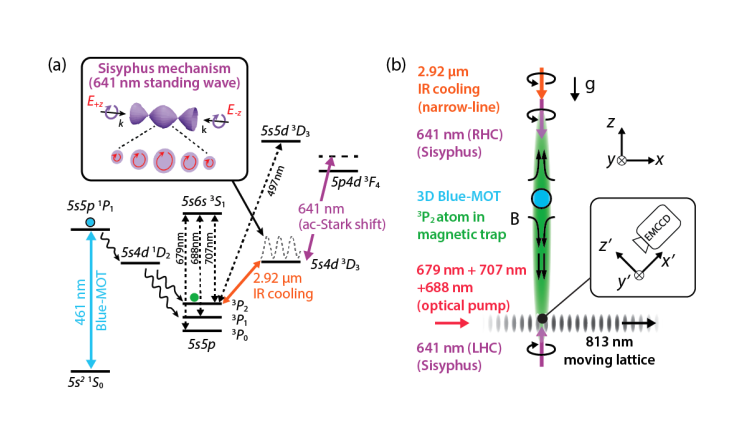
The pursuit of ultracold atoms represents a significant area of contemporary physics, enabling precision measurements and novel sensing technologies. Researchers are continually refining techniques to achieve and maintain atomic temperatures close to absolute zero, a condition where quantum effects become prominent. A team led by Chun-Chia Chen, Ryoto Takeuchi, Shoichi Okaba, and Hidetoshi Katori, from institutions including RIKEN and the University of Tokyo, detail a method for enhancing the efficiency of ‘Sisyphus cooling’ in strontium atoms. Their work, published under the title “Narrow-line-mediated Sisyphus cooling in the metastable state of strontium”, demonstrates a two-fold improvement in atom trapping achieved through the application of a moving optical lattice and narrow-line cooling, a technique that utilises the Doppler effect to slow and cool atoms. This advancement holds promise for the development of next-generation sensors reliant on continuous beams of ultracold atoms.
Manipulation of ultracold atoms enhances beam production for advanced sensing applications. Recent research demonstrates narrow-line-mediated Sisyphus cooling of magnetically trapped strontium in the ⁵s⁵p ³P₂ state, utilising a 641-nanometre standing wave, blue-detuned from the ⁵s⁵p ³P₂ → ⁵s⁴d ³D₃ transition. This technique facilitates continuous atom outcoupling via a moving optical lattice, resulting in a two-fold increase in atom number and establishing a robust method for generating continuous ultracold atomic beams.
Sisyphus cooling, a technique named after the Greek myth of Sisyphus, relies on the repeated absorption and spontaneous emission of photons. This process creates a ‘sticky’ force that slows atoms down, effectively reducing their kinetic energy. The implementation of a moving optical lattice further enhances this process, improving the efficiency of momentum transfer and atom confinement, ultimately leading to a significant increase in the number of trapped atoms. An optical lattice is created by the interference of laser beams, forming a periodic potential that confines neutral atoms.
The research builds upon established techniques in atomic
The research builds upon established techniques in atomic physics, referencing prior work on Stark-electric-quadrupole interference and precise wavelength measurements for strontium spectra. Stark-electric-quadrupole interference arises from the interaction between the electric field gradient and the electric quadrupole moment of an atom, influencing its energy levels and transitions. Numerical methods for solving the differential equations governing atomic motion are crucial to modelling and optimising the cooling process, allowing for precise control over the atoms’ behaviour. Furthermore, the work leverages advancements in magnetic trapping techniques and a thorough understanding of strontium’s metastable states, providing a solid foundation for manipulating and controlling atomic beams. Metastable states are excited states with relatively long lifetimes, making them suitable for precision measurements and quantum control.
The demonstrated improvement in atom number and cooling efficiency has significant implications for the development of next-generation sensors, particularly in fields such as atomic clocks, gravitational wave detection, and fundamental physics research. By creating continuous beams of ultracold atoms, this technique paves the way for more precise and sensitive measurements, enabling advancements in various scientific disciplines. Atomic clocks, for example, rely on the precise measurement of atomic transitions, and ultracold atoms can significantly improve their accuracy and stability. Gravitational wave detectors utilise the interference of laser beams to detect tiny distortions in spacetime, and ultracold atoms can enhance their sensitivity.
This research opens new avenues for exploring the fundamental properties of matter and developing advanced technologies based on ultracold atoms. The ability to create continuous beams of ultracold atoms with high density and low velocity enables a wide range of applications, including precision measurements, quantum simulations, and the development of novel sensors. Quantum simulations utilise ultracold atoms to model complex quantum systems, providing insights into their behaviour and properties.
Researchers are currently investigating the use of this
Researchers are currently investigating the use of this technique to create more complex atomic structures and explore their properties, as well as developing new methods for controlling the interactions between atoms, which could lead to the creation of novel quantum materials. They are also exploring the potential of this technique for developing advanced sensors with unprecedented sensitivity and precision.
🗞 Narrow-line-mediated Sisyphus cooling in the metastable state of strontium
🧠 DOI: https://doi.org/10.48550/arXiv.2506.19701


