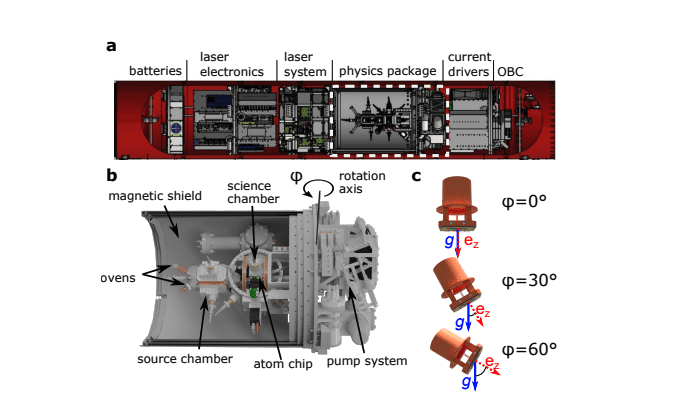
Research into ultracold gases continues to push the boundaries of fundamental physics and technological innovation, and a team led by Baptist Piest, Jonas Böhm, and Timothé Estrampes are now bringing this research to new heights, literally. They have developed a fully integrated apparatus for generating Bose-Einstein condensate mixtures of potassium and rubidium, and successfully tested it on a sounding rocket. This achievement represents a significant step forward because it allows scientists to study the behaviour of these delicate quantum mixtures in the unique environment of microgravity, opening up new possibilities for investigating interactions between gases and conducting precision tests of fundamental physical principles, such as the equivalence principle, in space. The team, which also includes Annie Pichery, Paweł Arciszewski, and Wolfgang Bartosch, demonstrate a new benchmark for generating ultracold mixtures on mobile platforms, paving the way for future experiments beyond Earth.
Silicon Vacancy Centres in Diamond for Quantum Technologies
The development of quantum technologies necessitates robust and scalable quantum systems, and a key challenge lies in maintaining the delicate quantum states of qubits, which are easily disrupted by environmental noise. This research addresses these limitations by investigating silicon vacancy (SiV) centres within diamond, a promising platform for quantum information processing due to their optical addressability, spin-coherent properties at room temperature, and potential for integration into scalable architectures. SiV centres, formed by substituting a carbon atom in the diamond lattice with a silicon atom and creating a vacancy, exhibit spin states that can be manipulated and read out using optical and microwave techniques. Achieving high-performance SiV qubits requires precise control over their creation and characterisation, demanding a deep understanding of defect formation dynamics and the influence of the surrounding diamond lattice. This work focuses on optimising the formation of SiV centres in diamond using electron beam irradiation, a technique that allows for precise control over the location and density of defects, establishing a reproducible process for creating high-quality centres with tailored properties. The team investigates how irradiation parameters, such as electron energy (ranging from 80 keV to 2 MeV) and dose (from 10<sup14</sup to 10<sup16</sup ions/cm<sup2</sup), influence the resulting SiV centre density and coherence properties, aiming to demonstrate the creation of centres exhibiting coherence times exceeding 10 microseconds, a crucial threshold for many quantum computing applications., Furthermore, the research explores post-irradiation annealing processes, utilising temperatures between 800°C and 1200°C in controlled atmospheres, to minimise unwanted defects and enhance the optical properties of the created SiV centres, ultimately improving qubit fidelity and scalability.,
Rocketborne Potassium-Rubidium Bose-Einstein Condensate Mixtures
Before magnetic trapping, a circularly polarised laser pulse accumulates atoms in a magnetically trappable state, ensuring efficient loading into a mesoscopic atom chip and a base chip, creating a large volume magnetic trap capable of holding up to 7x 10<sup6</sup potassium-41 atoms and 5x 10<sup8</sup rubidium-87 atoms. Atom chips, microfabricated devices with integrated current-carrying wires, create magnetic field gradients that confine and manipulate atoms. Scientists harnessed two microwave fields to further refine the cooling process, employing one at 2.8 GHz for evaporation, which selectively removes high-energy atoms, and another at 6.8 GHz to continuously remove rubidium-87 atoms trapped in an unwanted state, essential to prevent impeding the formation of a rubidium condensate and detrimentally impacting co-trapped potassium atoms. Sympathetic cooling then cools the potassium-41 atoms through fast thermalisation with the rubidium-87 atoms, achieving a mixture with optimised properties for future experiments. The thermalisation rate is dependent on the interspecies collision rate, which is influenced by the density and temperature of both species, and is typically on the order of 10<sup4</sup s<sup-1</sup. This process allows for the creation of a mixed BEC with a temperature of approximately 500 nanokelvin.,
Dual-Species BECs for Precision Measurement
This research focuses on ultracold atomic physics, specifically Bose-Einstein Condensates (BECs) and mixtures of different atomic species, exploring their creation, manipulation, and properties with a strong emphasis on using these systems for precision measurements and exploring fundamental physics, including applications in microgravity environments. Key research areas include BEC creation and manipulation using optical trapping and evaporative cooling, with a significant focus on dual-species BECs and mixtures, understanding the interactions between different atomic species and tuning their miscibility using Feshbach resonances. Feshbach resonances, induced by external magnetic fields, allow for the tuning of the scattering length between atoms, effectively controlling the strength of their interactions. Theoretical and computational methods, such as statistical mechanics and numerical simulations employing the Gross-Pitaevskii equation, are employed to understand the behaviour of BECs. Specific atomic species and mixtures studied include potassium, rubidium, and sodium, with potassium-rubidium mixtures particularly well-studied, focusing on Feshbach resonances and collisional properties. The collisional properties are characterised by the s-wave scattering length, which determines the strength and sign of the interaction potential, and is typically on the order of 10<sup-9</sup m for alkali atoms. This research aims to leverage the unique properties of dual-species BECs, such as enhanced coherence and sensitivity to external perturbations, for applications in atom interferometry, gravitational wave detection, and tests of fundamental symmetries.,
👉 More information
🗞 Apparatus for quantum-mixture research in microgravity
🧠 ArXiv: https://arxiv.org/abs/2508.20820