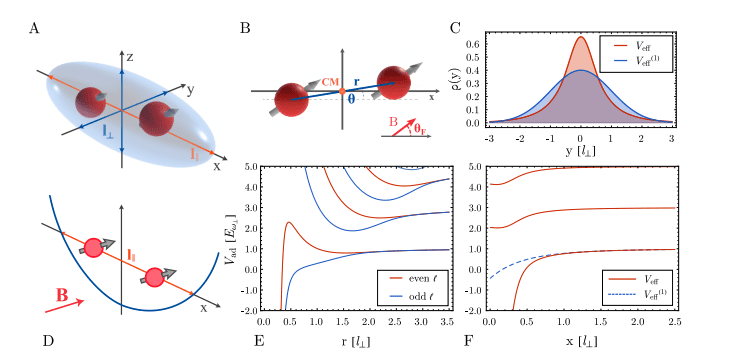
The behaviour of matter at ultracold temperatures presents a unique opportunity to simulate complex physical systems, and recent research focuses on harnessing the properties of dipolar quantum gases, formed from atoms or molecules possessing an electric dipole moment. These gases exhibit strong interactions that can be finely tuned, making them promising candidates for quantum simulation. However, accurately modelling these systems requires a detailed understanding of the effective interactions arising from the underlying microscopic parameters. Researchers at the University of Warsaw and the Polish Academy of Sciences, specifically Michał Zdziennicki, Mateusz Ślusarczyk, Krzysztof Pawłowski, and Krzysztof Jachymski, address this challenge in their work, titled “Effective Interactions in Quasi-One-Dimensional Dipolar Quantum Gases”. Their investigation reveals that standard one-dimensional models often fall short of capturing the full complexity of these systems, necessitating a comprehensive three-dimensional treatment to accurately describe their behaviour, particularly when probing excited states and phenomena occurring away from equilibrium.
Ultracold dipolar atoms and molecules represent a flexible platform for investigating strongly interacting quantum systems, yet accurate determination of microscopic Hamiltonian parameters remains crucial for effective simulation. Recent investigations focus on effective interactions within quasi-one-dimensional (q1D) dipolar gases, revealing substantial, nonuniversal corrections to the commonly employed one-dimensional pseudopotential. A pseudopotential is a mathematical simplification used to represent the short-range interactions between atoms, allowing for easier calculations. These corrections demonstrate the necessity of a complete three-dimensional treatment utilising realistic interaction potentials to accurately describe the reduced-dimensional system.
Early foundational work, commencing in 2002 with studies by Bolda et al. and Giovanazzi et al., established the principles of Feshbach resonances. Feshbach resonances are phenomena where the scattering length, a measure of the effective range of the interaction between atoms, can be tuned using external magnetic fields. This tuning capability is essential for controlling interactions in ultracold gases. Gao (2006) subsequently contributed to the theoretical understanding of quantum-statistical effects within these systems, providing deeper insight into the behaviour of many-body systems at extremely low temperatures. Further investigations into strongly correlated bosonic gases (Lahaye et al., 2008) and the dynamics of cold atomic collisions (Bohn et al., 2009; Quéméner et al., 2009) expanded understanding of these complex systems, laying the groundwork for exploring novel quantum phenomena.
From 2013 onwards, a significant body of research, consistently led by Langen, Boronat, Sánchez-Baena, Bombín, Karman, and Mazzanti, concentrates on refining the understanding of interactions in reduced dimensions, specifically q1D dipolar gases. Their work highlights the limitations of simplified pseudopotential approaches and emphasises the need for realistic descriptions of interatomic forces. The q1D geometry is achieved through confinement of the atoms using optical lattices or waveguides, effectively reducing their motion to one dimension.
Recent research demonstrates that a full three-dimensional treatment, utilising realistic interaction potentials, is essential for accurately describing interactions in q1D dipolar gases. This ensures the reliability and predictive power of these simulators, enabling researchers to explore complex quantum phenomena that would otherwise be inaccessible. Excited states often exhibit sensitivity to the details of the interactions, demanding an accurate description for understanding their properties, while nonequilibrium phenomena, such as those induced by external driving forces or sudden changes in parameters, can also be strongly influenced by the interactions.
This sustained investigation, spanning from 2002 to 2025, demonstrates a focused progression from establishing the fundamental principles of Feshbach resonances to meticulously characterising and refining the models needed to accurately simulate and interpret experiments with ultracold dipolar gases. This trajectory reveals a clear emphasis on understanding interactions in ultracold atomic gases and improving the fidelity of quantum simulations.
👉 More information
🗞 Effective Interactions in Quasi-One-Dimensional Dipolar Quantum Gases
🧠 DOI: https://doi.org/10.48550/arXiv.2506.19618