The behaviour of quantum systems frequently exhibits oscillations linked to underlying symmetries, and recent research demonstrates the persistence of these oscillations even when those symmetries are imperfectly maintained. Specifically, scientists investigate how quantum mixtures, composed of multiple types of bosons—particles that collectively occupy the lowest quantum state—respond to disruptions in a particular symmetry known as SU(2) symmetry. This symmetry dictates how particles interchange, and its breaking leads to predictable modulations in the momentum distribution of the mixture, a measurable property reflecting the particles’ collective motion. S. Musolino, M. Albert, P. Vignolo, and A. Minguzzi, from Universit´e Grenoble Alpes and Universit´e Cˆote d’Azur, alongside their colleagues at the CNRS research institutes, detail these findings in their article, “Symmetry oscillations sensitivity to U(2)-symmetry breaking in quantum mixtures”, published in Physical Review Letters. Their work establishes the robustness of these ‘symmetry oscillations’ across a range of interaction strengths between the constituent bosons, revealing a universal behaviour applicable to experiments utilising ultracold atoms.
Investigations into one-dimensional bosonic mixtures reveal that symmetry oscillations persist consistently, even with alterations in interaction strengths, offering accessible modulations in the momentum distribution for experimental observation utilising ultracold atoms. These bosonic mixtures, systems comprised of multiple boson species, exhibit collective behaviour governed by quantum mechanical principles. The research actively charts the dynamical evolution of particles across differing symmetry sectors, establishing a predictable correlation between initial conditions and subsequent dynamics. Researchers analyse how the amplitude and frequency of these symmetry oscillations respond to changes in the strength of the symmetry-breaking perturbation, confirming the observed phenomena represent a general characteristic of these quantum mixtures.
This research demonstrates the robustness of symmetry oscillations in strongly interacting one-dimensional bosonic mixtures, even when both inter-species and intra-species interaction strengths vary, providing valuable insights into the behaviour of Bose-Einstein condensates. A Bose-Einstein condensate is a state of matter formed when bosons are cooled to temperatures very close to absolute zero, resulting in a large fraction of the bosons occupying the lowest quantum state. The persistence of these oscillations despite varying interactions suggests a fundamental underlying mechanism governing the system’s behaviour.
The study focuses on systems exhibiting U(2)-symmetry breaking,
The study focuses on systems exhibiting U(2)-symmetry breaking, a characteristic frequently found in ultracold atom experiments, and reveals time-dependent modulations in the momentum distribution. SU(2) symmetry refers to a specific type of symmetry in quantum mechanics related to spin, and its breaking signifies a departure from this symmetrical state due to external influences or interactions. These modulations, or periodic changes, in the momentum distribution provide a measurable signature of the symmetry oscillations.
The investigation begins with the ground state of an U(2) symmetric Hamiltonian, a mathematical description of the system’s energy, and subsequently evolves the system using a Hamiltonian that breaks this symmetry, allowing for a detailed understanding of how external influences affect the system’s internal dynamics. Crucially, the research establishes that the coupling between symmetry sectors during time evolution is governed by the spin-flip symmetry of the initial state, highlighting the importance of initial conditions in determining the system’s subsequent behaviour. Spin-flip symmetry refers to the conservation of spin during interactions, influencing how the system evolves over time.
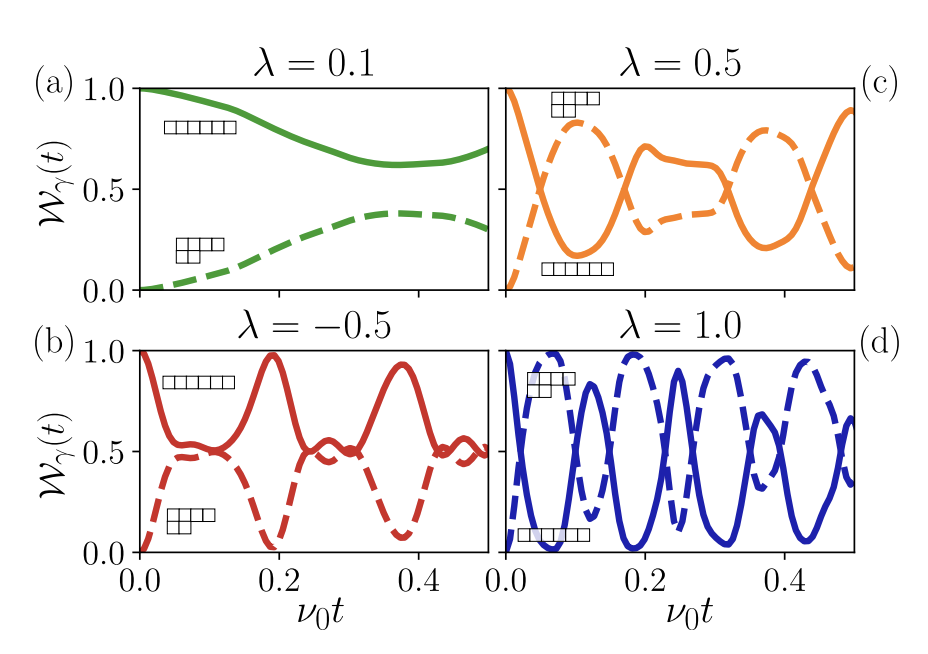
Furthermore, the study demonstrates that the population of the initial state can periodically diminish, even in specific limits, reinforcing the robustness and universality of the observed symmetry oscillations. This periodic reduction in the initial state population indicates a transfer of particles between different symmetry sectors, further confirming the dynamic nature of the system.
The methodology relies on theoretical modelling and simulation, providing a deeper understanding of strongly interacting quantum systems. These simulations allow researchers to explore the system’s behaviour under various conditions and validate their theoretical predictions.
Future research will investigate the influence of various
Future research will investigate the influence of various initial conditions and system parameters on the observed symmetry oscillations, thereby expanding our understanding of these complex quantum phenomena. Researchers plan to investigate the potential for utilising these oscillations as a tool for controlling and manipulating quantum systems, opening up new avenues for quantum technologies. They also aim to extend these studies to more complex systems, such as those with multiple interacting particles, to gain a deeper understanding of the underlying physics.
🗞 Symmetry oscillations sensitivity to SU(2)-symmetry breaking in quantum mixtures
🧠 DOI: https://doi.org/10.48550/arXiv.2506.22266