

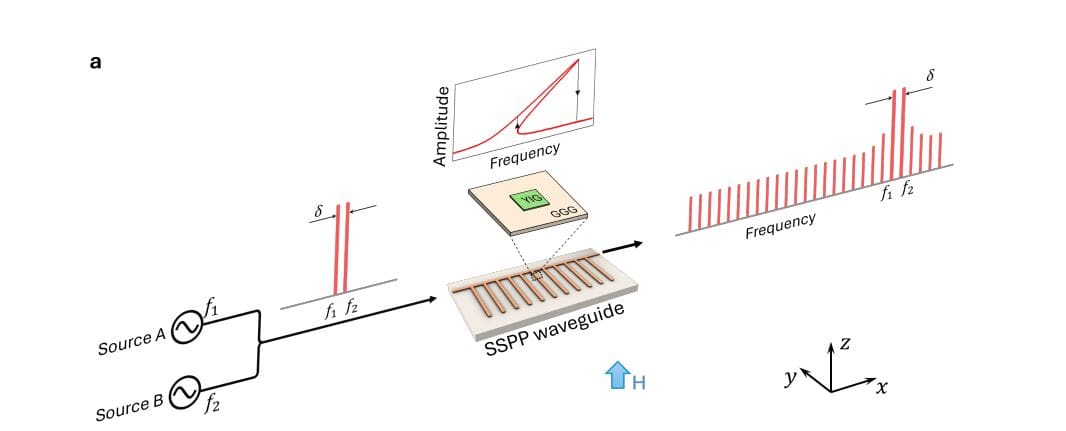
Magnonic frequency combs represent a potentially revolutionary technology for generating and processing microwave signals with significantly reduced energy consumption, and researchers are continually seeking ways to improve their performance and scalability. Yu Jiang, Vasyl Tyberkevych from Oakland University, Yizhong Huang, Zixin Yan, Amin Pishehvar, and Andrei Slavin from Northeastern University have now demonstrated a fundamentally new method for creating ultra-broadband magnonic frequency combs, achieving a substantial leap forward in the field. The team’s approach utilises a highly nonlinear, miniaturised magnonic resonator driven into a bistable regime, allowing for the generation of over 350 comb lines spanning a 450MHz bandwidth, an order of magnitude greater than previously reported. This ultra-compact platform, significantly smaller than conventional devices, offers continuous tunability and precise control over comb properties, paving the way for transformative advances in microwave signal processing and precision sensing technologies.
A promising route exists towards compact, energy-efficient platforms for on-chip coherent microwave signal generation and processing. Conventional on-chip comb generation typically relies on nonlinear resonators with fixed comb spacing, limiting flexibility. This work introduces a fundamentally different mechanism for ultrabroadband multi-frequency comb (MFC) generation, utilizing a highly nonlinear, miniaturized magnonic resonator. The small resonator volume, combined with a slow-wave transducer, concentrates power within the device, driving the system deeply into a nonlinear regime where complex interactions occur.
Magnonic Combs for Microwave and Terahertz Technology
Scientists are developing magnonic frequency combs, analogous to optical frequency combs but utilizing magnons, quantized spin waves in magnetic materials. These combs offer significant potential for advancements in microwave and terahertz technology, information processing, and high-precision sensing. The research focuses on generating broadband magnonic frequency combs, which provide greater versatility than traditional approaches, and utilizes hybrid systems combining magnons with phenomena like lattice vibrations and slow-wave structures to enhance interactions.
Ultra-Broadband Magnonic Comb Generation on Chip
Scientists have achieved a breakthrough in on-chip microwave signal generation with a new magnonic frequency comb (MFC) platform, demonstrating a significant leap in bandwidth and comb-line count. This work introduces a fundamentally different mechanism for generating these combs, utilizing a highly nonlinear, miniaturized magnonic resonator to create ultra-broadband signal generation. Experiments reveal the creation of over 350 comb lines spanning a 450MHz bandwidth, representing an order-of-magnitude improvement over previously reported results. The team fabricated a YIG thin-film microresonator, measuring just 0.
2 × 50 × 50 μm³, reducing the device volume by four to six orders of magnitude compared to conventional YIG sphere resonators. This miniaturization, combined with integration with a slow-wave microwave waveguide, dramatically increases power density within the resonator, driving the system into a bistable regime where parametric excitation of spin waves facilitates comb formation. Data shows that the platform achieves a threefold enhancement in performance compared to parallel studies relying on resonant comb generation, which exhibit fixed comb spacing. The researchers demonstrated large-amplitude nonlinear magnonic response by driving the resonator with a detuned microwave signal, achieving efficient power delivery to the uniform magnon mode. This breakthrough delivers a scalable and tunable solution for next-generation electronics, unlocking new possibilities in microwave signal processing, neuromorphic computing, and precision sensing.
Ultra-Broadband Magnonic Comb Generation Demonstrated
This research demonstrates a new method for generating magnonic frequency combs, achieving a significant advancement in on-chip microwave signal processing. Scientists have successfully created an ultra-broadband frequency comb using a miniaturized magnonic resonator, producing over 350 comb lines spanning a 450MHz bandwidth, representing an order-of-magnitude improvement in comb line count compared to previous demonstrations. The approach relies on parametric excitation of spin waves within the resonator, driven into a bistable regime, and allows for continuous tuning of comb line spacing, a key advantage over other frequency comb technologies. The resulting platform is remarkably compact, several orders of magnitude smaller than conventional systems, and is fully scalable for integration into complex circuits.
Experiments reveal a maximum on-chip comb power of 2. 58 μW, with an average power of 31 nanowatts per comb line, and demonstrate a single comb-line linewidth of 26Hz, indicating excellent coherence. While the comb lines are superimposed on a broadband continuum background, likely due to four-magnon scattering, the extinction ratio remains high at the upper end of the frequency span. Researchers acknowledge that further improvements could potentially increase comb line count even further. This work establishes a new paradigm for frequency comb technology, opening opportunities for transformative advances in microwave signal processing and precision sensing.
👉 More information
🗞 Generation of Ultra-Broadband Frequency Comb in Strongly Bistable Nonlinear Magnonic Resonator
🧠 ArXiv: https://arxiv.org/abs/2511.22915


