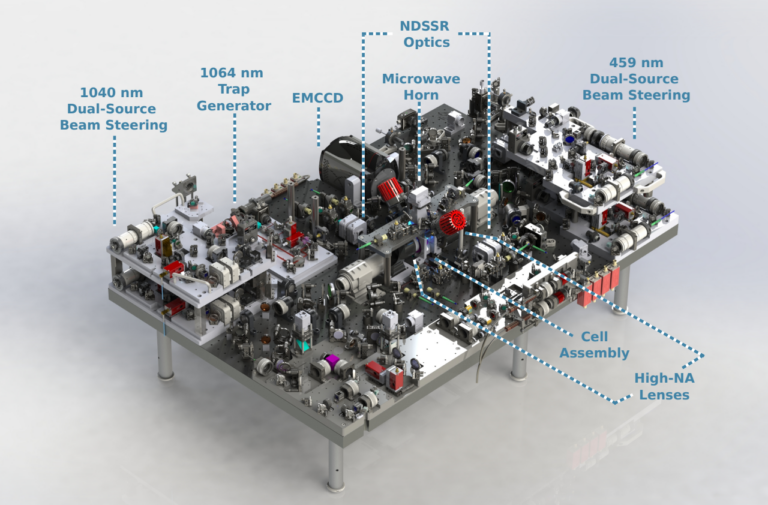
Infleqtion has secured £2.2 million in funding to enhance the performance of its Sqale neutral atom quantum computer at the National Quantum Computing Centre (NQCC) in Harwell, Oxfordshire. The 12-month SQALE2 programme, conducted in collaboration with the Fraunhofer Centre for Applied Photonics, the National Physical Laboratory, the University of Strathclyde, and the University of Edinburgh, aims to increase the rate of gate execution – a measure of computational speed – by a factor of 10 to 100. This development focuses on parallel processing via advanced optical technologies and seeks to improve the scalability and viability of quantum computing hardware within the UK’s national quantum infrastructure, with independent verification of results planned throughout the project.
Advancing Quantum Computation with Neutral Atoms
The Sqale platform advances quantum computing, collaborating with leading institutions to accelerate development and validation, and strengthen the UK quantum ecosystem through strategic investment and a skilled workforce. This collaborative framework extends beyond performance enhancement to encompass workforce development and knowledge transfer between partners, accelerating the advancement of expertise in quantum computing hardware and software. The UK quantum ecosystem benefits from this strategic investment, fostering a sustainable environment for long-term growth and innovation.
The project partners Infleqtion with the University of Strathclyde, the University of Edinburgh, and the Fraunhofer Centre for Applied Photonics to achieve advancements in quantum processing capabilities and establish a robust verification framework. The University of Strathclyde contributes expertise in quantum control and measurement, while the University of Edinburgh focuses on developing software tools for precise control over laser pulses applied to individual qubits. The Fraunhofer Centre for Applied Photonics designs and builds the specialized optical components required for high-fidelity qubit control and manipulation.
The Sqale platform utilizes neutral atoms, offering inherent advantages in coherence, and implements parallel processing to overcome the limitations of sequential gate execution. Maintaining qubit coherence during concurrent manipulation is crucial, requiring careful shielding from environmental noise and precise control over electromagnetic fields. The anticipated increase in gate execution rate relies not solely on hardware improvements but also on the optimization of control pulse shaping and sequencing.
Researchers implement a tiered benchmarking approach, utilizing established quantum algorithms for quantum simulation and optimization to compare performance against other quantum computing platforms. Complementary to this, the development of novel verification frameworks enables a more granular assessment, specifically focusing on the efficiency and fidelity of parallel gate operations. Researchers develop new verification frameworks to address the challenges of evaluating quantum systems, recognizing that traditional benchmarks may not fully capture the nuances of parallel processing or the specific advantages of neutral atom architectures.
These bespoke tools provide a more granular assessment of the platform’s capabilities, enabling a deeper understanding of its strengths and limitations. The project emphasizes independent verification to build trust and transparency in reported results, subjecting the Sqale platform to rigorous external scrutiny. The Sqale platform’s architecture, utilizing neutral atoms in a vacuum environment, inherently offers advantages in coherence, but further optimization of shielding and control systems is essential to maximize qubit lifetimes during parallel operations.
The Sqale platform represents a significant step forward in quantum computing, paving the way for more powerful and efficient quantum processors.
More information
External Link: Click Here For More