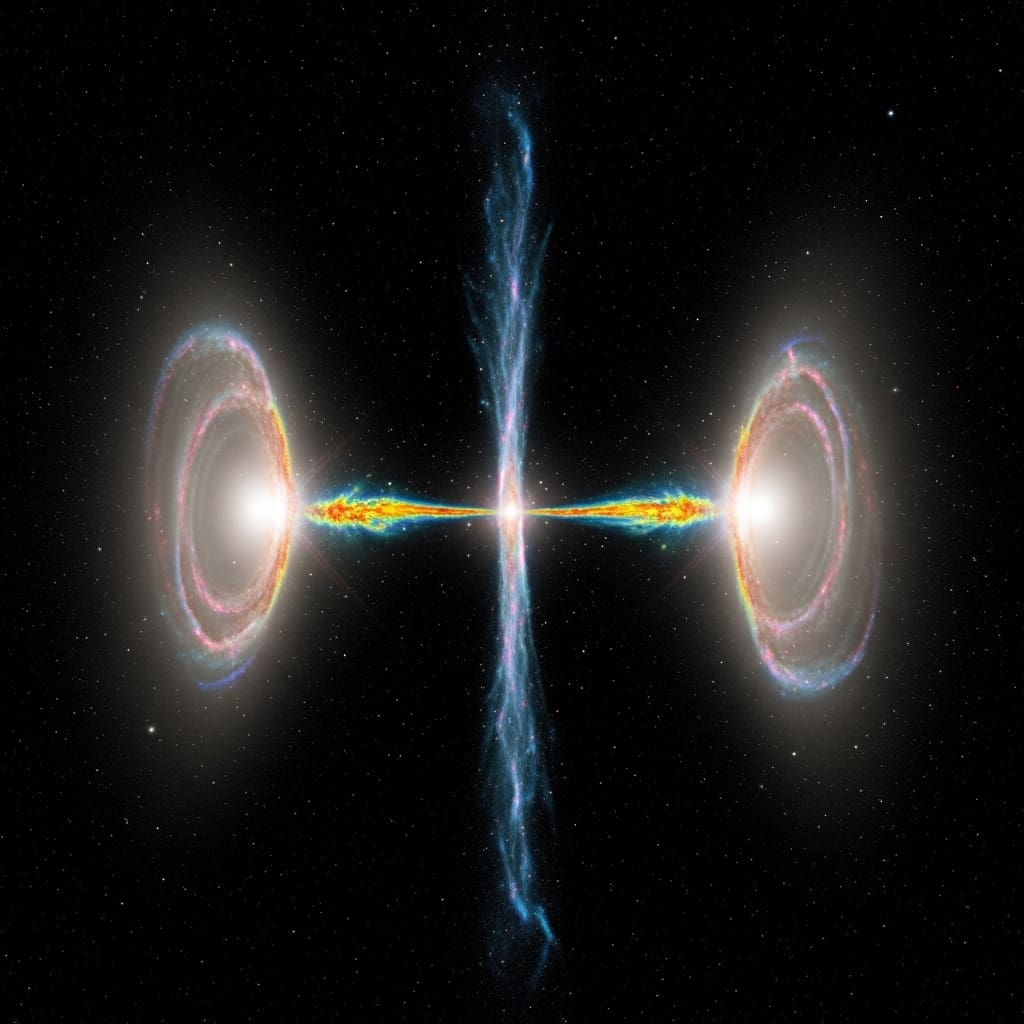
Scientists have detected a substantial outflow of neutral hydrogen gas extending far beyond the host galaxy of the radio galaxy 0731+438, offering a new insight into how active galactic nuclei influence their environments. Renzhi Su, from the Shanghai Astronomical Observatory, alongside Stephen J. Curran of Victoria University of Wellington, James R. Allison from First Light Fusion Ltd., and et al., used upgraded Giant Metrewave Radio Telescope observations to identify this outflow , a faint 21cm absorption line detected 47 kiloparsecs from the galaxy’s core. This discovery is significant because it reveals jet-gas interactions happening on a cosmic scale at a redshift of 2.429, a period known as ‘cosmic noon’ when galaxies were forming stars at their highest rate, and demonstrates a powerful mechanism for suppressing star formation through feedback from the central supermassive black hole. The outflow’s considerable mass and energy outflow rates, exceeding previously known examples, suggest that jet-driven outflows may play a more prominent role in galaxy evolution than previously thought.
429 and exhibiting lobes separated by 82 kpc, displays a blueshifted, faint, and broad H{\sc i} 21cm absorption line against its southern radio lobe, a clear indication of a neutral hydrogen outflow stemming from jet-gas interaction well beyond the host galaxy itself. The detected absorption line possesses a velocity full width at half maximum (FWHM) of approximately 600km s−1 and originates 47 kpc from the galaxy’s core, providing unprecedented insight into gas dynamics at cosmic noon. The research team meticulously analysed the uGMRT data, employing a bandwidth of 25MHz centred on 414.3MHz, divided into 2048 channels, to achieve a velocity coverage of -9000 to 9000km s−1 with a resolution of approximately 8.8km s−1.
Calibration procedures, including bandpass, flux, and gain corrections using 3C 147 and 0702+445 as calibrators, were crucial in mitigating radio frequency interference and ensuring data quality. This careful approach enabled the detection of the faint Hi absorption signal previously hinted at by earlier WSRT observations, which were hampered by significant RFI. The outflow’s mass outflow rate is estimated to be around 0.4TsΩM⊙yr−1, potentially increasing to 4.0TsΩM⊙yr−1, corresponding to an energy outflow rate ranging from 2.4TsΩ× 1040 to 1.5TsΩ× 1041 erg s−1, where Ts represents the spin temperature and Ω is the solid angle of the outflow. This breakthrough expands our understanding of jet-driven outflows, as previous detections have largely been limited to lower redshifts and smaller scales.
Furthermore, optical observations previously identified an extended emission line region aligned with the radio axis, ionized by the central Active Galactic Nucleus (AGN), and a warm ionized outflow with a mass outflow rate of approximately 50 M⊙yr−1 and an energy outflow rate of around 1.7×1043 erg s−1. The team proposes a synergistic effect between the jet and AGN radiation drives both the extended emission line region and the optical outflow, suggesting the AGN exerts negative feedback on the host galaxy through gas expulsion and high velocity dispersion. The high redshift, large outflow radii, substantial mass outflow rate, and significant energy outflow rate of the neutral hydrogen outflow in 0731+438 dramatically expand the known parameter space of such outflows. Initial analysis also reveals tentative correlations between the neutral hydrogen mass outflow rate (or energy outflow rate) and the rest-frame 1.4GHz radio power of the jets for the currently known broad neutral hydrogen outflows, hinting at a potential link between jet activity and outflow strength0.429, seeking to detect and characterise neutral hydrogen outflows driven by jet-gas interaction. The study utilised a 25MHz bandwidth centred on 414.3MHz, divided into 2048 channels, achieving a velocity coverage of -9000 to 9000km s−1 with a velocity resolution of approximately 8.8km s−1, enabling detailed spectral analysis of the Hi 21cm absorption line. Observations were conducted on January 20, 2023, with three 38-minute scans of the target, interspersed with observations of the gain calibrator 0702+445 and the bandpass/flux calibrator 3C 147, ensuring accurate calibration and reliable flux measurements. Researchers meticulously calibrated the data using CASA, beginning with initial flagging of corrupted data arising from shadowing, scan edges, non-functional antennas, and radio frequency interference, a crucial step for high-redshift observations.
Subsequent calibration stages included initial flux scaling, bandpass calibration, complex gain calibration, and amplitude scaling, iteratively refined through repeated flagging and calibration cycles to minimise systematic errors and maximise data quality. The team then focused on identifying and isolating the Hi absorption signal, confirming its presence within the frequency range of 413.610, 414.831MHz, corresponding to a redshift of 2.424, 2.434, and indicative of neutral hydrogen gas interacting with the radio jet. To create a detailed spectral cube, scientists first applied the self-calibration solutions to the high-resolution visibilities, then subtracted the continuum emission by fitting a second-order polynomial to the visibility data in the frequency ranges of 412.390, 413.610MHz and 414.831, 416.052MHz, a technique that effectively removes broadband emission and isolates the spectral line. Further inspection and flagging of channels with inadequate continuum subtraction ensured the accuracy of the final cube, which was then generated from the remaining channels between 412.390 and 416.052MHz, revealing the kinematics and dynamics of the neutral hydrogen outflow0.429. This detection, situated 47 kpc from the radio core, indicates a neutral hydrogen outflow resulting from jet-gas interaction extending beyond the host galaxy itself. Experiments revealed the outflow possesses a velocity full width at half maximum (FWHM) and a mass outflow rate ranging from 10⁴⁰ to 1.5x 10⁴¹ erg s⁻¹, dependent on the spin temperature (Ts) and solid angle (Ω) of the outflow. The team measured an energy outflow rate of between 2.4TsΩ x 10⁴⁰ and 1.5TsΩ x 10⁴¹ erg s⁻¹, providing crucial insight into the energy transfer occurring within this system.
Results demonstrate that the observed neutral hydrogen outflow is substantial, exhibiting a high redshift and extending to large radii, characteristics rarely seen in previous studies. Data shows that within an extended emission line region aligned with the radio axis, a warm and ionized outflow was previously detected with a mass outflow rate of approximately 50 M⊙yr⁻¹ and an energy outflow rate of around 1.7x 10⁴³ erg s⁻¹. Scientists propose a synergistic effect between the jet and the central Active Galactic Nucleus (AGN) radiation is responsible for both the extended emission line region and the optical outflow, suggesting a complex interplay of energy and matter. Measurements confirm the AGN likely exerts negative feedback on the host galaxy, evidenced by the expulsion of gas via the jet and the high velocity dispersion of ionized gas observed optically.
The breakthrough delivers a rare observation of a jet-driven neutral hydrogen outflow, expanding the known parameter space for such phenomena. Tests prove the high redshift, large outflow radii, substantial mass outflow rate, and significant energy outflow rate of the neutral hydrogen outflow in 0731+438 represent a significant expansion of previously known outflow parameters. Furthermore, the research uncovered tentative correlations between the neutral hydrogen mass outflow rate (or energy outflow rate) and the rest-frame 1.4GHz radio power of the jets for the known broad neutral hydrogen outflows. This work establishes a crucial link between radio emission and outflow dynamics, offering a new avenue for understanding jet-gas interaction and feedback mechanisms in distant galaxies.
👉 More information
🗞 A jet-gas interaction beyond the host galaxy: detection of a neutral hydrogen outflow at cosmic noon
🧠 ArXiv: https://arxiv.org/abs/2601.13728