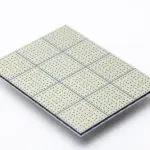
Researchers at the University of California, Santa Barbara (UCSB), led by Galan Moody and co-principal investigators Paolo Pintus of UCSB and the University of Cagliari, Italy, and Caroline A. Ross of MIT, have developed a precision magnetometer integrated onto a chip. This device utilizes a magneto-optic material that exhibits changes in optical properties when exposed to a magnetic field, enabling high-precision magnetic field measurement. Operating at room temperature, this magnetometer offers a light-weight and low-power alternative to existing technologies, potentially benefiting applications such as space exploration, magnetic navigation, and biomedical sensing. The research demonstrates sensitivity comparable to higher-performance, yet less practical, magnetometer systems.
Chip-Scale Magnetometer Technology and Development
Researchers have developed a chip-scale magnetometer utilizing a cerium-doped yttrium iron garnet (Ce:YIG) material that changes optical properties when exposed to a magnetic field. This device operates at room temperature and is fully integrable onto a chip, addressing limitations of existing magnetometers which often require extremely low temperatures or large apparatus. The new magnetometer can detect magnetic fields ranging from a few tens of picotesla to 4 millitesla, matching the sensitivity of high-performance cryogenic devices but without the associated constraints.
The magnetometer functions by measuring a phase shift in light propagating through the Ce:YIG material when a magnetic field is present, detected with an optical interferometer. Built on silicon photonics, the device minimizes size, weight, and power consumption, allowing integration with other chip-based optical components like lasers and photodetectors. Researchers also indicate that injecting quantum light could further improve performance, mirroring techniques used in gravitational wave detectors like LIGO to reduce noise and enhance sensitivity.
This chip-scale magnetometer has potential applications in space missions, magnetic navigation (especially where GPS is unavailable), and medical imaging like magnetocardiography and magnetoencephalography. The team demonstrated a device capable of detecting fields from picotesla to 4 millitesla, comparable to cryogenic magnetometers but without the need for extreme cooling. Further development focuses on exploring alternative materials and integrating quantum elements for even greater sensitivity and eventual commercialization.
Magnetometer Performance and Sensitivity
This new magnetometer achieves sensitivity comparable to high-performance cryogenic devices, but operates at room temperature. The device can detect magnetic fields ranging from a few tens of picotesla to 4 millitesla, covering a broad range relative to Earth’s magnetic field (approximately 100,000 picotesla). This performance is achieved without the restrictive size, weight, power consumption, or extremely low temperature requirements of traditional high-sensitivity magnetometers, broadening potential applications.
The magnetometer utilizes cerium-doped yttrium iron garnet (Ce:YIG), a material that experiences a phase shift in light when exposed to a magnetic field. This shift is detected using an optical interferometer built on silicon photonics, enabling a small, lightweight, and low-power device. Researchers demonstrated the device’s sensitivity through multi-physics simulations and experimental measurements, showcasing a potential alternative to current magnetic field measurement technologies.
Researchers are working to further enhance performance by exploring different magneto-optic materials and integrating quantum elements. They aim to reduce noise and increase sensitivity by utilizing squeezed light, similar to techniques used in large gravitational wave detectors. Transitioning this research into a commercial product requires developing a fully integrated chip-based system including lasers and photodetectors.
“Our device operates at room temperature and can be fully integrated onto a chip.”
Paolo Pintus
Applications for the New Magnetometer
This new magnetometer utilizes a cerium-doped yttrium iron garnet (Ce:YIG) material which experiences a phase shift in light when exposed to a magnetic field. Researchers detect this shift using an optical interferometer, splitting light paths and recombining them to measure changes in brightness – indicating magnetic field strength. Built on silicon photonics, the device minimizes size, weight, and power consumption, making it suitable for integration with other chip-based optical components like lasers and photodetectors.
The magnetometer can detect magnetic fields ranging from a few tens of picotesla to 4 millitesla, matching the sensitivity of high-performance cryogenic magnetometers, but without the need for extremely low temperatures. This capability opens doors for applications where traditional magnetometers are impractical, such as space missions studying planetary magnetic fields or characterizing metallic objects in space. Researchers also suggest potential use in magnetic navigation systems where GPS is unavailable.
Beyond these applications, the magnetometer could improve medical imaging techniques like magnetocardiography and magnetoencephalography. Current methods rely on bulky and costly, highly sensitive magnetometers. This chip-scale device, operating at room temperature, offers a potentially lighter, more affordable, and more versatile solution. Researchers are now working to further improve performance through alternative materials and the integration of quantum elements.