
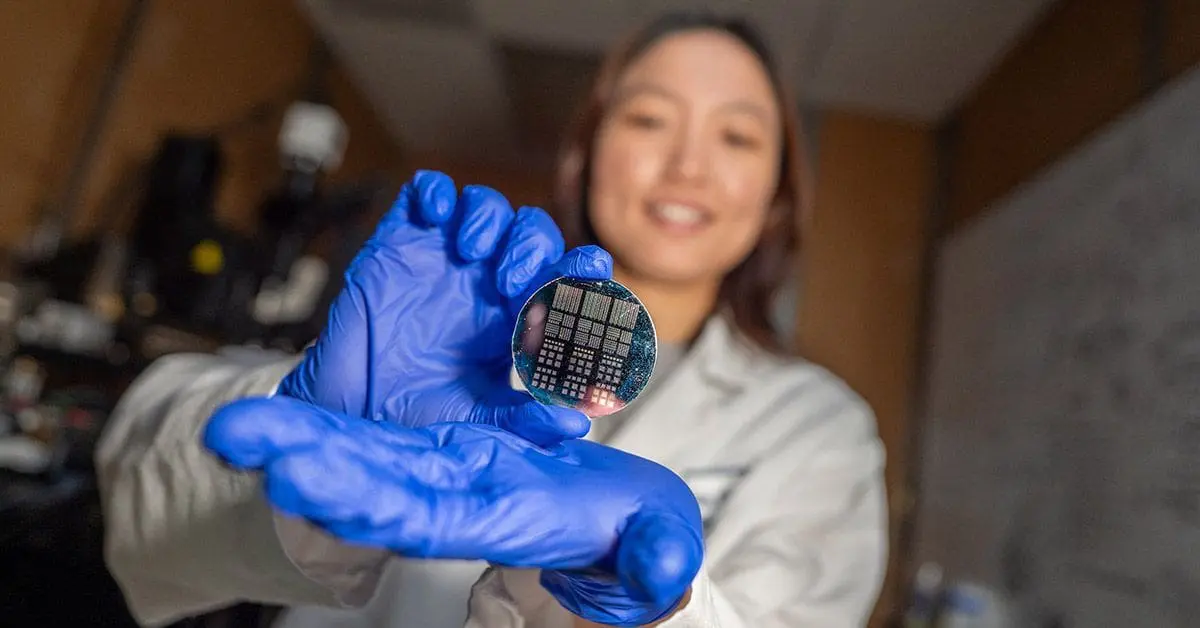
Engineers at the University of California San Diego have created a new hardware platform inspired by the human brain that promises to accelerate artificial intelligence while reducing energy consumption. The team, led by Duygu Kuzum, professor in the Department of Electrical and Computer Engineering at the UC San Diego Jacobs School of Engineering, successfully integrated memory and computation onto a single chip, allowing components to interact like neurons. This approach improved the speed and accuracy of pattern recognition in simulated tasks, including speech and early detection of epileptic seizures, as detailed in research published March 9 in Nature Nanotechnology. “Learning and computation do not arise from single neurons acting as isolated components,” explained Kuzum, the study’s senior author, emphasizing that the system identified warning signals in the seizure detection test using even a few seconds of brain data, rather than replicating the brain itself. The resulting technology could enable more compact and efficient AI systems for applications like wearable health monitors and smart sensors.
Neuromorphic Computing Platform Mimics Neural Network Interactions
A novel computing platform developed at UC San Diego achieves improved pattern recognition by mirroring the collective behavior of neurons. Researchers have engineered a system that moves beyond modeling individual brain components, instead focusing on the dynamic interactions within neural networks to enhance speed and efficiency. Unlike conventional computers where memory and processing are separate, this brain-inspired platform integrates both functions onto a single chip, eliminating the energy-intensive data transfer that limits current artificial intelligence systems. The core of this advancement lies in a hydrogen-doped perovskite nickelate, a quantum material exhibiting unusual electronic properties; introducing hydrogen ions creates tiny clouds beneath electrodes, altering electrical resistance with applied voltage. This allows each node within the platform to retain information about recent signals, while programmable elements manage longer-term data storage.
These nodes are not isolated, but are physically connected through the shared substrate of the material, enabling a form of communication reminiscent of ionic fluid surrounding neurons. “Activity at one location influences the behavior of others,” explained Yue Zhou, a postdoctoral researcher at UC San Diego. This interconnectedness facilitates collective behavior across the system, similar to communication across brain regions. This design enables a process called spatiotemporal computing, analyzing signals not just over time, but also through spatial interactions across the network. Incoming signals are converted into electrical spikes and processed into complex patterns that capture timing and network dynamics, then classified by a secondary layer of programmable junctions. Demonstrations using simulated applications revealed significant performance gains; the system accurately recognized spoken digits and detected early signs of epileptic seizures with greater speed than time-based methods.
In the seizure detection test, the platform identified warning signals even when given only a few seconds of brain data, because early signals from a few channels can spread across the network and help the system detect seizures sooner. The system operates with remarkable energy efficiency, consuming approximately 0.2 nanojoules per operation, which positions it for use in edge AI applications.
Hydrogen-Doped Neodymium Nickelate Enables Spatiotemporal Computing
The pursuit of artificial intelligence increasingly demands hardware capable of mirroring the brain’s efficiency, a challenge that conventional computing architectures struggle to meet. Current systems rely on physically separating memory and processing, creating a bottleneck as data shuttles between the two, which limits speed and dramatically increases energy consumption. This approach, published on March 9 in Nature Nanotechnology, moves beyond simply modeling individual brain components to focus on recreating the collective behavior of neuronal networks. Central to this innovation is the doping of neodymium nickelate with hydrogen, creating a substrate where numerous nodes are physically interconnected. Applying voltage pulses to this material causes hydrogen ions to migrate, altering electrical resistance and providing a form of memory; each node can temporarily store information about recent signals. However, the key advancement lies in the interconnectedness of these nodes. This shared substrate functions analogously to the ionic fluid surrounding neurons, facilitating signal propagation and network-wide influence. The researchers demonstrated the platform’s capabilities through simulations of spoken digit recognition and early epileptic seizure detection, achieving superior performance compared to time-based processing.
The platform’s architecture combines memory and computation on a single chip, addressing a key limitation of conventional computers where constant data transfer between processing and memory units creates a significant energy drain. This interconnectedness is achieved through a shared material substrate, mirroring the ionic fluid surrounding neurons in the brain. This spatiotemporal computing strategy, analyzing signals across both time and space, allowed the system to outperform methods relying solely on temporal processing.
Instead, they emerge from the rich, dynamic interactions of large networks of neurons collectively communicating across space and time.
The demand for artificial intelligence is rapidly increasing, yet current hardware struggles to keep pace with the computational load, particularly for devices operating outside of centralized data centers. The team constructed the system using neodymium nickelate, a quantum material modified with hydrogen; introducing hydrogen ions creates electrical resistance changes when voltage is applied, providing memory capabilities.