

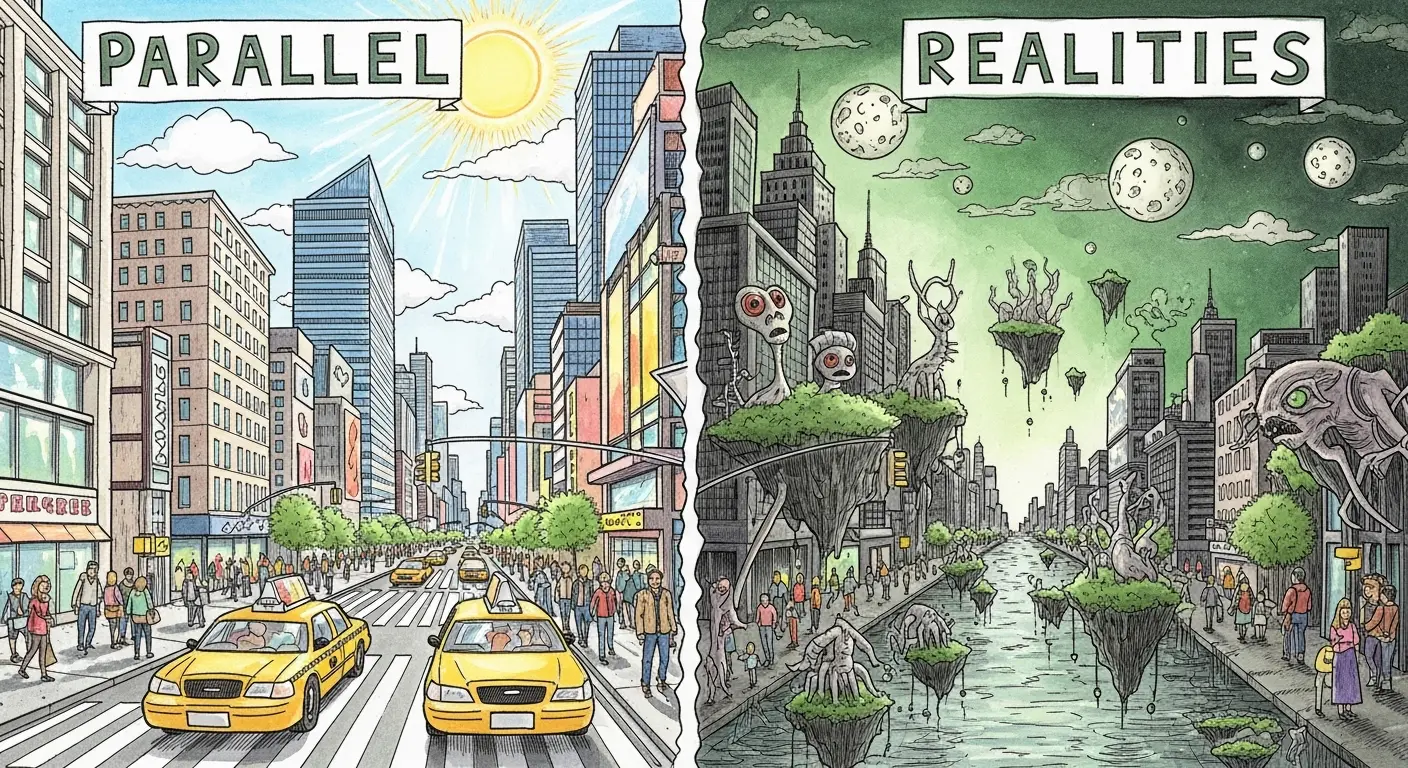
For decades, the unsettling idea that our reality is merely a sophisticated computer simulation, a concept popularized by films like The Matrix, has captivated both scientists and the public. Now, groundbreaking research from UBC Okanagan offers a definitive answer to this enduring question, proving conclusively that the universe cannot be a simulation. Led by Dr. Mir Faizal, a team of international physicists utilized logic and the fundamental laws of physics to demonstrate that the very nature of reality, built on an informational foundation beyond algorithmic reach, precludes the possibility of a simulated existence. This isn’t simply about disproving a science fiction trope; it’s a profound advancement in our understanding of the universe and the bedrock of its existence.
UBC Study Disproves Simulation Hypothesis: The Physics Behind Reality’s Foundation Limits of Computation and Understanding
The UBC Okanagan study’s definitive dismissal of the simulation hypothesis isn’t merely a philosophical exercise, but a rigorous application of advanced physics and mathematical logic to a question once relegated to science fiction. Dr. Faizal and his team’s work, published in the Journal of Holography Applications in Physics, centers on the increasingly accepted notion that reality isn’t built on tangible “stuff,” but on fundamental information residing in a “Platonic realm”, a mathematical foundation predating and underpinning our physical universe.
This realm isn’t simply a vast database, however; it’s governed by principles that transcend computational limits. The researchers leveraged the power of Gödel’s incompleteness theorem, a cornerstone of mathematical logic demonstrating the inherent limitations of formal systems, to prove that a complete and consistent description of reality requires “non-algorithmic understanding.” This means that certain truths about the universe aren’t accessible through step-by-step computation, no matter how powerful the simulated “computer” might be. The team illustrates this with the paradoxical statement, “This true statement is not provable,” highlighting how such “Gödelian truths” exist outside the reach of algorithmic proof. Essentially, the universe contains inherent complexities and self-referential truths that defy complete computational description.
While a simulation might successfully model aspects of reality, the study argues, it could never encapsulate the entirety of existence because it would inevitably encounter these non-algorithmic truths, leading to inconsistencies or incompleteness. This isn’t simply a matter of needing more processing power; it’s a fundamental limit imposed by the very nature of reality itself. The implications extend beyond disproving the simulation hypothesis; they suggest that understanding the universe requires more than just data processing and algorithmic analysis, it demands a form of comprehension that transcends computation, hinting at a deeper, more intuitive connection between consciousness and the cosmos. The research effectively shifts the debate from whether we’re in a simulation to why a complete computational model of reality is fundamentally impossible, solidifying the notion that the universe isn’t a program to be cracked, but a profoundly complex and ultimately unknowable entity beyond the confines of algorithmic definition. This discovery opens exciting new avenues for exploring the foundations of physics and the limits of human understanding, suggesting that the most profound truths about the universe may lie beyond the realm of computation altogether.
The underlying principle invoked here relates heavily to the holographic principle, which posits that the amount of information needed to describe a volume of space can be encoded on a boundary surface, much like a 2D image describing a 3D scene. In this context, if reality were a simulation running on a finite computational substrate, the complexity of physical laws—such as gravity’s behavior at the Planck scale—would necessitate an unmanageably dense informational encoding, suggesting a fundamental resource limitation for any proposed simulating system.
Furthermore, the research implicitly challenges the universal applicability of the Church-Turing thesis, which typically sets the theoretical upper limit on what physical computation can achieve. By demonstrating Gödelian constraints, the paper suggests that the actual processes governing quantum field theory might require resources beyond the Turing machine model, perhaps demanding a computational paradigm akin to hypercomputation or requiring inherent non-computational axioms for consistency.
From a broader scientific standpoint, the methodology draws parallels with efforts in quantum gravity research, particularly those attempting to unify general relativity with quantum mechanics. The necessity of non-algorithmic understanding thus moves the inquiry from pure mathematics into the realm of fundamental physics, suggesting that the very structure of spacetime itself dictates the limits of any potential computational model, irrespective of future technological advancements.


