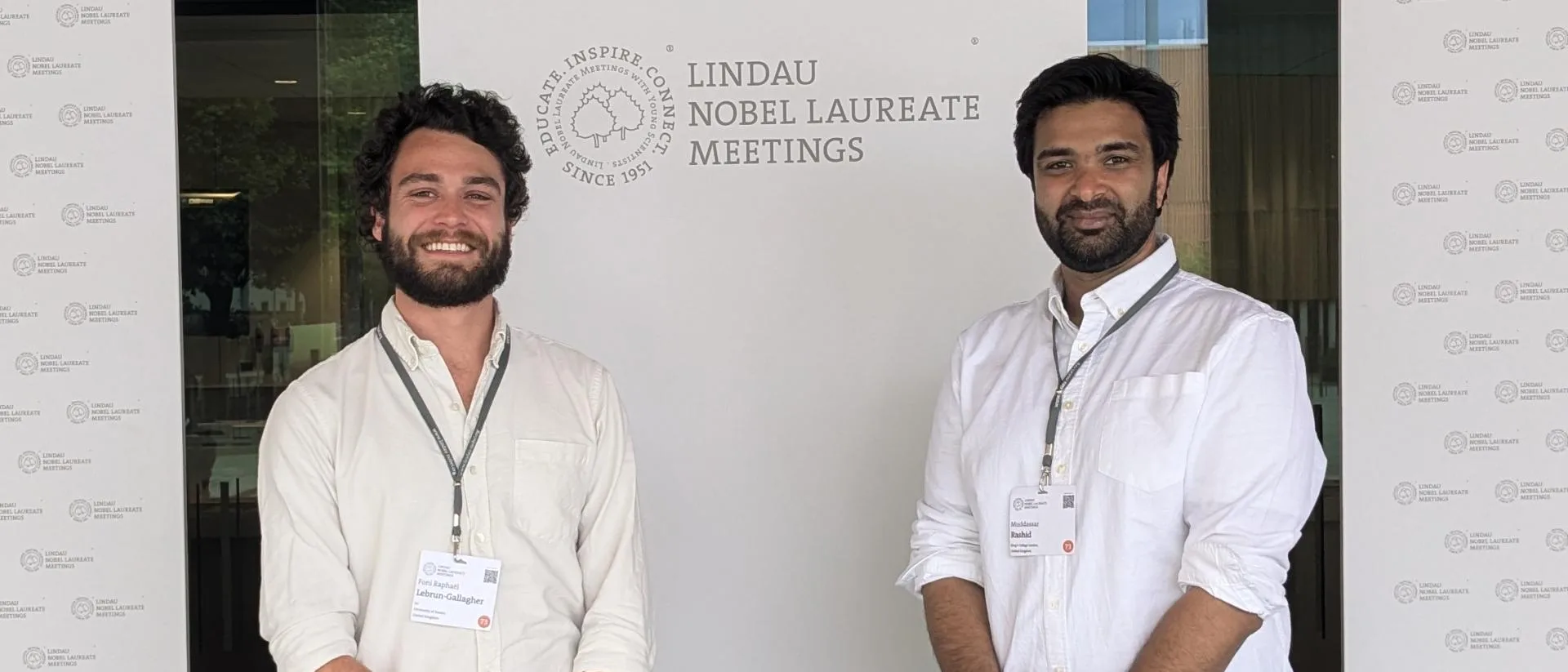
Two UQ (Universal Quantum) representatives, Foni Raphaël Lebrun-Gallagher and Muddassar Rashid, have been selected to attend the prestigious 73rd Lindau Nobel Laureate Meeting in Lindau, Germany. This year’s meeting focused on physics, with key themes including Quantum Physics and Quantum Technologies, Physics-based Solutions to the Energy Challenge, and Artificial Intelligence in Physics.
The event brought together over 30 Nobel Prize winners and 650 outstanding young researchers under the age of 35. Lebrun-Gallagher and Rashid are working on UQ’s mission to develop scalable trapped ion quantum computers, which could revolutionize multiple industries. They were excited to meet Nobel Laureates David Wineland and Alain Aspect, pioneers in the field of trapped ions and quantum computing. With breakthrough technologies like UQConnect and UQLogic, UQ is paving the way for utility-scale quantum systems.
Pioneering Quantum Computing: UQ Researchers Selected for Prestigious Lindau Meeting
The University of Queensland (UQ) has made a significant mark in the field of quantum computing, with two of its researchers, Foni Raphaël Lebrun-Gallagher and Muddassar Rashid, selected to attend the esteemed 73rd Lindau Nobel Laureate Meeting. This prestigious event brought together over 30 Nobel Prize winners and 650 outstanding young researchers from around the world to foster exchange among different generations, scientific disciplines, and cultures.
The Lindau Nobel Laureate Meetings have been a cornerstone of scientific collaboration since their establishment in 1951. The meetings rotate between three Nobel Prize scientific disciplines: physics, chemistry, and physiology/medicine. This year’s meeting focused on physics, with three key themes: Quantum Physics and Quantum Technologies, Physics-based Solutions to the Energy Challenge, and Artificial Intelligence in Physics.
UQ’s researchers are at the forefront of pioneering scalable trapped ion quantum computers, poised to revolutionize multiple industries. Breakthrough technologies like UQConnect, which enables world-record quantum connections between chips, and UQLogic, offering robust and scalable qubit control, demonstrate UQ’s commitment to paving the way for utility-scale quantum systems.
Quantum Computing: A New Frontier in Physics
Quantum computing is a rapidly advancing field that has the potential to transform various industries. By harnessing the power of quantum mechanics, researchers can develop computers that are exponentially more powerful than classical computers. This technology has far-reaching implications, from optimizing complex systems to simulating molecular interactions.
Trapped ion quantum computing, in particular, has shown great promise. This approach uses electromagnetic fields to trap and manipulate individual ions, which serve as the quantum bits or qubits. The ability to control and measure these qubits with high precision is crucial for the development of scalable quantum computers.
UQ’s researchers are making significant strides in this area, with technologies like UQConnect and UQLogic pushing the boundaries of what is possible. These innovations have the potential to enable the creation of large-scale quantum computers that can tackle complex problems in fields such as chemistry, materials science, and optimization.
The Lindau Nobel Laureate Meeting
The Lindau Nobel Laureate Meeting provides a unique forum for collaboration, inspiration, and the exchange of groundbreaking ideas. This year’s meeting brought together some of the brightest minds in physics, including Nobel Prize winners David Wineland and Alain Aspect, who are giants in the field of trapped ions and quantum computing.
For young researchers like Raphaël Lebrun-Gallagher and Muddassar Rashid, the opportunity to meet and learn from these luminaries is invaluable. The meeting provides a platform for them to share their perspectives, learn from others, and gain insights into the latest developments in their field.
Raphaël Lebrun-Gallagher expressed his gratitude and excitement at being selected for this event, stating that it was an extraordinary opportunity to hear from the figures who have inspired him throughout his career. He looked forward to connecting with other young researchers and learning from their brilliant work, which will undoubtedly help shape tomorrow’s society.
The Future of Quantum Computing
As quantum computing continues to advance, several challenges need to be addressed. One of the primary hurdles is scaling up these systems while maintaining control over the qubits. This requires significant advances in materials science, cryogenics, and precision engineering.
Another challenge is developing software that can harness the power of quantum computers. This involves creating algorithms that can solve complex problems efficiently and developing programming languages that can interface with these machines.
Despite these challenges, the opportunities presented by quantum computing are vast. From optimizing complex systems to simulating molecular interactions, this technology has the potential to transform various industries. UQ’s researchers are at the forefront of this revolution, pushing the boundaries of what is possible and paving the way for utility-scale quantum systems.
In conclusion, the selection of UQ’s researchers for the prestigious Lindau Nobel Laureate Meeting is a testament to their groundbreaking work in the field of quantum computing. As this technology continues to advance, it is essential to foster collaboration and inspiration among different generations, scientific disciplines, and cultures. The Lindau meeting provides a unique platform for this exchange, and UQ’s researchers are poised to play a significant role in shaping the future of quantum computing.
External Link: Click Here For More