

Detecting edges within medical images is crucial for diagnosis, yet current methods demand significant computational resources, prompting exploration of quantum solutions. Emmanuel Billias and Nikos Chrisochoides, from Old Dominion University, along with their colleagues, present a novel approach to quantum edge detection that tackles the limitations of current noisy quantum hardware. Their research introduces a two-level decomposition strategy, effectively breaking down complex image analysis into smaller, more manageable quantum circuits. This method achieves substantial reductions in circuit complexity, over 62% in circuit depth and 93% fewer operations, while maintaining high fidelity, demonstrating a pathway towards practical, utility-scale quantum image processing and offering early evidence of distributed quantum computing applied to real-world medical data, including raw MRI scans.
Hybrid Quantum-Classical Edge Detection for Imaging
Quantum computing holds significant promise for revolutionizing medical imaging, particularly in time-critical scenarios like real-time analysis of brain scans during neurosurgery. A crucial step in this process is edge detection, but current methods struggle with the large datasets typical of high-resolution medical scans. Researchers have addressed these limitations by developing a novel hybrid quantum-classical methodology focused on optimizing quantum image processing for current quantum devices. The team’s approach centers on enhancing a quantum algorithm for identifying edges within images using quantum circuits.
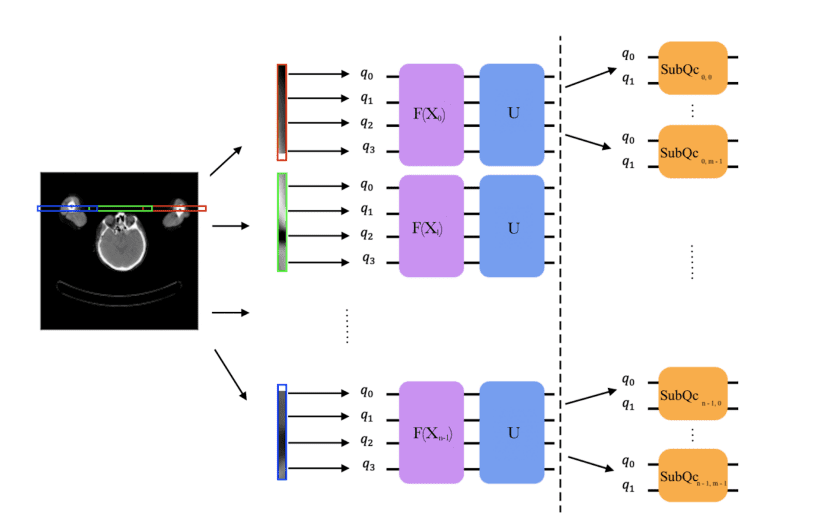
Recognizing that large images overwhelm current quantum computers, they implemented a strategy that decomposes the input image into smaller sub-images, each encoded into a separate quantum circuit. This decomposition is coupled with optimizations to the quantum circuit itself, minimizing the impact of noise. This two-level decomposition, combined with circuit optimizations, achieves substantial improvements in performance, reducing the number of operations and two-qubit operations, while maintaining high fidelity. The researchers validated their approach by successfully processing raw magnetic resonance imaging (MRI) data, demonstrating the feasibility of applying this technique to complex, real-world medical images. Beyond improving edge detection, this work represents a step towards “distributed” quantum computing. By partitioning the problem into smaller, independent sub-circuits, the team demonstrated a simulation on a high-performance computing cluster, paving the way for integrating quantum processors with existing classical computing infrastructure, ultimately promising faster, more accurate image analysis and improved patient outcomes.
Distributed Quantum Image Processing with D-NISQ
This research presents a novel approach called D-NISQ (Distributed Near-term Intermediate-Scale Quantum Computing) to tackle the challenges of running quantum algorithms on current, limited-scale quantum hardware for medical image processing. The core idea is to decompose large images into smaller sub-images, process them individually on a distributed computing cluster simulating a quantum processing unit (QPU), and then reassemble the results, allowing for processing images that would be too large for current quantum computers. The D-NISQ approach combines the Inverse Quantum Fourier Transform (IQFT) and a modified Quantum Hadamard Edge Detection (QHED) algorithm. Large images are divided into smaller sub-images with overlapping buffer pixels to maintain continuity and avoid artifacts.
A modified QHED circuit (QHEDM) is proposed to improve performance and reduce the number of quantum gates. The QHEDM circuit, combined with image decomposition and distributed processing, demonstrates significantly higher fidelity compared to the original QHED circuit, especially for larger images. Extensive simulations using IBM Qiskit and a high-performance computing cluster evaluated the performance of the D-NISQ approach on k-space MRI data and 2D/3D medical images. D-NISQ is a promising approach to overcome the limitations of current quantum hardware for medical image processing. Image decomposition and distributed processing are crucial for scaling quantum algorithms to larger datasets, and circuit optimization is essential for improving performance on current hardware, demonstrating the potential of quantum computing for medical image analysis.
Quantum Edge Detection on Noisy MRI Data
Results demonstrate the feasibility of performing high-fidelity Quantum Homomorphic Edge Detection (QHED) on current hardware and provide early evidence of distributed utility-scale quantum computing. This is illustrated by processing raw k-space MRI data with an Inverse Quantum Fourier Transform and a distributed simulation of a modified QHED on large 2D and 3D MRI datasets. The research focuses on Quantum Computing, Quantum Edge Detection, Algorithm development, and techniques including Circuit Cutting and Circuit Knitting, alongside Problem Decomposition strategies for achieving Quantum Utility-Scale computation in the field of Medical Image Computing.
Linear Scaling and Quantum Image Processing
This work demonstrates that a restructured decrement permutation yields a substantial fidelity enhancement in the QHED circuit by reducing circuit depth to linear scaling with respect to input size. When integrated with circuit cutting techniques, these architectural optimizations yield further fidelity improvements, although this currently incurs a classical overhead associated with post-processing required for stitching subcircuits. The approach has been validated for both two-dimensional (2D) pixel-based and three-dimensional (3D) voxel-based representations, and given real, positive-valued pixels and voxels, current hardware can be leveraged for medical image processing. Analysis reveals that reducing the width of the proposed quantum circuit achieves a significant decoupling of gate count and fidelity.
Future work will focus on minimizing the classical overhead to enhance scalability and practical applicability, leveraging the noise resilience afforded by the decoupling of gate count and fidelity. Another promising direction is the full distribution of the pipeline, starting from the inverse quantum Fourier transform (IQFT) circuit, potentially transforming IGNS and general medical image computing. This research was supported in part by the Richard T. Cheng Endowment at Old Dominion University (ODU). The authors thank Min Dong at ITS in ODU for his help with the HPC cluster at ODU. This work was performed using computational facilities at ODU enabled by grants from the National Science Foundation and Virginia’s Commonwealth Technology Research Fund. Gemini and Grammarly were used to improve readability; the authors reviewed and take full responsibility for the final content.
👉 More information
🗞 Towards a Utility-Scale Quantum Edge Detection for Real-World Medical Image Data
🧠 DOI: https://doi.org/10.48550/arXiv.2507.10939

