A new family of two-dimensional materials exhibits both magnetism and unusual electronic properties, potentially paving the way for advances in spintronics and valleytronics. Yong-Kun Wang, from Northwest University, Si Li, and Shengyuan A. Yang, of The Hong Kong Polytechnic University, lead a team that identifies monolayer iron oxyhalides as a novel class of ‘altermagnetic’ real Chern insulators. These materials demonstrate robust magnetic ordering alongside semiconducting behaviour and possess unique spin-polarized valleys, meaning electrons behave differently depending on their spin and location within the material. Crucially, the researchers find that strain can control the magnetic orientation and valley polarization, offering a pathway to manipulate these materials for future electronic devices and opening up exciting possibilities for controlling both spin and valley degrees of freedom in next-generation technologies.
Two-Dimensional Materials and Quantum Properties
Research in condensed matter physics, materials science, and nanotechnology increasingly focuses on two-dimensional materials, particularly transition metal dichalcogenides like molybdenum disulfide and tungsten diselenide. Investigations reveal these materials possess unique electronic, optical, and topological properties, attracting significant attention for potential applications in advanced technologies. Scientists employ computational methods, including Density Functional Theory, to model and predict the behavior of these materials, complementing experimental studies. A key area of exploration involves creating heterostructures by stacking different two-dimensional materials, tailoring their properties for specific functionalities.
Current research also investigates topological insulators and Weyl semimetals, materials exhibiting unusual electronic states and potential for novel devices. Understanding the role of topology, specifically Berry curvature and related phenomena, is crucial for controlling electron transport and optical properties. The combination of computational modeling and experimental characterization promises to unlock the full potential of these materials for future technologies.
Altermagnetic Chern Insulators in Iron Oxyhalides
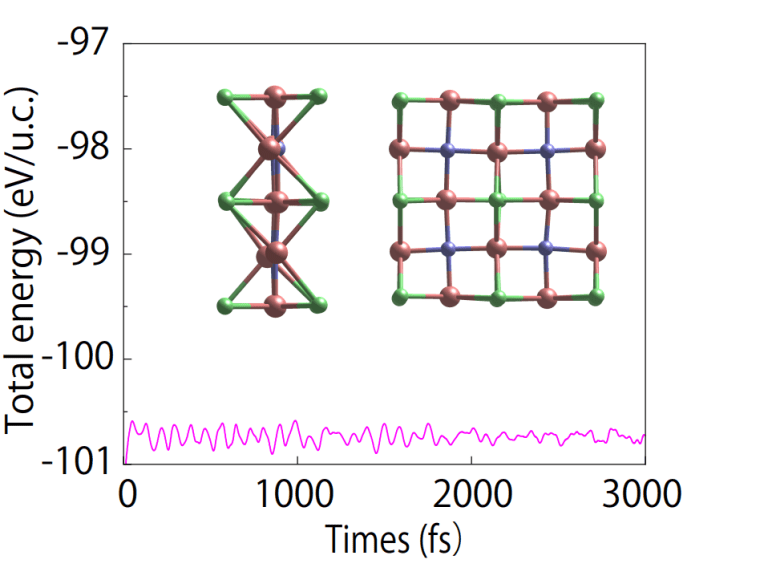
Scientists have conducted a comprehensive computational study of monolayer iron oxyhalides, identifying Fe₂X₂O (where X equals chlorine, bromine, or iodine) as a novel family of two-dimensional altermagnetic real Chern insulators. These materials exhibit unique spin-split band structures and hold promise for spintronic and valleytronic applications. The research team systematically investigated possible magnetic orderings, determining that a checkerboard antiferromagnetic arrangement is energetically favored across all three compounds, defining them as altermagnets while preserving inversion symmetry on oxygen or iron sites and breaking time-reversal symmetry. Calculations incorporating spin-orbit coupling reveal that Fe₂Br₂O and Fe₂I₂O favor an out-of-plane Néel vector, while Fe₂Cl₂O exhibits an in-plane preference.
This spontaneous breaking of in-plane isotropy in Fe₂Cl₂O manifests as a slight distortion of the lattice structure, classifying this material as a promising multiferroic system. Monte Carlo simulations estimate Néel temperatures around 100 Kelvin for all three materials, higher than many previously reported two-dimensional magnetic materials. Analysis of the electronic band structures reveals sizable band gaps exceeding 2 electron volts, with the conduction and valence band edges dominated by iron 3d orbitals.
Altermagnetic Chern Insulators with Valley Control
This research establishes monolayer iron oxyhalides, including Fe₂Cl₂O, Fe₂Br₂O, and Fe₂I₂O, as a new family of two-dimensional altermagnetic real Chern insulators. Scientists have demonstrated these materials exhibit stable altermagnetic ordering, maintaining this property up to approximately 100 Kelvin, alongside semiconducting band gaps exceeding 2 electron volts. Importantly, each spin channel displays nontrivial real Chern numbers, leading to the emergence of spin-polarized topological corner modes. The team further revealed strong interactions between altermagnetism, valley polarization, spin, and the crystal lattice within these materials.
This coupling enables valley-selective excitation using linear dichroism and allows for strain-induced control of valley polarization, offering potential for tuning charge and spin conductivity. Notably, the multiferroic nature of Fe₂Cl₂O allows for manipulation of the magnetic alignment via applied strain. These findings position iron oxyhalides as promising candidates for advanced spintronic, valleytronic, and quantum technologies, bridging magnetic topology with emergent degrees of freedom in two-dimensional materials.
🗞 Two-Dimensional Altermagnetic Iron Oxyhalides: Real Chern topology and Valley-Spin-Lattice coupling
🧠 ArXiv: https://arxiv.org/abs/2510.12748