The behaviour of electrons within layered materials holds immense promise for future technologies, but understanding their interactions within atomically thin structures remains a significant challenge. Mainak Mondal from the Indian Institute of Science, alongside Kenji Watanabe and Takashi Taniguchi from the National Institute for Materials Science, and colleagues, now reveal how electrons behave in specially constructed layered materials. Their work focuses on ‘interlayer excitons’, combinations of electrons and ‘holes’, within twisted structures of molybdenum and tungsten diselenide, materials exhibiting unique atomic arrangements. The team demonstrates that these excitons become confined within tiny, well-defined spaces, leading to the observation of multiple, closely-spaced energy states and surprisingly long-lived behaviours, ranging from fractions of a nanosecond to over 100 nanoseconds. Crucially, they also uncover a process termed “siphoning”, where excess energy appears to be channelled away from these confined excitons, suggesting new ways to control and manipulate their properties through careful material design and strain engineering.
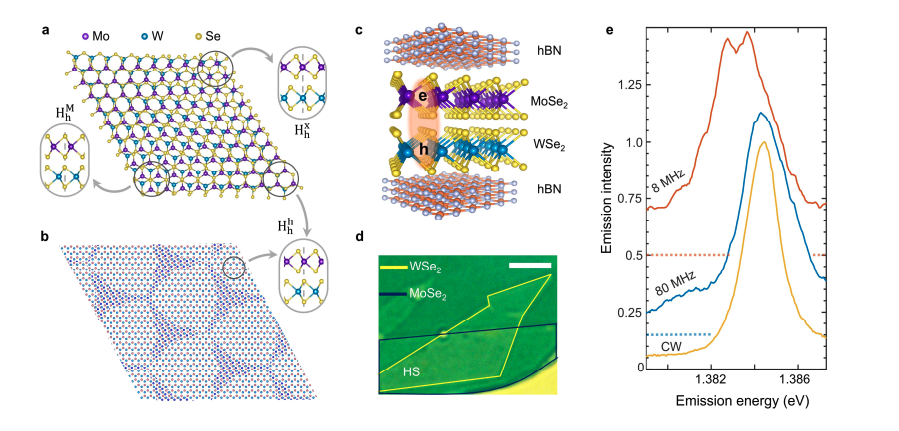
Atomic reconstruction in twisted transition metal dichalcogenide heterostructures creates mesoscopic domains with uniform atomic arrangement, profoundly altering the local potential landscape. These reconstructed regions provide unique environments for interlayer excitons, quasiparticles formed between electrons in different material layers. This research demonstrates that quantum confinement persists within these flat, reconstructed regions, significantly influencing the properties of the excitons they contain. Time-resolved photoluminescence spectroscopy reveals multiple, finely-spaced interlayer exciton states, separated by approximately 1 millielectronvolt, and correlated emission lifetimes spanning sub-nanosecond timescales.
Heterostructure Excitons and Interface Reconstruction Effects
This research details the experimental setup and data analysis for a study of interlayer excitons in a molybdenum diselenide/tungsten diselenide heterostructure. The team focused on the effects of reconstruction at the interface, specifically H-type stacking, on the exciton properties, employing techniques including photoluminescence spectroscopy and time-resolved photoluminescence. The data confirms the formation of interlayer excitons and trions, and demonstrates the influence of reconstruction on their behaviour. Optical and photoluminescence maps confirm the presence of a heterostructure with a region exhibiting quenched photoluminescence, indicating a high-quality interface and likely reconstruction, a crucial finding as reconstruction significantly alters electronic properties.
Second harmonic generation measurements confirm the H-type stacking in the heterostructure, consistent with the symmetry breaking expected from this non-centrosymmetric structure. Temperature-dependent photoluminescence measurements reveal that lower-energy triplet excitons disappear at higher temperatures, while triplet trions persist, suggesting weak confinement potentially due to interface quality or reconstruction. The photoluminescence spectrum is well-fitted with a single Lorentzian function, indicating a relatively homogeneous exciton population within a well-defined reconstruction domain. Increasing excitation power causes a blue shift in the emission energy and a slight increase in spectral width, while the integrated intensity saturates, consistent with the behaviour expected from reconstructed H domains. Emission intensity decreases more for lower energy than higher energy regions at higher repetition rates, due to higher lifetime and resulting saturation. Overall, the data strongly supports the formation of H-type stacking at the interface, significantly influencing exciton properties.
Quantum Confinement Survives Structural Disorder
Researchers have uncovered surprisingly complex behaviour within twisted stacks of two-dimensional materials, demonstrating that quantum confinement persists even when the materials undergo significant structural reconstruction. These heterostructures, created by layering materials like molybdenum diselenide and tungsten diselenide, exhibit unusual electronic and optical properties due to the way their atomic lattices interact. The team observed multiple, closely-spaced energy levels for interlayer excitons within these reconstructed domains, separated by only about 1 millielectronvolt. Crucially, the lifetimes of these excitons vary dramatically, ranging from less than a nanosecond to over 100 nanoseconds, demonstrating a wide range of behaviours within the same material.
This contrasts with earlier observations that often showed only a single emission peak, suggesting a lack of defined energy levels. Further investigation revealed a phenomenon termed “quantum siphoning”, where high excitation rates initially suppress light emission before it gradually recovers. This occurs because excitons scatter from bright states into darker, non-radiative states, effectively “siphoning” energy away from light emission. This effect highlights the complex interplay of nonlinear dynamics within the material and opens possibilities for controlling exciton behaviour through external stimuli like strain.
The observed variation in exciton lifetimes over two orders of magnitude resolves longstanding discrepancies in previous reports and suggests a richer landscape of radiative and non-radiative pathways than previously understood. These findings have significant implications for quantum technologies, particularly in the field of quantum sensing. The ability to control exciton lifetimes and manipulate energy transfer pathways could lead to the development of highly sensitive detectors and novel optoelectronic devices. Moreover, understanding the interplay between structural reconstruction and quantum confinement provides a pathway for engineering materials with tailored optical and electronic properties.
Quantum Siphoning and Confined Exciton Lifetimes
The research demonstrates the presence of multiple, closely-spaced energy levels within reconstructed mesoscopic domains in twisted transition metal dichalcogenide heterostructures. This confirms the significant impact of quantum confinement even within these flat potential landscapes, and potentially explains previously reported discrepancies in emission dynamics observed in similar materials. Time-resolved photoluminescence spectroscopy revealed variations in exciton lifetimes spanning two orders of magnitude within a narrow energy window. Notably, the team observed a phenomenon termed “quantum siphoning”, where high excitation rates lead to a transient reduction in photoluminescence due to exciton scattering into non-radiative states, followed by gradual recovery. This process highlights the importance of considering scattering-dominated dynamics in theoretical models and suggests potential avenues for controlling exciton behaviour through strain engineering. The authors propose that their approach, using repetition-rate-dependent excitation, offers a versatile platform for investigating subtle excitonic phenomena in engineered two-dimensional heterostructures.
🗞 Quantum siphoning of finely spaced interlayer excitons in reconstructed MoSe2/WSe2 heterostructures
🧠 ArXiv: https://arxiv.org/abs/2507.22584