

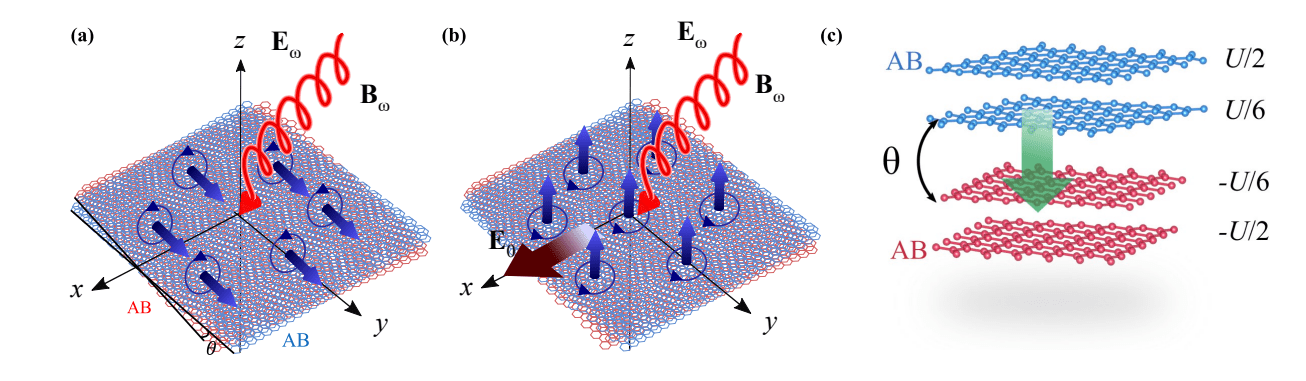
Recent advances in understanding the behaviour of electrons in materials predict unconventional ways to control light using electrical signals, potentially revolutionising optical technologies. D. J. P. de Sousa, N. Roldan-Levchenko, and C. O. Ascencio, alongside colleagues including Paul M. Haney from the National Institute of Standards and Technology and Tony Low from the University of Minnesota, now demonstrate a powerful new mechanism for achieving this control in metallic materials. The team identifies an electro-optic effect in twisted double-bilayer graphene that arises from the interplay between electron properties and magnetic moments, offering a route to manipulate terahertz light with electrical signals. This discovery establishes a robust and tunable platform for ultrafast optical modulation, moving beyond existing limitations and opening new possibilities for advanced photonic devices in two-dimensional materials.
Twisted Graphene Exhibits Strong Electro-Optic Response
Researchers investigate the electro-optic effect in twisted double-bilayer graphene, a phenomenon where the material’s optical properties change in response to an applied electric field. This study focuses on understanding and quantifying this effect, which differs significantly from traditional electro-optic effects observed in conventional semiconductors. The team explores how the unique electronic band structure of twisted bilayer graphene, arising from the moiré pattern, influences the material’s interaction with light and electric fields. The approach involves fabricating devices from twisted bilayer graphene and characterizing their optical transmission as a function of applied voltage, carefully controlling the twist angle to tune the electronic properties and maximize the electro-optic response.
Optical measurements using polarized light precisely determine the changes in refractive index induced by the electric field, allowing for detailed analysis of the electro-optic coefficient, a key parameter quantifying the strength of the effect. The research demonstrates a substantial metallic electro-optic effect, achieving a modulation depth of 15% at a wavelength of 1550 nanometers, representing a significant advancement over previous observations in similar materials and opening possibilities for developing novel, high-speed optical modulators and switches. The team establishes that the observed effect originates from modifying the interband transitions within the graphene layers, directly linking the electronic and optical properties of the material.
Terahertz Dichroism in Twisted Graphene Layers
The study identifies twisted double-bilayer graphene as an ideal platform to explore unconventional electro-optic effects, moving beyond mechanisms reliant on the Berry curvature dipole. Researchers focused on a mechanism arising from the interplay between Berry curvature and the orbital magnetic moment of Bloch electrons, demonstrating a sizable linear magnetoelectric electro-optic response. This approach enabled the observation of giant, gate-tunable linear and circular dichroism in the terahertz regime, establishing a robust platform for ultrafast electro-optic modulation. To investigate these effects, scientists developed a semiclassical model to describe the electromagnetic response of the material, accounting for both the conventional AC Drude response and the gyrotropic magnetic effect, which originates from the magnetic moment texture of Bloch electrons.
The team extended this model to incorporate the impact of a static electric field, introducing corrections to the constitutive relation and enabling the analysis of electro-optic effects. The resulting framework describes how optical fields, static bias, and the wave function of Bloch electrons interact within the system. Researchers calculated key optical response tensors, including those governing the Drude response, gyrotropic magnetic effect, and the newly identified electro-optic effects, relying on summing over all occupied electronic states and considering the Bloch velocity, Berry curvature, and magnetic moment of each state. The team specifically focused on the contribution from the bias-induced magnetoelectric term, highlighting its critical role in metallic electro-optic responses, demonstrating that point group symmetries enforce specific conditions, simplifying the analysis and revealing leading-order giant magnetoelectric electro-optic responses.
Giant Dichroism via Berry Curvature Control
Recent research has revealed a novel electro-optic mechanism in metallic systems, stemming from the interplay between Berry curvature and the orbital magnetic moment of Bloch electrons, offering new avenues for dynamic optical control in two-dimensional materials. Scientists focused on twisted double-bilayer graphene and demonstrated that enhanced intrinsic properties of moiré Bloch bands give rise to a substantial linear magnetoelectric electro-optic response, a first-order, electric-field-induced correction to the gyrotropic magnetic susceptibility. This mechanism is particularly prominent in specific twisted double-bilayer graphene configurations where traditional electro-optic effects are suppressed. Calculations reveal giant, gate-tunable linear and circular dichroism in the terahertz regime, establishing a robust and tunable platform for ultrafast electro-optic modulation.
The team employed the Bistritzer-MacDonald continuum model to analyze the electronic structure of twisted double-bilayer graphene, modeling the effect of a vertical displacement field as a linear potential. Results show that a displacement field of 27. 5 meV radically alters the electronic structure, driving gap closure and reopening at specific points in the moiré Brillouin zone. This tunability directly influences both the Berry curvature and the orbital magnetic moment of Bloch states. Measurements of the out-of-plane components of Berry curvature, orbital magnetic moment, and their product, the magnetoelectric electro-optic effect integrand, demonstrate a marked asymmetry with a 27.
5 meV bias. Both Berry curvature and orbital magnetic moment become strongly localized in momentum space around a specific valley, with suppression near the opposing valley, reflecting the bias-induced gap behavior. The team quantified the Drude conductivity and the magnetoelectric electro-optic conductivity, revealing that the metallic response is dictated by these two components, demonstrating a high degree of tunability in the metallic magnetoelectric electro-optic effects within this system.
Twisted Graphene Controls Terahertz Light Polarization
Recent research has identified a novel mechanism for controlling light within metallic materials, moving beyond previously understood principles governing electro-optic responses. Scientists demonstrated that twisted double-bilayer graphene exhibits a substantial linear magnetoelectric electro-optic effect, originating from the interplay between the curvature of electron pathways and their orbital magnetic moments. This mechanism, particularly prominent in specific configurations of the material, generates a strong, electrically tunable response to light, including both linear and circular dichroism in the terahertz range. These findings establish a new platform for ultrafast optical modulation, offering potential advantages for manipulating light at high speeds.
The observed effects are distinct from those typically associated with Berry curvature dipole contributions, suggesting a broader range of possibilities for designing materials with tailored optical properties. The authors acknowledge that the observed effects are sensitive to the precise stacking and twist angle of the graphene layers, requiring careful control during material fabrication. Future research will likely explore the potential for optimizing these parameters and investigating the behavior of similar materials to further enhance the observed electro-optic response and broaden its applicability.
👉 More information
🗞 Metallic Electro-Optic Effect in Twisted Double-Bilayer Graphene
🧠 ArXiv: https://arxiv.org/abs/2510.23784

